
The monuments at Mahabalipuram are monolith beautiful sculptures depicting our rich history and culture. The monuments and temples at Mahabalipuram including the Shore Temple complex were collectively classified as a UNESCO World Heritage Site since 1984.
The Mahabalipuram stone sculptures carved in stone have been inspired by the Pallava style of art. Each of the monuments at Mahabalipuram is dedicated to a deity or character from Hindu mythology and thereby represents Shaivism, Vaishnavism and Shaktism.
The monuments include – Rathas (chariot shaped temples), Mandapas (cave temples), Rock Reliefs, Structural Temples and Excavations.
The monuments at Mahabalipuram have lots in store for art lovers and history buffs. Mahabalipuram falls in Kanchipuram District and is well connected to all major cities through road. The nearest airport is at Chennai (around 60 kilometres away).
Kodaikanal – The Princess of Hill Stations
Kodaikanal is a charming hill town located near Palani in the scenic hills of Dindigul district, Tamil Nadu. People widely know it as “The Princess of Hill Stations.” In Tamil, the name Kodaikanal means “The Gift of the Forest.” Depending on pronunciation, the name carries several interpretations. Many refer to it as “a place to visit in summer” due to its pleasant climate. Geographically, it also means “the end of the forest,” as the town sits atop the Palani Hills. Additionally, some interpret it as “the forest of creepers or vines.”
Major Attractions in Kodaikanal
Kodaikanal offers a wide variety of attractions that suit different travel interests. Visitors can explore serene lakes, scenic viewpoints, temples, waterfalls, and museums.
Kodaikanal Lake
Sir Vere Hendry constructed Kodaikanal Lake in 1863. The lake spreads across 24 hectares and features a 5-kilometre walking path around it. Visitors enjoy boating, cycling, horse riding, and relaxing walks along the lake.
Bryant Park
British Army officer Glen Bryant landscaped Bryant Park, a well-maintained botanical garden located east of the lake, just 500 metres from the bus stand. The park covers 20.5 acres and remains open throughout the year. Moreover, the annual Flower Show held every May attracts numerous visitors.
Coaker’s Walk, Kodaikanal
Coaker’s Walk runs along the southern edge of Kodaikanal as a 1-kilometre paved pedestrian path. Lt. Coaker developed this walkway, which lies 500 metres from the bus stand. From here, visitors enjoy panoramic views of Dolphin’s Nose, the Pambar River valley, Periyakulam, and Madurai.
Pine Tree Forest, Kodaikanal

Mr. Bryant started the pine plantations in 1906, creating the Pine Tree Forest southwest of Kodaikanal. Rows of towering pine trees stretch as far as the eye can see. As a result, photographers, nature lovers, and filmmakers frequently visit this scenic location.
Poombarai Village (Kuzhanthai Velappar Temple)
Poombarai Village lies 15 kilometres from the Kodaikanal bus stand. At its center stands the Kuzhanthai Velappar Temple, administered by the Palani Temple authorities. The temple enshrines Lord Murugan in a standing posture and holds a history of over 3,000 years.
Green Valley View
Green Valley View, formerly known as Suicide Point, lies just over 5 kilometres from the bus stand. This viewpoint offers breathtaking views of the Vaigai Dam and the deep valley below, which descends nearly 5,000 feet.
Shenbaganur Museum, Kodaikanal
The Shenbaganur Museum, also called the Fauna Flora Museum, began operations in 1895. Located about 5 kilometres from the lake, the museum displays over 300 species of exotic orchids and a taxidermy collection featuring more than 500 species of animals, birds, and insects.
Kodaikanal Solar Observatory Museum
The Kodaikanal Solar Observatory Museum stands 6 kilometres from the bus stand on Observatory Road at an altitude of 2,343 metres. Visitors can explore the astronomy museum, access the astronomy library, and view the town through a terrestrial telescope.
Pillar Rocks View Point
Pillar Rocks View Point features three massive rock pillars, each rising to a height of 122 metres. Located 8 kilometres from the bus stand, the viewpoint attracts large crowds due to its stunning scenery. A public garden near the viewpoint adds to the experience.
Guna Caves, Kodaikanal
Guna Caves, earlier known as Devil’s Kitchen, lie between the Pillar Rocks. These deep, narrow chambers gained fame after the Tamil movie Guna. Due to past tragic incidents, authorities now prohibit entry into the caves.
Silver Cascade Waterfalls, Kodaikanal
Silver Cascade Waterfalls lies 8 kilometres from Kodaikanal and forms from the overflow of Kodaikanal Lake. Travelers often stop here while journeying between Kodaikanal and Madurai to enjoy the refreshing surroundings.
Dolphin’s Nose View Point
Dolphin’s Nose View Point offers a peaceful retreat with stunning valley views. The flat rock formation resembles a dolphin’s nose and provides an ideal spot to experience the tranquil hill station atmosphere.
Kurinji Andavar Murugan Temple
This temple, located 4 kilometres from the bus stand, worships Lord Murugan as the “God of the Hills.” The surrounding region becomes famous when the Kurinji flower blooms once every 12 years. Visitors also enjoy views of Palani and the Vaigai Dam from here.
Berijam Lake
Berijam Lake lies 21 kilometres southwest of Kodaikanal Lake. The reservoir supports diverse wildlife, including birds, animals, plants, and fish. The Forest Department restricts entry between 9:30 AM and 3:00 PM, making it ideal for birdwatching and nature photography.
Things to Do in Kodaikanal
Kodaikanal offers activities such as cycling, pony rides, boating, trekking, and angling. For a safe trekking experience, follow our trekking gear checklist. Tourists also shop for eucalyptus oil, homemade chocolates, fruits, and woolen clothing.
Ideal Time to Visit Kodaikanal
Visitors can travel to Kodaikanal throughout the year due to its moderate climate. However, the best months to visit are April to June and September to October. The Summer Festival held every May adds to the town’s charm.
How to Reach Kodaikanal
Buses operate regularly from Madurai Aarappalayam bus stand and Batlagundu. Travelers also find frequent buses from Palani, Kodai Road, and Dindigul. The nearest railway stations are Palani (64 km), Kodaikanal Road (80 km), Dindigul Junction (100 km), and Madurai Junction (114 km). The nearest airports are located in Madurai, Coimbatore, Trichy, and Thoothukudi.
Explore Kodaikanal – FAQ
Why is Kodaikanal called the Princess of Hill Stations?
Kodaikanal is called the Princess of Hill Stations for its mist-covered hills, scenic lake, cool climate, and romantic viewpoints that make it one of Tamil Nadu’s most beautiful hill retreats.
What are the top attractions in Kodaikanal?
Major attractions include Kodaikanal Lake, Coaker’s Walk, Pillar Rocks, Bryant Park, Silver Cascade Falls, and Green Valley View Point.
What is the best time to visit Kodaikanal?
The best time to visit Kodaikanal is from October to June when the weather remains pleasant, with temperatures ranging between 8°C and 20°C.
How many days are enough for a Kodaikanal trip?
A 2 to 3-day trip is ideal to explore the main attractions, enjoy boating, trekking, sightseeing, and relax in the cool hill station atmosphere.
Is Kodaikanal suitable for honeymoon trips?
Yes, Kodaikanal is a popular honeymoon destination due to its serene environment, scenic viewpoints, boating experiences, and cozy resorts.
Tourist Attractions near Kodaikanal
Udhagamandalam, fondly called Ooty, is a charming hill town located in the Nilgiri District of Tamil Nadu. Known for its misty climate, rolling grasslands, scenic lakes, cascading waterfalls, and lofty mountain peaks, Ooty beautifully blends natural beauty, adventure, and romance. Moreover, the town’s manicured gardens, colonial-era cottages, and cool weather make it one of the most loved tourist destinations in South India throughout the year.
Places to Visit in Ooty
Ooty offers a wide range of attractions that cater to nature lovers, families, honeymooners, and adventure seekers alike.
Botanical Gardens
The Government Botanical Gardens attract visitors from across the globe. The garden features an impressive collection of exotic flowers, ancient trees, ornamental shrubs, and vibrant lilies, making it a delight for nature enthusiasts and photographers.
Ooty Lake & Boat House
Located near the Central Bus Stand and close to the Ooty Railway Station, Ooty Lake serves as a popular recreational hub. Visitors can enjoy boating, pony rides, a children’s park, boat races, and a nearby deer park, ensuring fun for all age groups.
Rose Centenary Garden
Spread across 10 acres in the heart of Ooty town, the Rose Centenary Garden is maintained by the Tamil Nadu Horticulture Department. The garden showcases thousands of rose varieties in rare colors and patterns. In addition, the “Nila Maadam” viewpoint offers a panoramic view of the entire rose garden.
Pykara Lake and Pykara Boat House
Located about 19 kilometres from Ooty, Pykara Lake is a pristine and scenic water body surrounded by hills. Since it remains relatively untouched by crowds and pollution, the lake offers a peaceful retreat amidst nature.
Shooting Spots
The famous Shooting Spots, situated at the 6th and 9th mile from Ooty town, feature vast meadows and tranquil surroundings. These picturesque locations, often used in Indian films, include a calm lake, dense trees, and mountain views, making them ideal for picnics.
Avalanche Lake
Avalanche Lake lies about 28 kilometres from Ooty and derives its name from a landslide that occurred in 1823. Surrounded by lush green hills and crystal-clear waters, the lake offers a serene experience, especially for nature lovers and trekkers.
Belikkal Lake
Belikkal Lake is a lesser-known yet popular destination in Ooty. As it serves as a drinking water source for wildlife, visitors often spot elephants, deer, and occasionally tigers near the lake. Additionally, it is an excellent spot for birdwatching and guided trekking.
Upper Bhavani Lake
Situated around 48 kilometres from Ooty, Upper Bhavani Lake offers a perfect escape for those seeking solitude and untouched natural beauty. Surrounded by dense forests and hills, the lake promises a refreshing and immersive nature experience.
Sim’s Park
Sim’s Park, established in 1874 by J.D. Sim, a former government secretary, features a beautifully landscaped garden with rare plant species. Every year in May, the park hosts the popular Annual Fruits and Vegetables Show, attracting visitors in large numbers.
Nilgiris Mountain Railway
The Nilgiris Mountain Railway, built by the British in 1908, is a metre-gauge heritage railway operated by Southern Railway. Covering a distance of 26 kilometres between Ooty and Mettupalayam, the toy train ride offers breathtaking views of tunnels, bridges, and lush landscapes. In 2005, UNESCO recognized it as an extension of the Darjeeling Himalayan Railway World Heritage Site.
Doddabetta Peak
Doddabetta, meaning “Big Mountain,” stands as the highest peak in the Nilgiris at an elevation of 2,637 metres. Located about 10 kilometres from Ooty, Doddabetta Peak lies within a reserved forest area. Visitors can enjoy sweeping views of the district from the Telescope House managed by the Tourism Department.
The Tea Factory & Tea Museum
The Nilgiris District is one of India’s largest tea-growing regions. Established in 2005, the Dodabetta Tea Factory at Coonoor spreads over one acre and offers insights into tea processing. Adjacent to it, the Tea Museum allows visitors to learn about the history and varieties of Nilgiri tea.
Emerald Lake
Emerald Lake, located in Silent Valley, stands out as another major attraction near Ooty. Known for its stunning sunrise and sunset views, the lake also attracts numerous bird species, making it an ideal destination for photographers and nature lovers.
Things to Do in Ooty
Apart from sightseeing, visitors can enjoy boating, riding the Nilgiri Mountain toy train, and exploring outdoor activities such as trekking, fishing, golfing, horse riding, and hiking. In addition, shopping for handicrafts, woollen clothes, homemade chocolates, tea, and spices adds to the overall experience.
Ideal Time to Visit Ooty
Ooty enjoys a pleasant climate throughout the year; however, the months from March to June offer the best conditions for sightseeing and outdoor activities. As a result, this period marks the peak tourist season in Ooty.
How to reach Ooty?
Ooty is well connected by road to major cities including Chennai, Coimbatore, Bangalore, Mysore, Calicut. By rail, Ooty is connected to Mettupalayam by narrow gauge and going forward is connected to Coimbatore. The nearest airport is Coimbatore at a distance of 104 kilometres.
Explore Ooty – FAQ
Why is Ooty called the Queen of Hill Stations?
Ooty is known as the Queen of Hill Stations for its rolling tea gardens, colonial charm, cool climate, and scenic landscapes nestled in the Nilgiri Hills.
What are the must-visit attractions in Ooty?
Top attractions include Ooty Lake, Nilgiri Mountain Railway (Toy Train), Doddabetta Peak, Government Botanical Garden, Rose Garden, and tea estates.
What is the best time to visit Ooty?
The best time to visit Ooty is from October to June when the weather is pleasant, with temperatures ranging between 5°C and 20°C.
How many days are ideal for an Ooty trip?
A 3-day trip is ideal to explore major attractions, enjoy boating, visit viewpoints, experience the toy train ride, and relax in the hill station atmosphere.
Is Ooty suitable for family and honeymoon trips?
Yes, Ooty is perfect for families and honeymooners alike, offering scenic spots, boating experiences, gardens, and comfortable resorts.
Overview
Dhanushkodi lies at the southern tip of Rameswaram, bordered by the Bay of Bengal on one side and the Indian Ocean on the other. As a result of this unique location, the town offers dramatic coastal views. The name Dhanushkodi literally translates to “the tip of the bow,” symbolizing its mythological and geographical significance.
The Devastating Cyclone of 1964
Until December 22, 1964, Dhanushkodi functioned as a bustling and densely populated town. However, a catastrophic cyclonic storm completely washed away the settlement, leaving it in ruins.
Today, visitors can still witness the shattered remnants of the Church, Railway Station, and Passport Office, which stand as silent reminders of the tragedy. At present, only around 500 people live in Dhanushkodi, primarily fishermen and their families who have resettled in the area.
Popular Attractions in Dhanushkodi
Dhanushkodi Beach
The Dhanushkodi Beach stretches for nearly 15 kilometres, offering vast and uninterrupted coastal scenery. However, the shoreline frequently experiences high tides and strong currents, making swimming unsafe for non-swimmers.
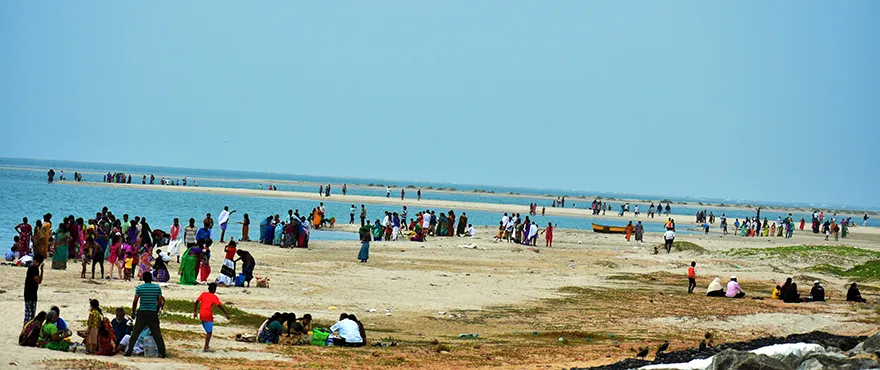
Nevertheless, a peaceful stroll or a bike ride along the beach delivers an unforgettable and exhilarating experience for visitors.
Rama Sethu or Arichal Munai View Point
Arichal Munai marks the exact point where the Indian Ocean meets the Bay of Bengal, and visitors can clearly view this natural confluence at Dhanushkodi.
According to legend, this is the sacred spot where Lord Rama pointed the end of his bow and commanded his army to build a bridge across the sea to Lanka (Sri Lanka) to rescue Goddess Sita. Therefore, this location holds immense mythological importance.
The southernmost end of Rameswaram and the meeting point of the two seas are collectively identified as Arichal Munai or Rama Sethu.
How to Reach Dhanushkodi
To facilitate tourism, the Government of India introduced public transportation services to Dhanushkodi. Visitors can reach the destination using government buses, auto-rickshaws, or private vehicles such as bikes, cars, and vans.
Dhanushkodi is situated approximately 26 kilometres from the Rameswaram bus stand and about 24 kilometres from the railway station. Moreover, Rameswaram connects well with major cities through road and rail networks. For air travel, the nearest airport is located at Madurai, nearly 198 kilometres away.
Epilogue
Ultimately, the haunting beauty of Dhanushkodi leaves a lasting impression on every visitor. The expansive beach, roaring tides, crystal-clear blue waters, and haunting ruins of the once-thriving town together evoke a deep sense of wonder and reflection.
Dhanushkodi – FAQ
Why is Dhanushkodi called a ghost town?
Dhanushkodi is called a ghost town because it was destroyed by a powerful cyclone in 1964. After the disaster, the town was declared unfit for habitation, leaving behind haunting ruins.
Where is Dhanushkodi located?
Dhanushkodi is located at the southeastern tip of Rameswaram Island in Ramanathapuram district, Tamil Nadu, where the Bay of Bengal meets the Indian Ocean.
What are the main attractions in Dhanushkodi?
Key attractions include the abandoned church ruins, old railway station remains, Arichal Munai (land’s end), and the serene beach views.
Is Dhanushkodi connected to the Ramayana?
Yes, according to legend, Lord Rama marked the spot here with his bow (Dhanush) before the construction of Rama Setu to Lanka, giving the town its name.
What is the best time to visit Dhanushkodi?
The best time to visit is from October to March when the weather is pleasant and ideal for sightseeing.
Tourist Attractions near Dhanushkodi:
- Ramanathaswamy Temple, Rameswaram
- Agni Theertham Beach
- APJ Abdul Kalam Memorial – Rameswaram
- Kunthukal Beach
- Pamban Bridge
Pamban Bridge: India’s First Sea Bridge – History, Facts & Travel Guide
The Pamban Bridge stands proudly as India’s first sea bridge and showcases an exceptional engineering achievement. The bridge directly connects the holy town of Rameswaram on Pamban Island with mainland India. Stretching nearly 2 kilometres across the sea and supported by 143 sturdy piers, the Pamban Bridge holds the distinction of being the second-longest sea bridge in India, next only to the Bandra–Worli Sea Link in Mumbai. Situated in Rameswaram, which lies at the southeastern tip of India, this century-old bridge serves as the lifeline that links the island town to the mainland, making it historically, culturally, and strategically significant.
Unique Design and Engineering Excellence of Pamban Bridge
Engineers designed the Pamban Bridge as India’s first cantilever bridge, making it truly unique. Most notably, they constructed a double-leaf bascule section over a century ago to ensure uninterrupted ferry movement. When the bridge opens, it splits into two sections, allowing ships and ferries to pass smoothly through the Palk Strait between Rameswaram and Pamban Island. This opening mechanism creates a breathtaking sight for visitors. Moreover, the bridge consists of over 140 spans, with the famous 114th span known as the Scherzer span. Altogether, the bridge measures 2.057 kilometres in length and includes 145 steel girder spans of 12.20 metres each, along with a 225-metre Scherzer rolling lift navigational span.
Construction History
Construction of the Pamban railway bridge began in 1911, and authorities commissioned it on February 24, 1914. German engineer Scherzer designed the central opening span, which allows ships and ferries to move freely beneath the bridge. On average, 10 to 15 boats and small vessels pass under the bridge every month. Although the devastating cyclone of 1964 destroyed the nearby port town of Dhanushkodi, the rolling lift center span of the bridge remained undamaged. Engineers and workers used nearly 4,000 tonnes of cement and the efforts of around 600 workers to complete this monumental structure.
Maintenance and Safety Measures
After the tragic train accident caused by the 1964 cyclone, Indian Railways strengthened safety measures on the Pamban Bridge. Authorities installed wind velocity monitoring devices to continuously assess wind conditions across the bridge. Whenever wind speeds exceed 58 kmph, officials immediately halt train services to ensure passenger safety. In addition, Indian Railways converted the bridge’s railway line from metre gauge to broad gauge in 2007, significantly improving rail connectivity to Rameswaram.
Pamban Road Bridge – A Scenic Parallel Wonder
Alongside the railway bridge, the Annai Indira Gandhi Road Bridge connects Rameswaram with the mainland. Authorities opened this road bridge in 1988, and it runs parallel to the railway bridge. Measuring about 2.3 kilometres in length, the bridge offers spectacular views of the sea, fishing boats, and the iconic railway bridge below. Driving across this bridge delivers a thrilling experience, especially during sunrise and sunset when golden light reflects on the water. As a result, photographers and tourists frequently stop here to admire the scenery. Additionally, this bridge provides the perfect vantage point to watch trains glide across the sea.
The New Pamban Bridge: India’s First Vertical Sea Bridge
To meet modern transportation demands, authorities began constructing the New Pamban Bridge in February 2020. This advanced structure spans 2,070 metres and introduces India’s first vertical lift sea-bridge technology, which allows sections of the bridge to rise vertically for maritime traffic. Engineers designed the bridge to support double railway tracks and future electrification. Standing 3 metres higher than the old bridge, the new structure significantly improves safety and capacity. By September 2024, authorities completed construction and successfully conducted trial runs in October 2024. The bridge is scheduled to open for traffic on April 6, 2025, marking a major milestone in India’s infrastructure journey.
How to Reach Pamban Bridge
Pamban Bridge lies approximately 14.8 kilometres from Rameswaram. Travelers can easily reach the bridge using public or private transport from Ramanathapuram and Rameswaram. Rameswaram also has its own railway station, which ensures convenient rail access. For air travel, visitors can use Madurai Airport, located about 120 kilometres away, or Thoothukudi Airport, which lies around 145 kilometres from Ramanathapuram.
Epilogue
Pamban Bridge ranks among the most iconic attractions in Tamil Nadu. A journey across this magnificent bridge offers an unforgettable experience, complete with sweeping views of the sea, Rameswaram Island, Kunthukal Vivekananda Memorial, and nearby islands. Visitors can also relax and spend quality family time at the Children’s Park located on the Mandapam shore at the far end of the bridge. Whether you love history, engineering, or scenic travel, Pamban Bridge delivers a truly memorable experience.
Pamban Bridge – FAQ
What is Pamban Bridge famous for?
Pamban Bridge is famous as India’s first sea bridge, connecting Rameswaram Island to mainland Tamil Nadu. It is known for its engineering design and scenic ocean views.
When was Pamban Bridge built?
The railway bridge was opened in 1914, making it over 110 years old and one of the oldest functioning sea bridges in India.
What is special about the structure of Pamban Bridge?
The bridge features a double-leaf bascule (Scherzer rolling lift) section that can be raised to allow ships to pass through the Palk Strait.
How long is Pamban Bridge?
Pamban Railway Bridge stretches approximately 2.06 kilometers across the sea, linking Mandapam to Rameswaram.
Is there a road bridge near Pamban Bridge?
Yes, alongside the railway bridge, the Annai Indira Gandhi Road Bridge provides road connectivity and offers panoramic views of the Bay of Bengal.
Nearby Tourist Attractions
- Dr. APJ Abdul Kalam Memorial – Rameswaram
- Ramanathaswamy Temple, Rameswaram
- Agni Theertham Beach
- Dhanushkodi
There are sixty-four Theerthams (sacred water bodies) in and around Rameswaram, each holding deep spiritual significance. Among them, twenty-two Theerthams are located within the Ramanathaswamy Temple. Devotees believe that bathing in these holy waters equals intense penance, and therefore, it forms an essential part of the Rameswaram pilgrimage. Notably, every Theertham carries its own unique religious importance.
Among these sacred sites, the eastern seashore located opposite the Ramanathaswamy Temple is known as Agni Theertham. Significantly, Agni Theertham is regarded as the primary and most important sea shore associated with the temple.
Discover the Spiritual Significance of Agni Theertham
According to legend, Goddess Sita underwent the Agni Pariksha (ordeal by fire) at this sacred spot to prove her chastity to Lord Rama. However, since she was pure, sinless, and virtuous, the fire caused her no harm. Consequently, Lord Agni, believing that he had committed a sin by touching Goddess Sita, prayed to Lord Shiva and immersed himself in the sea. Over time, this sacred location came to be known as Agni Theertham.
The Rituals and Beliefs Associated with Agni Theertham
- The term Agni means fire in Sanskrit, while Theertham refers to holy water. Therefore, Agni Theertham is revered as a sacred pilgrimage centre among Hindus.
- Devotees visiting the Theertham offer prayers and take a ritual dip in the holy waters, believing it helps atone for their sins.
- In addition, devotees perform sacred ancestral rituals, including Tharpanam, at Agni Theertham.
- Bathing in the holy waters on full moon and new moon days is considered especially auspicious.
- Notably, Agni Theertham is the only Theertham of the Ramanathaswamy Temple that lies outside the temple complex.
How to Reach Agni Theertham
Agni Theertham is located just 3 kilometres from the Rameswaram bus stand. As a result, visitors can easily reach the site by local bus or by hiring an auto rickshaw. Similarly, the nearest railway station is Rameswaram, which is also approximately 3 kilometres away.
Moreover, Rameswaram enjoys excellent road and rail connectivity with major cities such as Chennai, Madurai, Coimbatore, Trichy, and several other important destinations.
The 2.3-kilometre-long Indira Gandhi Road Bridge, popularly known as the Pamban Bridge, connects Mandapam on the Indian mainland with Pamban, the fisherman town of Rameswaram. Furthermore, the nearest airport is located in Madurai, approximately 163 kilometres from Rameswaram.
Agni Theertham Beach, Rameswaram – FAQ
What is Agni Theertham famous for?
Agni Theertham is a sacred sea bathing spot located near Ramanathaswamy Temple in Rameswaram. Devotees take a holy dip here before entering the temple for darshan.
Why is Agni Theertham spiritually significant?
According to legend, Lord Rama worshipped Lord Shiva here to absolve sins after the battle in Lanka. Bathing in Agni Theertham is believed to cleanse sins and remove doshas.
Where is Agni Theertham Beach located?
Agni Theertham is situated on the eastern shore of Rameswaram Island in Ramanathapuram district, just a short walk from Ramanathaswamy Temple.
Is Agni Theertham safe for bathing?
The waters are generally calm and shallow, making it suitable for ritual bathing. However, visitors should follow safety instructions and local guidelines.
What is the best time to visit Agni Theertham?
The best time to visit is between October and March when the weather is pleasant for pilgrimage and coastal visits.
Near by Tourist Attractions to Agni Theertham Beach:
- Ramanathaswamy Temple, Rameswaram
- Dhanushkodi
- Dr. APJ Abdul Kalam Memorial – Rameswaram
- Kunthukal Beach
- Pamban Bridge
Overview of Ramanathaswamy Temple, Rameswaram
The Ramanathaswamy Temple is a revered Hindu shrine dedicated to Lord Shiva and is located on Rameswaram Island in the Ramanathapuram district of Tamil Nadu. Built in the traditional Dravidian style of architecture, the temple stands as one of the most sacred pilgrimage destinations for Hindus across India.
Moreover, the temple holds immense spiritual importance as it forms an integral part of major Shaivite and pan-Indian pilgrimage traditions.
The Legend Behind Ramanathaswamy Temple
Lord Shiva, worshipped here as Ramanathaswamy in the form of a Lingam, is believed to have been installed and worshipped by Lord Rama himself. According to the epic Ramayana, Lord Rama sought absolution for the sins committed during his battle against Ravana, the demon king of Lanka.
Consequently, Lord Rama instructed his devotee Hanuman to bring a sacred lingam from the Himalayas. However, when Hanuman was delayed, Goddess Sita fashioned a lingam out of sand on the shores of Rameswaram. This sand lingam, known as Ramalingam, remains the principal deity in the sanctum even today.
Architecture of Ramanathaswamy Temple
The gradual transformation of the temple from a humble thatched structure into its present magnificent form is largely attributed to the Sethupathi rulers of Ramanathapuram. Their patronage shaped the temple into a grand architectural marvel.
Inside the sanctum, the temple uniquely houses two lingams—Ramalingam, crafted by Sita, and Vishwalingam, brought by Hanuman from Mount Kailash. As instructed by Lord Rama, devotees continue to worship Vishwalingam first.
Furthermore, the temple features towering compound walls on all four sides, with majestic gopurams to the east and west and completed gateways to the north and south. The temple’s most striking feature is its long corridors. In fact, the outer corridor, supported by 1,212 intricately carved pillars, is regarded as the longest temple corridor in the world. The imposing Rajagopuram rises to a height of 53 metres.
Additionally, the temple complex includes several notable halls such as the Anuppu Mandapam, Sukravara Mandapam, Sethupathi Mandapam, Kalyana Mandapam, and Nandi Mandapam. Separate shrines for Ramanathaswamy and Goddess Parvathavardhini lie opposite each other, connected by a corridor. Shrines dedicated to Goddess Vishalakshi, Subramanya, Nataraja, Hanuman, Lord Vishnu, and Lord Ganesha further enhance the spiritual richness of the temple.
Interesting Facts About Ramanathaswamy Temple
- The Ramanathaswamy Temple is one of the twelve Jyotirlinga shrines and also one of the 274 Paadal Petra Sthalams glorified by the Shaivite saints Appar, Sundarar, and Tirugnana Sambandar.
- It forms an essential part of the sacred Char Dham pilgrimage, along with Badrinath, Puri, and Dwaraka.
- The temple corridor spans approximately 197 metres from east to west and 133 metres from north to south, making it the longest in Asia.
- Even today, Vishwalingam is worshipped before Ramalingam, following Lord Rama’s instruction.
- The Maratha rulers of Thanjavur established rest houses in Rameswaram and donated them to support pilgrims.
- Devotees believe that a pilgrimage to both Varanasi and Rameswaram completes a Hindu’s spiritual journey toward salvation.
The Sacred 22 Holy Theerthams
Rameswaram is home to sixty-four sacred Theerthams (holy water bodies), each carrying spiritual significance. Among them, Agni Theertham along the seashore holds primary importance. Notably, twenty-two of these Theerthams are located within the Ramanathaswamy Temple complex.
Devotees believe that bathing in these twenty-two Theerthams equals performing intense penance. Therefore, ritual bathing forms a vital part of the Rameswaram pilgrimage, with each Theertham symbolizing a unique spiritual benefit.
Temple Timings: The temple remains open daily from 5:00 AM to 1:00 PM and again from 3:00 PM to 9:00 PM.
The Rituals and Pujas at Rameshwaram Temple
| Pooja details of Rameshwaram Temple | Timings |
|---|---|
| Palliyarai Deepa Aradhana | 5:00 AM |
| Spadigalinga Deepa Aradhana | 5:10 AM |
| Thiruvananthal Deepa Aradhana | 5:45 AM |
| Vila Pooja | 7:00 AM |
| Kalasanthi Pooja | 10:00 AM |
| Uchikala Pooja | 12 Noon |
| Sayaratchai Pooja | 6:00 PM |
| Arthajama Pooja | 8:30 PM |
| Pilliyarai Pooja | 8:45 PM |
Ramanathaswamy Temple Festivals
The prominent festivals observed in the temple are:
- Maha Sivarathri – 10 days festival during the Tamil month of Maasi (February-March)
- Vasanthotsavam – 10 days festival during the Tamil month of Vaikasi (May-June)
- Ramalinga Prathishtai – 3 days festival during the Tamil month of Aani (June-July)
- Thirukalyanam – 17 days festival during the Tamil month of Aadi (July-August)
- Navarathri – 10 days festival during the Tamil month of Purattasi (September-October)
- Kantha Sashti – 6 days festival during the Tamil month of Aippasi (October-November)
- Aarudhra Darshanam – 10 days festival during the Tamil month of Margazhi (December-January)
How to reach Rameswaram
Rameswaram is well connected by road and rail with Chennai, Madurai, Coimbatore, Trichy and other important cities. The 2.3 kilometres long Indira Gandhi Road Bridge (popularly called Pamban Bridge) connects Mandapam (a place on Indian mainland) with Pamban (fisherman town in Rameswaram). The city bus stand is at a distance of around 2 kilometres from Ramanathaswamy Temple. Rameswaram has a railway station, about 1.3 kilometres from the temple. The nearest airport is at Madurai, 163 kilometres from Rameswaram.
Epilogue
Ramanathaswamy Temple is a holy paradise for devotees and an ideal delight for tourists. With its architectural grandeur, imposing temple tower, magnificent long corridors, aesthetically carved pillars and holy water bodies purifying mind and soul, the temple attracts millions of pilgrims every year.
Tips for Visiting Rameswaram Ramanathaswamy Temple
Temple Rituals:
- Holy Bath: Take a dip in the sacred waters of the 22 holy theerthams, believed to purify the soul.
- Main Darshan: Seek the blessings of Lord Ramanatha Swamy at the main shrine.
- Pujas and Offerings: Participate in various pujas and offer prayers.
Temple Etiquette:
- Respectful Behavior: Maintain silence and a respectful demeanor within the temple premises.
- Photography Restrictions: Mobile phone is strictly not allowed inside the temple.
- Queue Discipline: Follow the queue system and wait patiently for your turn.
Exploring the Complex:
- Holy Wells: Visit the 22 holy wells, each with its own significance.
- Ramanathaswamy Temple: Admire the magnificent architecture and intricate carvings.
- Other Temples: Explore nearby temples like the Hanuman Temple and the Kothandarama Swamy Temple.
Local Cuisine:
- Vegetarian Options: Enjoy vegetarian dishes influenced by South Indian cuisine.
- Seafood Delights: Indulge in fresh seafood delicacies.
By following these tips, you can make the most of your pilgrimage to Ramanathaswamy Temple and immerse yourself in its spiritual significance.
Ramanathaswamy Temple, Rameswaram – FAQ
Why is Ramanathaswamy Temple famous?
Ramanathaswamy Temple is famous as one of the 12 Jyotirlinga temples of Lord Shiva and for having the longest temple corridor in India, measuring about 1,200 meters.
Where is Ramanathaswamy Temple located?
The temple is located in Rameswaram on Pamban Island in Ramanathapuram district, Tamil Nadu.
What is the significance of the 22 Theerthams?
The temple has 22 sacred wells (Theerthams) within its premises. Devotees take ritual baths in these wells before darshan, as each is believed to have unique spiritual benefits.
What is the connection between Ramanathaswamy Temple and the Ramayana?
According to legend, Lord Rama worshipped Lord Shiva here to absolve sins after defeating Ravana, establishing the sacred Shiva Lingam at this site.
What is the best time to visit Ramanathaswamy Temple?
The best time to visit is from October to March when the weather is pleasant for pilgrimage and temple visits.
Tourist Attractions near Rameswaram:
- Agni Theertham Beach
- Dhanushkodi
- APJ Abdul Kalam Memorial – Rameswaram
- Kunthukal Beach
- Pamban Bridge
The Velankanni Church, popularly known as the Basilica of Our Lady of Good Health, is located in the coastal town of Velankanni. Situated along the Coromandel Coast, about 12 kilometres south of Nagapattinam, this sacred shrine stands as one of the most important Christian pilgrimage centres in India.
More about Velankanni Church
Officially spelled as “Vailankanni,” the church is revered for its Roman Catholic shrine dedicated to Our Lady of Good Health. Devotees across the world also refer to the shrine as the “Lourdes of the East,” highlighting its spiritual significance. The Velankanni Church is dedicated to Virgin Mary, worshipped as the Heavenly Mother. According to belief, Virgin Mary appeared at this site along with Infant Jesus between the late 16th and early 17th centuries. Following these events, Velankanni gradually emerged as a sacred destination for Christian devotees.
The first apparition is believed to have taken place at Matha Kulam, also known as Our Lady’s Tank, where Virgin Mary appeared to a milk vendor boy. Later, a second apparition reportedly occurred at Naduthittu, where a lame boy experienced a miraculous healing. In addition, local belief holds that Our Lady saved Portuguese sailors from a violent sea storm near Velankanni.
However, there are no written historical records or officially attested statements confirming these apparitions. The Holy See has not formally approved the reported phenomena. Nevertheless, devotion to Our Lady of Velankanni continues to flourish, drawing millions of pilgrims every year.
Architecture of the Velankanni Church
The Velankanni Church impresses visitors with its grand architectural design and expansive layout. The church complex includes three chapels within its premises. The southern wing of the church was extended in 1928, followed by the northern extension in 1933. Later, during 1974–75, authorities expanded the Basilica further, drawing inspiration from the architectural style of the Basilica at Lourdes in France.
Today, the church campus houses several important structures, including the Shrine Basilica Main Church, Our Lady’s Tank, the Lower Basilica, Upper Basilica Morning Star Church, and Naduthittu Church.
Velankanni Church Opening Timings
The Velankanni Church remains open daily from 5:00 AM to 9:00 PM. Regular masses are conducted in Tamil, Malayalam, and English, ensuring accessibility for devotees from different regions.
In addition to daily masses, visitors can participate in Novena prayers, Rosary services, and evening prayers, making the church a vibrant centre of faith and devotion throughout the day.
Velankanni Church Mass Timings
Shrine Basilica Main Church
- 5:40 AM – Morning Prayer
- 6:00 AM – Mass in Tamil
- 6:45 AM – Matha Blessing (Every Saturday)
- 3:00 PM – Eucharistic Adoration Daily
Our Lady’s Tank
- 7:00 AM – Mass in Tamil (Every Saturday)
- 6:30 PM – Mass in Tamil (Lent Season only)
Lower Basilica
- 7:00 AM – Mass in Tamil
- 7:30 AM – Mass in Tamil (Sunday only)
- 10:00 AM – Mass in English
- 12:00 Noon – Mass in Tamil
- 4:00 PM – Mass in Konkani (Every Tuesday)
- 5:00 PM – Mass in Tamil (Sunday Parishners Mass)
Upper Basilica
- 8:00 AM – Mass in Telugu
- 11:00 AM – Mass in Hindi
- 4:00 PM – Mass in Malayalam (Every Sunday)
Morning Star Church
- 9:00 AM – Mass in Malayalam
- 4:00 PM – Mass in Tamil (Monday to Saturday)
- 8:00 PM – Mass in Konkani
Naduthittu Church
- 7:00 AM – Mass in Tamil (Last Saturday of the month)
How to reach Velankanni Church
Velankanni Church is located at a distance of 12 kilometres from Nagapattinam and 350 kilometres south of Chennai. Local transportation such as buses and taxis can be easily accessed to reach the church. The nearest railway station to Velankanni Church is at Nagapattinam. Trichy Airport (160 kilometres away) and Chennai International Airport (350 kilometres away) are the nearest terminals to the church.
Epilogue
Velankanni Church has been declared as a holy city by Pope and attracts devotees in large numbers from across the world. The church is revered by people of different nationalities irrespective of their caste, creed and religion.
Velankanni Church, Nagapattinam – FAQ
Why is Velankanni Church famous?
Velankanni Church is famous as the Basilica of Our Lady of Good Health, a major Christian pilgrimage site in India where devotees believe miraculous healings have occurred.
Where is Velankanni Church located?
The church is located in Velankanni town in Nagapattinam district, Tamil Nadu, along the Coromandel Coast of the Bay of Bengal.
What is the significance of the Velankanni Annual Festival?
The annual feast, held from August 29 to September 8, commemorates the Nativity of Mother Mary and attracts millions of pilgrims from across India and abroad.
Is Velankanni Church open to people of all religions?
Yes, Velankanni Church welcomes devotees from all faiths, reflecting religious harmony and spiritual inclusiveness.
What is the best time to visit Velankanni?
The best time to visit is between October and March when the weather is pleasant, though the annual festival season is spiritually vibrant but crowded.
Tourist Attractions near Nagapattinam
The Arulmigu Subramanya Swamy Temple is located in the town of Tiruchendur along the scenic shores of the Bay of Bengal. As one of the most revered ancient Hindu temples, it is dedicated to Lord Murugan. Most importantly, the temple is recognised as one of the six sacred abodes, known as the Arupadaiveedu, of Lord Murugan.
Legend
According to legend, Tiruchendur is the sacred place where Lord Murugan, the second warrior son of Lord Shiva, defeated the powerful demon Surapadman. Furthermore, it is believed that the divine demigods wished to worship Lord Murugan at a location blessed with mountains, the sea, and a river. Therefore, Tiruchendur was chosen as the ideal divine setting.
Structure of the Tiruchendur Subramanya Swamy Temple
The Raja Gopuram, which serves as the main temple tower, stands on the western side of the temple. Unlike most temples where the Raja Gopuram rises on the eastern side, this unique orientation exists because the sea lies very close to the eastern boundary of the temple.
Moreover, the nine-tiered gopuram rises to an impressive height of 138 feet, making it a prominent landmark. Inside the sanctum sanctorum, Lord Subramanyam appears in a majestic standing posture. Additionally, devotees can find the shrine of Sivalinga Jagannatha located to the left of the main deity.
Temple Festivals of Tiruchendur Subramanya Swamy Temple
- Brahmotsavam is celebrated twice every year during the Tamil months of Masi (February–March) and Aavani (August–September). Consequently, thousands of devotees gather for the 12-day-long celebrations.
- The Vasantha Festival is a ten-day celebration held during the Tamil month of Chittirai (April–May).
- In addition, Vaikasi Visagam is observed during the Tamil month of Vaikasi (May–June).
- Finally, the Skanda Sasti Festival is a seven-day celebration conducted in the Tamil month of Aippasi (October–November).
Timings of Tiruchendur Subramanya Swamy Temple
Temple is open on all days from 5:00 AM to 9:00 PM.
Pooja Details of Tiruchendur Subramanya Swamy Temple
| Pooja Name | Pooja Timing |
|---|---|
| Suprabatam | 5:10 AM |
| Viswaroopa Darshanam | 5:30 AM |
| Dwajasthamba Namaskaram | 5:45 AM |
| Udaya Marthanda Abhishekam | 6:15 AM |
| Udaya Marthanda Deeparadhanai | 7:00 AM |
| Kalasandhi Pooja | 8:00 to 8:30 AM |
| Kalasha Pooja | 10:00 AM |
| Uchikala Abhishekam | 10:30 AM |
| Uchikala Deeparadhanai | 12:00 Noon |
| Sayaratchai Pooja | 5:00 PM |
| Arthasama Abhishekam | 7:15 PM |
| Arthasama Pooja | 8:15 PM |
| Ekanda Seva | 8:30 PM |
| Ragasia Deeparadhanai | 8:45 PM |
| Nadai Thirukappiduthal | 9:00 PM |
How to reach Tiruchendur Subramanya Swamy Temple
The temple is located at a distance of 60 kilometres south-east of Tirunelveli, 40 kilometres from Tuticorin and 75 kilometres north-east of Kanyakumari.
Tiruchendur is well connected with many major cities across South India. Thoothukudi Railway Station is the nearest station to the temple at a distance of around 42 kilometres. The nearest airport is at Madurai (around 99 kilometres away).
Tiruchendur Subramanya Swamy Temple – FAQ
Where is Tiruchendur Subramanya Swamy Temple located?
The temple is located in Tiruchendur in Thoothukudi district, Tamil Nadu, uniquely situated along the shores of the Bay of Bengal.
Why is Tiruchendur Temple famous?
Tiruchendur Temple is famous as one of the six sacred Arupadai Veedu temples of Lord Murugan and for its coastal location beside the sea.
What is the significance of Tiruchendur in Hindu mythology?
According to legend, Lord Murugan defeated the demon Surapadman at Tiruchendur, making it a powerful spiritual site associated with Skanda Sashti.
What are the major festivals celebrated at Tiruchendur Temple?
The temple’s major festivals include Skanda Sashti, Vaikasi Visakam, and Aavani Festival, attracting lakhs of devotees every year.
What is the best time to visit Tiruchendur Temple?
The best time to visit is between October and March when the weather is pleasant, especially during Skanda Sashti for a vibrant devotional experience.
Kuttralam lies in the Tenkasi District of Tamil Nadu and people widely recognize it as the “Spa of South India.” This scenic destination attracts visitors with its roaring waterfalls, expansive greenery, and pristine natural surroundings. In addition, Kuttralam features several ancient temples and prominent tourist attractions that enhance its cultural appeal.
Locals and visitors also call Kuttralam the Herbal Hill because water from its waterfalls carries medicinal properties. As a result, many wellness resorts and health clinics operate in and around the town. Several perennial rivers, including the Thamirabarani River, Chittar River, Manimuthar River, and Pachaiyar River, originate in this region of Tirunelveli.
Coutrallam Location
Coutrallam, also known as Kuttralam, functions as a panchayat town located at an elevation of about 160 metres on the Western Ghats. It sits within the Tenkasi District of Tamil Nadu and serves as one of South India’s most visited waterfall destinations.
Reference to Literature
The name Kutralam originates from the term “Kuru Aal,” which means dwarf banyan trees. The region earned this name because forests in the area once flourished with such trees. Renowned poet Thiurkudarasappa Kavirayar vividly praised the beauty and grandeur of this serene town near Tenkasi. Moreover, Sangam literature highlights Kuttralam by comparing its natural charm to the elegance of a woman, emphasizing its literary and cultural importance.
Major Waterfalls in Kuttralam
Kuttralam features nine major waterfalls, each offering a unique bathing experience. Visitors from across the country travel here to rejuvenate themselves in the herb-rich waters that refresh both body and mind.
Coutrallam Main Falls (Peraruvi)
Peraruvi stands as the largest and most prominent waterfall in Kuttralam. At this location, water plunges from a height of nearly 60 metres before slowing down inside a natural crater called Pongumakadal, which measures about 19 metres in depth. The flowing water passes over rocks carved with Shiva Lingams and other deities, creating a deeply spiritual atmosphere. Combined with the healing properties of the water, a bath here delivers a refreshing and divine experience. Visitors often follow the bath with a relaxing body massage. During peak seasons, large crowds gather at the falls, and visitors wait in queues for their turn. Notably, the Main Falls can accommodate nearly 300 people at a time.
Small Falls (Chitraruvi)
Chitraruvi, commonly called the Small Falls, lies adjacent to the Main Falls. From this point, visitors can walk uphill to reach Shenbagadevi Falls and Thenaruvi. Here, the water flows gently, allowing visitors to enjoy a mild shower. Authorities provide separate bathing facilities for men and women.
Shenbagadevi Falls
Visitors reach Shenbagadevi Falls by trekking about 2.5 kilometres through the Chitraruvi forest. The waterfall sits roughly 40 feet above Chitraruvi Falls. The water flows through fragrant Shenbaga trees, enhancing the site’s spiritual atmosphere. A temple dedicated to Shenbagadevi Amman stands nearby and attracts many pilgrims, especially on full moon days.
Thenaruvi (Honey Falls)
Thenaruvi, popularly known as Honey Falls, lies about 3 kilometres from the Main Falls. Water drops from a height of nearly 40 metres between two massive rocks. The falls get their name from honeycombs found on the surrounding hills. Dense forests and steep mountain trails lead to this horseshoe-shaped waterfall. Due to safety risks, authorities restrict public access.
Aintharuvi (Five Falls) in Kuttralam
Aintharuvi, also called Five Falls, lies around 4 kilometres from Kuttralam town. The waterfall splits into five streams before merging into a single flow downhill. Authorities reserve two sections for women and three for men. Visitors can also explore the nearby Eco Park, boating facilities, and several popular temples.
Pazhathotta Aruvi (Orchard Falls)
Pazhathotta Aruvi flows above Aintharuvi through orchards, creating a scenic setting. People once referred to it as the VIP Falls because only politicians and bureaucrats could enter. Currently, authorities restrict entry for all visitors.
Pazhaya Courtalla Aruvi (Old Coutrallam Falls)
Pazhaya Courtalla Aruvi, also known as Shivamathungai Falls, lies about 6 kilometres from the Main Falls. Initially, water flowed into a deep valley between two large rocks. Later, authorities altered the watercourse to allow safe bathing. Workers carved steps into the rocks, and water now cascades from a height of nearly 200 metres. Separate bathing areas and oil massage facilities serve visitors.
Puli Aruvi (Tiger Falls)
Puli Aruvi earned its name because tigers once used it as a watering spot. The mild waterfall lies about 2 kilometres from the Courtallam bus stand on private land. Water collects in a small lake before flowing into irrigation canals. Nearby attractions include the Sastha Temple, a bathing ghat, and an old palace that now remains private property.
The Private Falls
A small waterfall located above Five Falls inside the Government Horticulture Park remains closed to the public. Visitors can reach the Main Falls, Five Falls, and Old Courtallam Falls by road, while Shenbaga Waterfalls and Honey Falls require mountain trekking.
Places to Visit in Coutrallam or Kutralam
Some of the other places of interest that could be visited near Kutralam are:
- Palaruvi (Milk Falls) lies at the Tamil Nadu – Kerala border at the mountain pass named Aryankavu.
- Gundaru Aruvi is Located at a distance of 10 kilometres from Kutralam, near Sengottai. Traveling 2 kilometres inward from the Gundaru Dam will take you to Gundaru Aruvi.
- Kannupuli Mettu is Located at a distance of 5 kilometres to the west Sengottai Taluk Office at the top of Gundaru Reservoir.
- Children’s Park, Aquarium and Snake park near Main Falls, Eco Park near Five Falls, Therkumalai Estate, around one hour travel from Honey Falls, Boat Houses near Five Falls and Old Courtallam Falls, Gundam Dam & Reservoir near Senkottai.
- The Chitra Sabha at Kutralam is one of the five sabhas where Lord Nataraja (a form of Lord Shiva) is said to have performed his divine dance. The historical paintings and other religious events are very significant here.
- The Kutralanathar Temple near to the Main Falls is dedicated to Lord Shiva. The temple is around 2000 years old and Tamil inscriptions of Chola and Pandyan periods can be found here.
- Other temples near Kutralam include
- Thirukutralanathar Temple
- Chitra Sabai Sivan Temple – Kuttralam
- Kasi Viswanathar Temple, Tenkasi (6 kms from Kutralam)
- Thirumalai Temple, Panpoli (8 kms from Kutralam)
- Kumaran Temple, Ilanji (3 kms from Kutralam)
- Dakshinamoorthy Temple, Puliyarai (12 kms from Kutralam)
- Ulagaambigai & Lord Shiva Temple, Papanasam (35 kms to the Southeast of Kutralam)
- Ariyankavau Ayappan Temple (35 kms to the Northwest of Kutralam)
- Sri Siddheswari Peetham, Courtallam
- Papanasam River at a distance of 35 kms from Kutralam
- The Banatheertham Falls and Agasthiyar Falls near Papanasam
- Lower Papanasam Dam, Kaaraiyar Dam, Servalar Dam and Manimuthar Dam near Papanasam
- Kalakaddu – Mundanthurai Tiger Sanctuary near Papanasam
- Kumbavuruti Aruvi – Located at a distance of 32 kms from kutralam, on the way to Achan Koil in Kerala.
Unique Attributes of Coutrallam
- Flora & Fauna – Apart from the rare herbs, Kutralam is rich with diverse flora and fauna found around the place. Around 2000 varieties of flowers and plants have been identified in the hills at Kutralam.
- Tourists savor in the fresh and hot Halwa prepared and sold at shops on the way to Kuttralam Main Falls.
- The aromatic masala milk sold usually in the evenings is very popular among the tourists.
- The towel made up of thin fiber and pure organic cotton, called the Aruvi Thundu, is a unique accessory that dries up very quickly and is very useful for having a bath in various falls. Tourists can get it in the nearby textile shops.
- The famous Border Kadai is at a distance of just 5 minutes from Kutralam. It is well known for its parottas and non-vegetarian cuisine.
- Tourists looking out for an elegant meal can drop at Vinayaga Dosa Kadai, located at Melagaram on the road from Thenkasi to Kutralam. One can relish the several varieties of Dosa available here.
- Courtallam encompasses hotels, lodges, and resorts according to the budget.
Ideal time to visit Kuttralam or Coutrallam
Best time to visit would be from June to December from the onset of South West Monsoons. If due to heavy rains the falls get flooded, people would not be allowed to take bath in the falls.
How to reach Coutrallam Falls?
Senkottai is the nearest bus stand. Frequent buses ply to Coutrallam. The nearest railway hub is at Thenkasi (5kms) and the nearest airport is Thoothukudi Airport and Trivandrum International Airport.
Coutrallam Main Waterfalls – FAQ
Where is Coutrallam Main Waterfalls located?
Coutrallam Main Waterfalls is located in Courtallam (Kuttralam) in Tenkasi district, Tamil Nadu, at the foothills of the Western Ghats.
Why is Coutrallam Main Falls famous?
The falls are famous for their herbal-rich waters that flow through forested hills, earning Courtallam the title “Spa of South India.”
What is the best time to visit Coutrallam Main Falls?
The best time to visit is during the monsoon season from June to September when the waterfalls are in full flow.
Is Coutrallam Main Falls safe for bathing?
Yes, the falls are generally safe for bathing as the water spreads over a wide rock surface, but visitors should follow safety guidelines and official instructions.
Are there facilities available near the waterfall?
Yes, basic amenities such as changing rooms, parking, shops, and eateries are available near the falls for tourists.