
Swaminathaswamy Temple, Swamimalai
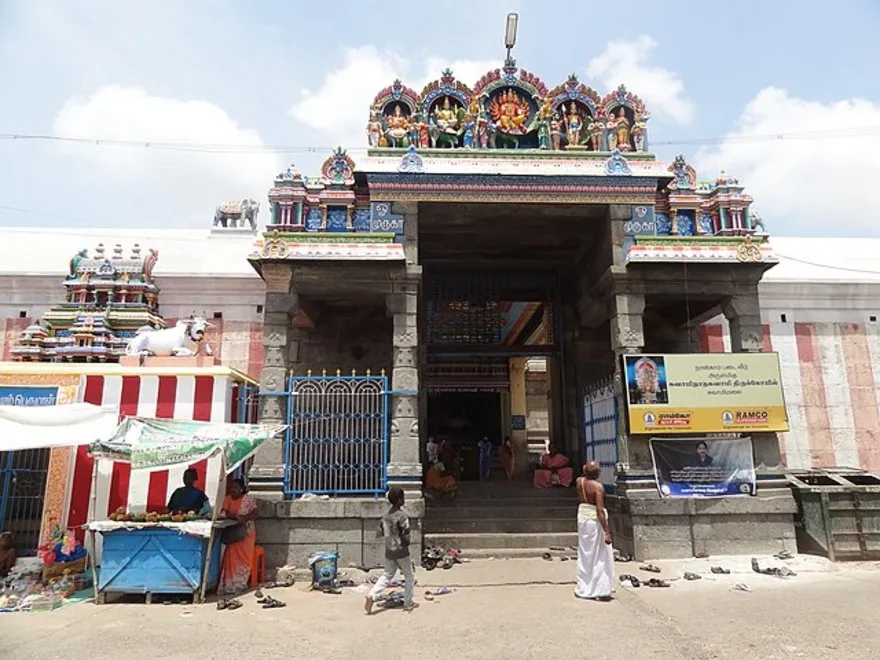
Lord Murugan has six sacred abodes, collectively known as the Arupadaiveedu, across Tamil Nadu. Among them, the Swamimalai Sri Swaminathaswamy Temple occupies a revered place. The temple stands atop a hill in Swamimalai, located in the Thanjavur district, about 8 kilometres from Kumbakonam, along the banks of a tributary of the River Cauvery.
At present, the Hindu Religious and Charitable Endowments Department of the Government of Tamil Nadu administers and maintains the temple.
Image Attribution : Shankaran Murugan
Historical Significance of the Temple
According to Hindu legend, Lord Murugan once expressed anger toward Lord Brahma, the creator, after Brahma showed disrespect during a visit to Mount Kailash, the abode of Lord Shiva. As a result, Lord Murugan stopped Brahma and questioned him about the meaning of the sacred Pranava mantra, “Om.” When Brahma failed to explain its meaning, Lord Murugan struck him on the forehead, imprisoned him, and assumed the role of the creator himself. Subsequently, the Devas approached Lord Shiva and requested the release of Brahma.
When Lord Shiva asked Murugan to free Brahma, Murugan refused and instead challenged Shiva to explain the meaning of “Om.” At this moment, Lord Murugan revealed the meaning of the Pranava mantra to his own father. Hence, this sacred site came to be known as Swamimalai, meaning “the hill where Shiva became the student.” According to belief, Swamimalai is the holy place where Lord Murugan taught the Pranava mantra to Lord Shiva.
Architecture of Swaminathaswamy Temple
The Swaminathaswamy Temple rises on a Kattu Malai, which means an artificially constructed hill. The temple complex features three gopurams and three prakarams. The first prakaram lies at the base, the second midway up the hill, and the third surrounds the sanctum at the hilltop.
Sixty well-laid stone steps lead devotees to the main shrine. Tradition associates these steps with the 60 years of the Tamil calendar cycle. At the foothill, devotees can worship Lord Shiva as Sundareswarar and Goddess Parvathi as Meenakshi. The first precinct includes a Vinayagar shrine just outside the enclosure, along with images of Dakshinamurthy, Durga, Chandikeswarar, and the festival idol of Swaminathaswamy. Meanwhile, the second precinct, which is the largest within the complex, houses the temple chariot and a marriage hall used for religious ceremonies.
At the hilltop sanctum, devotees worship the six-foot-tall granite image of Lord Swaminathaswamy. Priests adorn the deity with golden armour, crowns, and a diamond lance. Unlike most Murugan temples where a peacock appears as the vahana, this temple uniquely features an elephant.
Reference to the Literature
Swamimalai Temple finds mention in Tamil devotional literature. Poet Nakkeerar praised the temple, while Arunagirinathar glorified it in his Tirupugazh hymns. The temple also appears in the revered work Tirumugattrupadai, further highlighting its literary and spiritual importance.
Swaminathaswamy Temple Timings
Morning 6:00 AM to 12:00 PM and Evening 4:00 PM to 10:00 PM.
Devotees are served Annadhanam every day. Rooms and cottages are available for devotees at nominal rates.
Pooja Timings
| Pooja Name | Timings |
|---|---|
| Usha kalam | 6:00 AM |
| Kalasanthi | 9:00 AM |
| Uchikalam | 12:00 Noon |
| Sayaratchai | 5:30 PM |
| Irandan Kalam | 8:00 PM |
| Arthajamam | 10:00 PM |
Worship practices in the temple include tonsuring, Abhishekam (ablution of deity) with milk, sandal, ash and panchamirtham.
Festivals observed in the Temple
The major festivals observed in the temple are:
- Kirutikai Festival – in the Tamil month of Adi (July-August)
- Car Festival – in the month of April
- Visakam Festival – in the month of May
- Navarathri – during the Tamil month if Purattasi (September –October)
- Kanda Shashti – in the month of October
- Tiru Karthikai – in the month of November/December
- Thaipusam – in the month of January
- Pankuni Uttiram – in the month of March
How to reach Swaminathaswamy temple
Regular buses and private cabs can be availed to reach Kumbakonam. Kumbakonam is well connected with all major cities in Tamil Nadu. Kumbakonam is the nearest railway head (8.5 kilometres away) and Trichy International Airport is the nearest Airport (85 kilometres away).
Swaminathaswamy Temple, Swamimalai – FAQ
Where is Swaminathaswamy Temple located?
Swaminathaswamy Temple is located in Swamimalai near Kumbakonam in Thanjavur district, Tamil Nadu.
Why is Swamimalai Temple famous?
The temple is famous as one of the six sacred Arupadai Veedu temples of Lord Murugan, where he is believed to have taught the meaning of the Pranava mantra “Om” to Lord Shiva.
How many steps are there to reach the sanctum?
Devotees climb 60 steps to reach the sanctum, symbolizing the 60 Tamil years in the traditional calendar.
Who are the presiding deities of the temple?
Lord Murugan is worshipped as Swaminathaswamy, while Lord Shiva and Goddess Parvati are worshipped in separate shrines within the temple complex.
What is the best time to visit Swaminathaswamy Temple?
The best time to visit is between October and March, especially during festivals like Skanda Sashti, Thai Poosam, and Panguni Uthiram.