
Ariyaman Beach, also known as Kushi Beach, is an untouched stretch of white sandy shoreline located along the Palk Bay in the Ramanathapuram District of Tamil Nadu. Stretching over 2 kilometres in length and approximately 150 metres in width, this serene beach lies about 27 kilometres from the town of Rameswaram, making it an ideal coastal getaway.
Scenic Beauty
Ariyaman Beach is widely admired for its scenic beauty and calm atmosphere. The pristine sands, coupled with peaceful surroundings, create a picturesque coastal landscape. As a result, the beach serves as a perfect spot for relaxation while enjoying the soothing views of the Bay of Bengal.
Sunset Views
Moreover, the beach is particularly famous for its breathtaking sunset views. Every evening, visitors gather here to witness the sun dipping into the horizon, painting the sky with vibrant hues. Consequently, Ariyaman Beach becomes an ideal destination for leisurely evening strolls.
Swimming
The shallow waters and gentle waves make Ariyaman Beach suitable for swimming. Both locals and tourists frequently enjoy a refreshing dip in the sea. However, visitors should always exercise caution and strictly follow safety guidelines while entering the water.
Fishing
Fishing remains a common activity along the shoreline. You can often observe local fishermen engaged in their daily routines using traditional fishing boats, casting nets, and net-fishing techniques. Typically, these activities take place during the early mornings and late afternoons, offering visitors a glimpse into the region’s coastal lifestyle.
Birdwatching
In addition, Ariyaman Beach provides excellent opportunities for birdwatching, especially during migratory seasons. Visitors may spot a variety of bird species along the shore and in the nearby wetland areas, making it a rewarding experience for nature enthusiasts.
Water Sports
Although Ariyaman Beach is not extensively developed for water sports, visitors may occasionally find activities such as jet skiing and boat rides. Availability varies, so it is advisable to check with local operators in advance if you wish to participate.
Lighthouse
Ariyaman Beach also features a prominent lighthouse that offers panoramic views of the surrounding coastline and the Bay of Bengal. This lighthouse stands as one of the key attractions in the area and provides an excellent vantage point to admire the scenic beauty of the beach and the sea.
Visitors can climb to the top of the lighthouse to enjoy sweeping views and capture memorable photographs of the shoreline and the tranquil coastal landscape. Therefore, it remains a popular spot for photography enthusiasts and nature lovers alike.
Peace and Serenity
One of the standout features of Ariyaman Beach is its peaceful and relatively uncrowded environment. As a result, it is an ideal destination for travellers seeking a calm and less commercialised beach experience.
How to Reach Ariyaman Beach
By Air: The nearest airport to Ariyaman Beach is Madurai Airport, located approximately 180 kilometres away. From the airport, visitors can hire taxis or use public transport to reach the beach.
By Train: Rameswaram Railway Station is the closest major railhead, situated around 28 kilometres from Ariyaman Beach. From Rameswaram, travellers can continue their journey by road.
By Road: Ariyaman Beach enjoys good road connectivity and can be accessed through the following routes:
- From Rameswaram: Travel south on NH87 towards Kushi Nagar. After approximately 28 kilometres, you will reach Ariyaman Beach. The route is well-marked and easy to navigate.
- From Madurai: Travellers can take NH87 or NH87B to reach Ramanathapuram and then proceed towards Ariyaman Beach.
- From Other Cities: Visitors can first reach Ramanathapuram and then follow local signboards leading to Ariyaman Beach. Locals are also readily available to guide travellers.
- Local Transportation: Once near the beach, auto-rickshaws, taxis, and rented vehicles are easily available to reach the destination conveniently.
Ariyaman Beach – FAQ
Where is Ariyaman Beach located?
Ariyaman Beach is located about 27 kilometres from Ramanathapuram town in Tamil Nadu, along the Gulf of Mannar coastline.
Why is Ariyaman Beach famous?
Ariyaman Beach is famous for its clean shoreline, calm waters, and well-maintained facilities. It is considered one of the best beaches in Tamil Nadu for family outings.
Is Ariyaman Beach safe for swimming?
Yes, the beach has relatively shallow and calm waters, making it safer for swimming compared to many other beaches. However, visitors should always follow local safety guidelines.
What are the facilities available at Ariyaman Beach?
The beach offers children’s play areas, boating options, seating arrangements, parking facilities, and food stalls, making it ideal for picnics.
What is the best time to visit Ariyaman Beach?
The best time to visit is from October to March when the weather is pleasant. Evenings are especially popular for enjoying the sea breeze and sunset views.
Tourist Attractions near Ramanathapuram
Ramanathapuram district stands out as a renowned eco-tourism destination in Tamil Nadu. This lush mangrove forest thrives with diverse mangrove species and rich aquatic flora, making it an ideal retreat for nature enthusiasts. Moreover, visitors can enjoy kayaking, snorkeling, and boating activities, allowing them to fully immerse themselves in the captivating beauty of the mangrove ecosystem.
Image Attribution : furious.feet
Karangadu Mangrove Forest
Mangrove forests represent unique coastal ecosystems where land and water seamlessly merge. These forests play a vital role by serving as nurseries for marine species while also acting as natural barriers against coastal erosion and storm surges. Among them, Karangadu Mangrove Forest stands out for its dense greenery and thriving wildlife.
The mangrove ecosystem supports a wide variety of plant and animal life. Towering mangrove trees, distinguished by their stilt-like roots, line the waterways. These intricate root systems not only stabilize the shoreline but also create shelters for numerous bird species, crabs, and small fish.
Karangadu Boating Experience
Undoubtedly, the highlight of a visit to Karangadu Mangrove Forest is the boating experience. Visitors can embark on a tranquil journey through the forest’s winding waterways, which offers an intimate view of the mangrove ecosystem and an immersive nature experience.
As you gently glide through the narrow channels, a breathtaking panorama unfolds before you. The calm waters reflect the dense mangrove canopy, creating a serene and mirror-like ambiance. Meanwhile, the soothing chorus of bird calls fills the air. If you are fortunate, you may spot herons, egrets, kingfishers, and other avian species perched on branches or wading through shallow waters.
The boatmen guiding these excursions are usually locals with extensive knowledge of the mangrove ecosystem. Consequently, they share valuable insights into the wildlife, conservation efforts, and ecological importance of the forest. The boating admission fee is ₹200, and life jackets are provided to ensure visitor safety.
Boating through the Karangadu Mangrove Forest offers a peaceful eco-tourism experience, enabling visitors to explore dense mangrove roots and rich marine biodiversity. Furthermore, this unique ride forms part of Tamil Nadu’s broader network of water-based attractions. Travelers interested in similar experiences can explore boating in Tamilnadu, which showcases lakes, mangroves, reservoirs, and hill-station boat rides across the state.
Preserving Karangadu’s Natural Beauty
Preservation efforts play a crucial role in protecting the Karangadu Mangrove Forest. Several conservation initiatives actively maintain the delicate ecological balance of this region. These measures include strict regulations such as avoiding littering, preventing wildlife disturbance, and prohibiting motorized boats.
Therefore, visitors are strongly encouraged to respect the environment and follow all guidelines responsibly. By doing so, they help ensure that future generations can continue to experience and appreciate the pristine beauty of Karangadu.
Transportation Facilities
Karangadu Mangrove Forest is easily accessible through multiple transportation options. Below are the convenient ways to reach this natural attraction:
- The nearest airport is located in Madurai, approximately 170 kilometres away. From Madurai, visitors can hire taxis or use public transportation to reach Karangadu.
- For rail travelers, Ramanathapuram Railway Station is the closest railhead, situated around 40 kilometres from Karangadu Mangrove Forest. From the station, taxis and local transport services are readily available.
- Traveling by road is convenient due to the well-maintained road network. Whether using private taxis, rental cars, or local buses, visitors can easily reach the forest from nearby towns and cities such as Ramanathapuram and Madurai.
Karangadu Mangrove Forest – FAQ
Where is Karangadu Mangrove Forest located?
Karangadu Mangrove Forest is located near Ramanathapuram in Tamil Nadu, along the Gulf of Mannar coastline. It is an emerging eco-tourism destination in the region.
Why is Karangadu Mangrove Forest famous?
The forest is famous for its dense mangrove ecosystem, serene backwaters, and guided boating experience through narrow water channels surrounded by lush greenery.
Is boating available at Karangadu Mangrove Forest?
Yes, visitors can enjoy eco-friendly boating organized by local authorities. Life jackets are provided, and guided tours explain the importance of mangrove conservation.
What is the best time to visit Karangadu Mangroves?
The best time to visit is from October to March when the weather is pleasant and ideal for boating and birdwatching.
Are there entry fees for Karangadu Mangrove Forest?
A nominal entry fee and separate boating charges may apply. Timings and rates can vary depending on the season and local management policies.
Tourist Attractions near Ramanathapuram
Erwadi Village, located in Kilakkarai Taluk of Ramanathapuram District, is home to the revered grave and shrine of Qutb Sultan Syed Ibrahim Shaheed Badusha, the former ruler of Madinah Al Munawwara. This sacred site holds immense spiritual importance and attracts pilgrims from across the country.
The Journey of Shaheed Badusha
Sultan Syed Ibrahim Shaheed Badusha was an 18th-generation descendant of the Islamic prophet Muhammad. During the early 12th century, while ruling Madinah, he set out on a divine mission to India to spread Islam, following the spiritual guidance of his revered ancestor.
With a firm resolve to propagate Islamic teachings, Shaheed Badusha began his journey from Madinah along with his family and followers. Despite facing numerous hardships while traveling by sea and through dense forests, he reached Kannanur in Kerala. Subsequently, he continued his journey through Kayalpattinam and Vaippar before finally arriving at Bouthiramanickapattinam, which is now known as Erwadi.
In his efforts to establish Islamic principles, Shaheed Badusha engaged in battles against the Pandya ruler Thiru Pandian in Madurai and later against Vikrama Pandyan in Bouthiramanickapattinam. After emerging victorious, he ruled the region for twelve years and played a significant role in spreading Islam across southern Tamil Nadu.
The Erwadi Dargah
The Erwadi Dargah stands as one of the holiest Islamic shrines in Tamil Nadu. Devotees believe the sanctity of the site comes from the sacred soil brought from Madinah. The main Dargah complex houses the graves of Emperor Sultan Ibrahim Shaheed Badusha along with his family members.
In addition, the premises contain the holy graves of other revered Shahudaas and relatives of Sultan Syed Ibrahim Shaheed. A large mosque within the Dargah campus can accommodate nearly 10,000 pilgrims during prayer services. Eiatibar Khan constructed the main prayer hall of the shrine, while the flag throne located south of the main entrance surrounds the grave of Begum, the wife of Eiatibar Khan. Moreover, the Dargah features three main entrances for devotees. The towering minaret of the mosque, rising to a height of nearly 250 feet, enhances the grandeur of the shrine. Interestingly, it also serves as a guiding landmark for fishermen from Erwadi and nearby coastal villages.
Urus Festival or Erwadi Santhanakoodu Festival
The grand Urus Festival, popularly known as the Santhanakoodu Festival, takes place every year during the Islamic month of Dhu al-Qi’dah. The festival commemorates the martyrdom anniversary of Qutb Sultan Syed Ibrahim Shaheed Badusha. The celebrations begin on the 1st of Zul Qaida and conclude on the 30th of the same month in the Hijri calendar. Notably, both Hindus and Muslims participate in the festival, symbolizing the strong tradition of religious harmony in Tamil Nadu.
During this period, millions of devotees visit the Erwadi Dargah to seek blessings. Many also believe that visiting the shrine helps cure spiritual and mental ailments, further strengthening the faith associated with this sacred place.
How to reach Erwadi Dargah
Erwadi is well connected through road with all parts of Tamil Nadu. Frequent buses ply from Ramanathapuram to Erwadi. Ramanathapuram railway station (around 27 kilometres away) is the nearest station to Ervadi. Thoothukudi Airport (around 123 kilometres away) is the nearest airport from Ervadi Dargah.
Erwadi Dargah – Kilakkarai FAQ
What is Erwadi Dargah famous for?
Erwadi Dargah is famous as the sacred resting place of Sultan Syed Ibrahim Shaheed, a revered Sufi saint. It attracts devotees of all faiths seeking spiritual blessings and healing.
Where is Erwadi Dargah located?
The dargah is located in Erwadi village near Kilakkarai in Ramanathapuram district, Tamil Nadu, close to the coastal region of the Bay of Bengal.
Who was Sultan Syed Ibrahim Shaheed?
He was a 12th–13th century Islamic saint and warrior believed to have come from Arabia to spread Islamic teachings in South India. His shrine became a major pilgrimage center.
What is the Sandanakoodu Festival?
The Sandanakoodu Festival is the grand annual celebration held at Erwadi Dargah, featuring sandal paste offerings, processions, and communal prayers attended by thousands of devotees.
Is Erwadi Dargah open to people of all religions?
Yes, Erwadi Dargah welcomes devotees from all religious backgrounds, reflecting harmony and spiritual inclusiveness.
Tourist Attractions near Ramanathapuram
The Chitrangudi Bird Sanctuary forms an integral part of Chitrangudi village in the Ramanathapuram District. Covering an area of about 4763 sq km, the region received official protection and was declared a bird sanctuary in the year 1989.
The sanctuary lies adjacent to the Kanjirankulam Bird Sanctuary and is popularly known as Chitrangudi Kanmoli. It is located within the community tank embankment and the surrounding water-holding channel, which extends approximately 15 metres from the base of the embankment.
Image Attribution : rajesh.udhayan
Fauna of Chitrangudi Sanctuary
This scenic, crescent-shaped sanctuary attracts a wide variety of migratory birds during the winter season. As the area provides excellent nesting and feeding conditions, it has become a preferred nesting ground for colonial birds and heronry species.
In particular, the months between October and February offer the best opportunity to observe colourful migratory birds arriving from distant regions. The sanctuary supports diverse fauna, including Spot-billed Pelican, Open-billed Stork, Little Egret, Large Egret, and Purple Heron.
Flora of Chitrangudi Sanctuary
In addition to its rich birdlife, the sanctuary is equally known for its distinctive vegetation. The most prominent feature of the landscape is the widespread presence of Babul trees.
Furthermore, the Chitrangudi region largely consists of dry deciduous forest interspersed with grassy vegetation. Several other tree species such as Tamarind, Silk Cotton, Fig, Neem, Palmyra, Drumstick trees, and various medicinal plants thrive naturally in this area.
Epilogue
Chitrangudi Bird Sanctuary remains open throughout the year and serves as an ideal weekend getaway for nature enthusiasts. Bird watching and leisurely nature walks, therefore, remain the most rewarding ways to experience the tranquil environment of the sanctuary.
Accommodation facilities are available at the PWD Guest House in Mudukalathur, located approximately 10 kilometres away. In addition, visitors can also stay at the Forest Rest House in Sayalgudi and Paramakudi.
How to reach Chitrangudi Bird Sanctuary
Chitrangudi Bird Sanctuary can be reached by road from Mudukalathur (4 kilometres), Sayalgudi (12 kilometres), Ramanathapuram (45 kilometres) and Madurai (120 kilometres). The nearest railway station to the sanctuary is at Paramakudi (around 34 kilometres away) and nearest airport is at Madurai(around 96 kilometres away).
Chitrangudi Bird Sanctuary – FAQ
Where is Chitrangudi Bird Sanctuary located?
Chitrangudi Bird Sanctuary is located in Ramanathapuram district of Tamil Nadu, near Mudukulathur, and is part of a protected wetland ecosystem.
Why is Chitrangudi Bird Sanctuary famous?
The sanctuary is famous for attracting migratory birds such as painted storks, open-bill storks, herons, and egrets during the winter season.
What is the best time to visit Chitrangudi Bird Sanctuary?
The best time to visit is between November and February when migratory birds arrive and the wetlands are filled with water.
Is Chitrangudi Bird Sanctuary suitable for bird photography?
Yes, the sanctuary offers excellent opportunities for bird watching and wildlife photography, especially during early morning hours.
Are there entry fees or facilities available?
Visitors may need permission from the Forest Department. Basic facilities are limited, so it is advisable to plan your visit accordingly.
Tourist Attractions near Ramanathapuram
Kunthukal Beach & Vivekananda Memorial Hall, Rameswaram
Kunthukal Beach lies in the quiet fishing village of Kunthukal, located about 12 kilometres from Rameswaram. With its crystal-clear blue waters and gentle tides, this scenic shoreline offers a calm and refreshing coastal experience. Moreover, the peaceful ambience makes Kunthukal Beach an ideal spot for relaxation away from crowded tourist areas.
Adjacent to the beach, near Pamban, stands the Vivekananda Memorial Hall. This memorial commemorates the historic return of Swami Vivekananda to India on January 26, 1897, after his iconic participation in the Parliament of World Religions held in Chicago. Swami Vivekananda, a revered Indian Hindu monk, was a devoted disciple of Sri Ramakrishna Paramahansa and played a vital role in introducing Indian philosophy to the Western world.
More About Vivekananda Memorial Hall
- The Vivekananda Memorial Hall was inaugurated on January 26, 2010. Prior to its construction, a simple pillar marked the site in memory of Swami Vivekananda.
- The memorial proudly houses a six-foot statue of Swami Vivekananda alongside Ramanathapuram King Baskara Sethupathi, who generously sponsored his journey to Chicago.
- In addition, the complex features a spiritual library and a serene meditation hall, encouraging visitors to reflect and unwind.
- The memorial is situated close to Kunthukal Beach and is approximately 15 kilometres from the Rameswaram bus stand.
How to Reach Kunthukal Beach
Kunthukal is located nearly 12 kilometres from Rameswaram. Rameswaram enjoys excellent road and rail connectivity with major cities such as Chennai, Madurai, Coimbatore, and Trichy. Furthermore, Madurai Airport, situated about 163 kilometres away, serves as the nearest airport for travellers heading to Kunthukal Beach.
Tourist Attractions near Kunthukal Beach:
- Pamban Bridge
- APJ Abdul Kalam Memorial – Rameswaram
- Ramanathaswamy Temple, Rameswaram
- Agni Theertham Beach
- Dhanushkodi
Uthirakosamangai Mangalanatha Swamy Temple, located in Ramanathapuram, is an ancient and sacred Hindu temple dedicated to Lord Shiva. Believed to be over 3,000 years old, this revered shrine stands as one of the oldest Shaivite temples in Tamil Nadu. At present, the Hindu Religious and Charitable Endowments Department of the Government of Tamil Nadu administers and maintains the temple.
More About Uthirakosamangai Mangalanatha Swamy Temple
Uthirakosamangai holds immense spiritual, historical, and literary significance. Over the centuries, saints, poets, and devotees have celebrated this sacred site for its divine legends and unique traditions.
- Notably, the temple finds mention in the devotional hymns of the 9th-century saint Manickavasagar and later in the verses of the 15th-century Tamil poet Arunagirinathar.
- The main shrine of Lord Shiva exists in the form of a Swayambumurthi, meaning the Shiva Lingam is self-manifested.
- Over different periods, Pandya rulers such as Achutappa Nayak, Muthuveerappar, and the kings of Ramanathapuram contributed to the temple’s construction and expansion.
- Interestingly, the name Uthirakosamangai originates from Tamil words—Uthiram meaning “secrets,” Kosam meaning “to convey,” and Mangai referring to Goddess Parvati. According to belief, Lord Shiva revealed the sacred secrets of the Vedas to Parvati at this very place.
- The temple houses prominent shrines of Mangalanathar (Lord Shiva), Mangalambigai (Goddess Parvati), and Natarajar. Remarkably, the Nataraja idol stands six feet tall and is carved from Maragatha, a rare emerald stone.
- Unlike most Shiva temples, devotees worship the presiding deity using Thazhambu (screw pine flower), which is considered highly auspicious here.
Temple Timings
The temple welcomes devotees every day from 6:00 AM to 11:00 AM and again from 4:00 PM to 8:00 PM.
How to Reach the Temple
Uthirakosamangalam Temple lies about 17 kilometres from Ramanathapuram town. Ramanathapuram Railway Station serves as the nearest railhead. Meanwhile, Madurai Airport, located nearly 110 kilometres away, offers the closest air connectivity to the temple.
Nearby Tourist Attractions
- Ramanathaswamy Temple, Rameswaram
- Agni Theertham, Rameswaram
- Pamban Bridge, Rameswaram
- Dhanushkode, Rameswaram
- Dr. APJ Abdul Kalam Memorial, Rameswaram
- Devipattinam, Navashabashanam
- Aadhi Jaganatha Perumal Temple – Thiruppullani (about 10 kilometres from Ramanathapuram)
- Erwadi Dargah, Kilakkarai
Sri Adi Jagannatha Perumal Temple, situated in Thiruppullani, stands as one of the revered 108 Divya Desams dedicated to Lord Vishnu. Notably, the Ramanathapuram Samasthan Devasthanam manages and maintains this ancient shrine, while the Hindu Religious and Charitable Endowments Department of the Government of Tamil Nadu audits its accounts. At this sacred site, devotees worship Lord Vishnu as Adi Jagannatha Perumal in a reclining posture. Meanwhile, Goddess Lakshmi appears as Padmasini, symbolizing divine grace, prosperity, and harmony alongside the presiding deity.
Legend and History of Sri Adi Jagannatha Perumal Temple
According to the Indian epic Ramayana, Lord Rama, an incarnation of Lord Vishnu, rested on sacred Dharba grass at this location. During this period, he prayed to Samudraraja, the God of the Ocean, seeking guidance to cross the sea and reach Lanka. As a result, the place earned the name Dharbasayanam, meaning “the place of resting on Dharba grass. In addition, another legend from the Ramayana recounts that King Dasaratha arrived here with his queens to worship the deity. Following their prayers, he received sacred Payasam at this site. Consequently, he shared it with his wives, which eventually led to the birth of Lord Rama and his brothers.
From a historical perspective, the temple’s earliest structure dates back to the Chola period. Subsequently, the Pandya kings expanded and enhanced the complex. Moreover, rulers of Ramanathapuram, along with the Jaffna kings and the Vijayanagara Empire, contributed significantly to the temple’s architectural and spiritual growth.
Architecture of Sri Adi Jagannatha Perumal Temple
Architecturally speaking, Sri Adi Jagannatha Perumal Temple impresses visitors with its timeless elegance and sacred atmosphere. Built in the traditional Dravidian style, the temple rises gracefully in the village of Thiruppullani. Furthermore, the east-facing five-tiered Rajagopuram forms a striking and majestic entrance. Inside the complex, worshippers can see shrines dedicated to Adi Jagannatha Perumal along with Bhudevi and Sridevi in seated postures. Separately, Goddess Padmasini has her own shrine, emphasizing her distinct importance. Additionally, the temple houses the shrine of Dharbasayana Ramar in a reclining posture and a rare metal idol of Lord Krishna from the 13th-century Pandya era.
Literary References and Spiritual Importance
Sri Adi Jagannatha Perumal Temple occupies a prominent place in Tamil Vaishnavite literature. The sacred site finds mention in the renowned Kamba Ramayanam. Furthermore, Thirumangai Azhwar praised the temple in twenty verses of his Periya Thirumozhi, which forms part of the revered Nalayira Divya Prabandham.
Temple Timings – Sri Adi Jagannatha Perumal Temple
The temple remains open from 7:00 AM to 12:30 PM and from 3:30 PM to 8:30 PM.
The temple rituals performed during the day are:
| Pooja Name | Timings |
|---|---|
| Usha kalam | 7:00 AM |
| Kalasanthi | 8:00 AM |
| Uchikalam | 12:00 Noon |
| Sayaratchai | 6:00 PM |
| Irandan Kalam | 7:00 PM |
| Arthajamam | 10:00 PM |
Thiruppullani Sri Adi Jagannatha Perumal Temple Festivals
The major festivals celebrated in the temple are the Panguni Brahmotsavam in the Tamil month of Panguni (March-April) and Rama Navami Utsavam during the Tamil month of Chittirai (April-May). Other major festivals include Vaikunta Ekadasi, Krishna Jayanti, Pongal and Diwali
.
How to reach Sri Adi Jagannatha Perumal Temple
The temple is located at a distance of 66 kilometres from Rameshwaram and 15 kilometres from Ramanathapuram. Nearest railway station to the temple is located at Ramanathapuram. Madurai airport is the nearest terminal, around 125 kilometres from the temple.
Sri Adi Jagannatha Perumal Temple, Thiruppullani – FAQ
What is Sri Adi Jagannatha Perumal Temple famous for?
The temple is famous for its association with the Ramayana. It is believed that Lord Rama worshipped Lord Vishnu here before building the Rama Setu to Lanka.
Where is Sri Adi Jagannatha Perumal Temple located?
The temple is located in Thiruppullani near Ramanathapuram in Tamil Nadu, close to the sacred coastal region of Rameswaram.
Who are the presiding deities of the temple?
Lord Vishnu is worshipped as Adi Jagannatha Perumal, and the temple also houses Dharba Sayana Ramar, depicting Lord Rama in a reclining posture on sacred grass (dharba).
Is Thiruppullani Temple a Divya Desam?
Yes, the temple is one of the 108 Divya Desams, the sacred Vishnu temples praised in the hymns of the Alvars.
What is the best time to visit the temple?
The ideal time to visit is between October and March when the weather is pleasant for temple visits and pilgrimage travel.
Tourist Attractions in Ramanathapuram
- Pamban Bridge – Rameswaram
- Dhanushkode – Rameswaram
- Dr. APJ Abdul Kalam Memorial – Rameswaram
- Devipattinam Navashabashanam – Ramanathapuram
- Uthirakosamangai Mangalanatha Swamy Temple – Ramanathapuram
- Kunthukal Beach – Rameswaram
- Chitrangudi Bird Sanctuary – Ramanathapuram
Navabashanam Temple derives its name from the Tamil words Nava, meaning nine, and Bashanam, meaning stones. This sacred Hindu temple is located in Devipattinam, an ancient coastal town and historic port in Ramanathapuram district of Tamil Nadu. The temple is dedicated to the nine planetary deities, collectively worshipped as the Navagrahas in Hindu tradition.
Earlier, the Sivaganga Devasthanam administered and maintained the temple. However, in 2012, the Hindu Religious and Charitable Endowments Department of the Government of Tamil Nadu assumed control. As a result, the temple now benefits from systematic management and regular upkeep.
Location of the Navagraha Temple
The Navagraha Temple stands uniquely within the waters of the Bay of Bengal. Therefore, it is considered one of the most distinctive pilgrimage centres in Tamil Nadu. The Navagraha deities appear in a matrix-like formation. They are represented by nine sacred stones placed in shallow sea waters.
An entrance arch on the shoreline welcomes devotees. From there, a pathway measuring about 100 yards (91 metres) leads toward the sanctum. In addition, four stepped pathways descend into the sea from the four cardinal directions. These steps provide easier access to the sacred stones.
Depending on tide levels, visitors can clearly view the nine stones symbolising the planetary deities. During low tide, access becomes even more convenient.
Legend and History of Navabashanam Temple
According to popular legend, Lord Rama, an incarnation of Lord Vishnu, worshipped the Navagrahas here. He performed this worship before beginning his expedition to Lanka to rescue Goddess Sita from Ravana.
It is believed that Lord Rama fashioned the Navagraha idols using sacred clay. He then installed them at this very site. Consequently, Navabashanam gained immense spiritual importance. Devotees regard it as a sacred place where divine planetary worship began under Lord Rama’s guidance.
Timings and Festivals of Navagraha Temple
The Navagraha Temple remains open daily from 4:30 AM to 6:30 PM. Throughout the year, several important festivals draw large crowds.
The major festivals include Aadi Amavasai and Aadi Pournami during July–August. In addition, Thai Amavasai in January–February attracts thousands of pilgrims. During these auspicious days, devotees gather in large numbers. They offer prayers, perform rituals, and seek relief from planetary doshas.
How to reach Devipattinam Navabashanam
Navabashanam is located in Devipattinam. It lies about 66 kilometres along the East Coast Road. Moreover, it is just 14 kilometres from the district headquarters of Ramanathapuram.
Ramanathapuram connects well by road and rail to major cities across Tamil Nadu. Therefore, reaching the temple is convenient for pilgrims.
The nearest airport is Madurai Airport, located around 120 kilometres away. Alternatively, Tuticorin Airport is about 125 kilometres from Ramanathapuram.
Navagraha Temple at Devipattinam – FAQ
What is special about the Navagraha Temple at Devipattinam?
The Navagraha Temple at Devipattinam is unique because the nine planetary deities (Navagrahas) are represented by stone pillars installed in the sea, known as Navapashanam.
What is the historical significance of this temple?
According to legend, Lord Rama installed the Navagrahas here and performed prayers before proceeding to Lanka, linking the site to the Ramayana.
Where is the Navagraha Temple located?
The temple is located in Devipattinam in Ramanathapuram district, Tamil Nadu, along the Bay of Bengal coast.
What rituals are performed at Devipattinam Navagraha Temple?
Devotees perform Navagraha dosha parihara poojas, offering prayers while standing in the shallow sea waters around the stone pillars.
What is the best time to visit Devipattinam?
The ideal time to visit is from October to March when the weather is pleasant and suitable for pilgrimage and coastal travel.
Nearby Attractions to Navabashanam Temple
Devipattinam, a serene coastal town, is a popular pilgrimage destination with the Navabashanam Temple as its centerpiece. Beyond the temple, visitors can explore nearby attractions like the sacred Ramanathaswamy Temple in Rameswaram, the historic Dhanushkodi, and the scenic Pamban Bridge. Other notable sites include the Dr. APJ Abdul Kalam Memorial and the holy Agniteertham. These attractions offer a unique blend of spirituality, history, and natural beauty, making Devipattinam a worthwhile destination for travelers seeking a meaningful experience.
One of the most popular tourist attractions in the temple town of Rameswaram is the memorial dedicated to India’s renowned scientist, visionary leader, and former President, Dr. APJ Abdul Kalam. The memorial honours his life, ideals, and invaluable contributions to the nation.
The Dr. APJ Abdul Kalam National Memorial was inaugurated by the Prime Minister of India, Mr. Narendra Modi, on 27th July 2017. Since then, the memorial has consistently attracted visitors from across the country. The APJ Abdul Kalam Memorial spreads across 2.11 acres and stands on the very site where Dr. Kalam’s mortal remains were laid to rest on 27th July 2015. With an investment of Rs. 20 crore, authorities completed the construction within a remarkably short span of just nine months.
More about the Dr. APJ Abdul Kalam Memorial
- An Initiative of DRDO: The Defence Research and Development Organisation (DRDO), with which Dr. Kalam remained closely associated for several years, took the initiative to construct this memorial as a tribute to his service to the nation.
- Symbol of National Integration: The memorial strongly reflects India’s unity in diversity, a value Dr. Kalam deeply admired. Notably, the entrance resembles India Gate, while its doorway mirrors the entrance of the Brihadeeswara Temple in Thanjavur. Additionally, the main dome draws inspiration from the Rashtrapati Bhavan. Together, these elements create a harmonious blend of Mughal and Indian architectural styles. Materials, plants, and flowers were sourced from various parts of the country, further symbolising national unity.
- The Memorial’s Inside: The interior of the memorial actively reflects the teachings, vision, and beliefs of Dr. Kalam. It features four exhibition halls, each highlighting a distinct phase of his life. Moreover, exhibits on the Pokhran nuclear tests, along with replicas of rockets and missiles, celebrate his outstanding contributions to space science and national defence.
- Statue of the Missile Man of India: Another major attraction is the life-size statue of Dr. Kalam, inaugurated in 2016. This statue, placed at the centre of the memorial, portrays him playing the veena. In addition, two silicon statues depict Dr. Kalam in his presidential attire, shown in both sitting and standing postures.
- The Garden: The garden surrounding the memorial resembles traditional Mughal-style landscaping. Designers carefully selected plants and flowers from different states, keeping Dr. Kalam’s preferences in mind. Furthermore, a model of the Agni missile stands at the rear of the memorial, reinforcing his legacy as a pioneering scientist.
Opening Time:
The Memorial is open in the morning from 9:00 AM to 1:00 PM and from 2:00 PM to 5:00 PM.
How to reach Dr. APJ Abdul Kalam Memorial
The memorial is less than 3.5-kilometers distance from Rameswaram Bus stand. Rameswaram is well connected by road and rail with Chennai, Madurai, Coimbatore, Trichy and other important cities. The nearest airport is at Madurai, 163 kilometres from Rameswaram.
Dr. APJ Abdul Kalam Memorial – FAQ
Where is Dr. APJ Abdul Kalam Memorial located?
Dr. APJ Abdul Kalam Memorial is located in Pei Karumbu near Rameswaram in Ramanathapuram district, Tamil Nadu.
Why is the Dr. APJ Abdul Kalam Memorial important?
The memorial honors India’s former President Dr. A.P.J. Abdul Kalam, known as the “Missile Man of India,” celebrating his contributions to space research, defense technology, and education.
What can visitors see at the memorial?
Visitors can explore galleries showcasing Dr. Kalam’s photographs, personal belongings, awards, books, and models of missiles and rockets related to his scientific achievements.
What are the visiting hours of Dr. APJ Abdul Kalam Memorial?
The memorial is generally open daily from 8:00 AM to 7:00 PM, though timings may vary on public holidays.
Is there an entry fee to visit the memorial?
No, entry to Dr. APJ Abdul Kalam Memorial is free for visitors.
Nearby Tourist Attractions:
- Pamban Bridge
- Kunthukal Beach – Rameswaram
- Ramanathaswamy Temple, Rameswaram
- Agni Theertham Beach
- Dhanushkodi
Overview
Dhanushkodi lies at the southern tip of Rameswaram, bordered by the Bay of Bengal on one side and the Indian Ocean on the other. As a result of this unique location, the town offers dramatic coastal views. The name Dhanushkodi literally translates to “the tip of the bow,” symbolizing its mythological and geographical significance.
The Devastating Cyclone of 1964
Until December 22, 1964, Dhanushkodi functioned as a bustling and densely populated town. However, a catastrophic cyclonic storm completely washed away the settlement, leaving it in ruins.
Today, visitors can still witness the shattered remnants of the Church, Railway Station, and Passport Office, which stand as silent reminders of the tragedy. At present, only around 500 people live in Dhanushkodi, primarily fishermen and their families who have resettled in the area.
Popular Attractions in Dhanushkodi
Dhanushkodi Beach
The Dhanushkodi Beach stretches for nearly 15 kilometres, offering vast and uninterrupted coastal scenery. However, the shoreline frequently experiences high tides and strong currents, making swimming unsafe for non-swimmers.
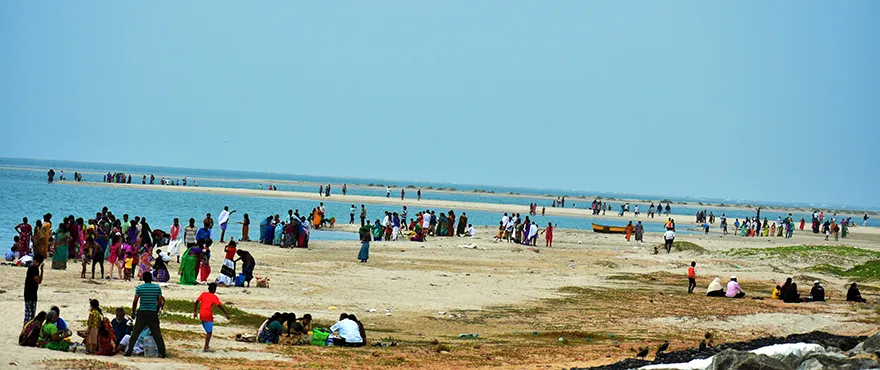
Nevertheless, a peaceful stroll or a bike ride along the beach delivers an unforgettable and exhilarating experience for visitors.
Rama Sethu or Arichal Munai View Point
Arichal Munai marks the exact point where the Indian Ocean meets the Bay of Bengal, and visitors can clearly view this natural confluence at Dhanushkodi.
According to legend, this is the sacred spot where Lord Rama pointed the end of his bow and commanded his army to build a bridge across the sea to Lanka (Sri Lanka) to rescue Goddess Sita. Therefore, this location holds immense mythological importance.
The southernmost end of Rameswaram and the meeting point of the two seas are collectively identified as Arichal Munai or Rama Sethu.
How to Reach Dhanushkodi
To facilitate tourism, the Government of India introduced public transportation services to Dhanushkodi. Visitors can reach the destination using government buses, auto-rickshaws, or private vehicles such as bikes, cars, and vans.
Dhanushkodi is situated approximately 26 kilometres from the Rameswaram bus stand and about 24 kilometres from the railway station. Moreover, Rameswaram connects well with major cities through road and rail networks. For air travel, the nearest airport is located at Madurai, nearly 198 kilometres away.
Epilogue
Ultimately, the haunting beauty of Dhanushkodi leaves a lasting impression on every visitor. The expansive beach, roaring tides, crystal-clear blue waters, and haunting ruins of the once-thriving town together evoke a deep sense of wonder and reflection.
Dhanushkodi – FAQ
Why is Dhanushkodi called a ghost town?
Dhanushkodi is called a ghost town because it was destroyed by a powerful cyclone in 1964. After the disaster, the town was declared unfit for habitation, leaving behind haunting ruins.
Where is Dhanushkodi located?
Dhanushkodi is located at the southeastern tip of Rameswaram Island in Ramanathapuram district, Tamil Nadu, where the Bay of Bengal meets the Indian Ocean.
What are the main attractions in Dhanushkodi?
Key attractions include the abandoned church ruins, old railway station remains, Arichal Munai (land’s end), and the serene beach views.
Is Dhanushkodi connected to the Ramayana?
Yes, according to legend, Lord Rama marked the spot here with his bow (Dhanush) before the construction of Rama Setu to Lanka, giving the town its name.
What is the best time to visit Dhanushkodi?
The best time to visit is from October to March when the weather is pleasant and ideal for sightseeing.