
Mosques in Chennai reflect the city’s rich Islamic heritage and long tradition of religious harmony. As a result, Chennai has remained a welcoming home for diverse communities over centuries. Moreover, Muslim traders and scholars contributed greatly to the city’s cultural identity. Today, mosques stand as places of worship as well as important historical and architectural landmarks.
Historically, many mosques in Chennai date back to the Nawab era and the early days of maritime trade. During this period, Arab merchants and Islamic scholars settled along the Coromandel Coast. Consequently, Islamic traditions and institutions flourished across the region, shaping the city’s spiritual landscape.
Architecturally, these mosques feature elegant domes, tall minarets, and spacious prayer halls. In addition, intricate calligraphy enhances their visual appeal. Together, Indo-Islamic elements and regional styles create a distinctive architectural character rooted in faith and tradition.
Even today, mosques across Chennai function as active spiritual centres. Every day, devotees gather for prayers, while especially on Fridays, congregations draw large numbers of worshippers. Similarly, major Islamic festivals bring communities together in devotion and unity.
Beyond religious practices, mosques in Chennai support education, charity, and social welfare. For instance, many organise community gatherings that strengthen social bonds. During festivals such as Ramzan and Bakrid, mosques become vibrant centres of prayer and celebration.
Overall, the mosques of Chennai offer a meaningful insight into the city’s pluralistic identity. Therefore, visiting these sacred sites helps visitors appreciate Chennai’s cultural depth, architectural beauty, and enduring spirit of coexistence.
Libraries in Chennai represent the city’s long-standing commitment to education, learning, and intellectual growth. Known as a major cultural and educational hub of South India, Chennai has nurtured a strong reading culture for generations. These libraries serve students, researchers, scholars, and book lovers, offering access to knowledge across subjects, languages, and formats.
A Rich Literary Heritage
The libraries in Chennai trace their roots to the colonial era and the early development of modern education in the region. Many of them house rare manuscripts, historical documents, newspapers, and classical literary works. As a result, these libraries play a key role in preserving Tamil literature, regional history, and academic research materials.
Public and Academic Libraries
Chennai is home to a wide range of public and academic libraries. Public libraries provide free or affordable access to books, magazines, and digital resources for readers of all ages. Meanwhile, academic and institutional libraries support higher education and research by offering specialised collections, reference sections, and study spaces. Together, they create an inclusive learning environment for the city.
Modern Facilities and Reading Spaces
In recent years, libraries in Chennai have evolved to meet modern needs. Many now offer digital catalogues, online resources, computer access, and comfortable reading halls. Additionally, quiet study zones and children’s sections make these libraries suitable for diverse user groups. This blend of tradition and technology enhances the overall reading experience.
Importance in Today’s Urban Life
Beyond books, libraries in Chennai act as community spaces that encourage lifelong learning. They host lectures, exhibitions, reading programmes, and cultural events that promote knowledge sharing. Overall, libraries remain essential landmarks in the city’s educational landscape. Exploring libraries in Chennai offers insight into the city’s intellectual heritage while supporting a culture of learning in a fast-changing urban environment.
Shopping malls in Coimbatore have become key lifestyle destinations, offering a modern retail experience alongside leisure and entertainment. Known for its industrial strength and cultural roots, the city has embraced organised shopping spaces that cater to residents, tourists, and business visitors alike. These malls bring together convenience, comfort, and variety under one roof.
Modern Retail Spaces and Brand Choices
Coimbatore’s major malls house a wide range of fashion, lifestyle, electronics, and home décor brands. Visitors can explore both Indian and international labels in well-planned retail environments. Moreover, spacious walkways, air-conditioned interiors, and clear store layouts make shopping relaxed and enjoyable. As a result, these malls suit everyday shopping as well as festive purchases.
Entertainment and Family Attractions
Apart from retail outlets, malls in Coimbatore offer engaging entertainment options. Multiplex cinemas screen the latest regional and international films, while gaming zones and indoor play areas attract children and teenagers. In addition, weekend events and seasonal promotions create a lively atmosphere, making malls popular social spaces for families and friends.
Food Courts and Dining Experiences
Food courts form an essential part of the mall experience in Coimbatore. Visitors can enjoy a mix of South Indian delicacies, fast food, and global cuisines. Cafés and dessert counters also provide comfortable spaces to relax after shopping. This variety ensures that every age group finds something appealing.
A Complete Urban Lifestyle Destination
Overall, shopping malls in Coimbatore reflect the city’s evolving urban lifestyle. They combine shopping, entertainment, and dining in a single destination. Whether spending a casual evening or planning a weekend outing, these malls offer a pleasant and well-rounded experience for visitors of all ages.
Theme parks in Coimbatore offer exciting entertainment options for families, children, and adventure lovers. Known as one of Tamil Nadu’s major industrial and educational hubs, Coimbatore also provides refreshing leisure experiences through its well-developed amusement and theme parks. These attractions combine fun rides, water activities, and relaxing spaces, making them ideal for short getaways and weekend outings.
A Perfect Blend of Fun and Relaxation
Theme parks in Coimbatore are designed to suit visitors of all age groups. From thrilling roller rides to gentle attractions for children, these parks ensure a balanced mix of excitement and comfort. Moreover, many parks feature landscaped gardens, food courts, and shaded seating areas, allowing visitors to relax between rides. As a result, families can enjoy a full day of entertainment in a safe and pleasant environment.
Water Rides and Adventure Attractions
One of the highlights of Coimbatore’s theme parks is the wide range of water-based attractions. Wave pools, water slides, and splash zones provide a refreshing escape from the city’s warm climate. In addition, adventure rides such as giant wheels, spinning rides, and high-speed slides attract thrill seekers. These features make theme parks a popular choice during summer vacations and festive seasons.
Family-Friendly and Child-Centric Spaces
Theme parks in Coimbatore also focus strongly on children’s entertainment. Dedicated play zones, mini rides, and interactive areas keep young visitors engaged and happy. Furthermore, trained staff and safety measures ensure a secure experience for families visiting with kids.
An Ideal Weekend Getaway
Overall, theme parks in Coimbatore add a vibrant recreational dimension to the city’s tourism landscape. They offer the perfect combination of fun, relaxation, and family bonding. Therefore, whether visiting with friends or family, exploring Coimbatore’s theme parks promises joyful memories and an entertaining break from daily routines.
Theme parks in Chennai offer a perfect blend of thrill, relaxation, and family-friendly entertainment. As one of South India’s major metropolitan cities, Chennai has developed several amusement and water parks that attract tourists as well as local visitors. These parks provide a refreshing escape from city life and serve as popular weekend and holiday destinations.
Adventure Rides and Entertainment
Most theme parks in Chennai feature a wide range of dry rides designed for all age groups. High-speed roller coasters, giant wheels, wave swingers, and interactive adventure rides offer excitement for thrill seekers. At the same time, gentle rides and play zones cater to children and senior visitors. Live shows, themed attractions, and entertainment programs further enhance the overall experience.
Water-Based Attractions
Water parks form an important part of Chennai’s theme park culture. These attractions include wave pools, lazy rivers, water slides, and splash zones that provide relief from the city’s warm climate. Visitors can enjoy safe and well-maintained swimming areas under trained supervision, making water-based activities enjoyable for families and groups.
Family-Friendly Experiences
Theme parks in Chennai focus strongly on family entertainment. Spacious dining areas, rest zones, locker facilities, and safety services ensure visitor comfort. Many parks also organize seasonal events, school outings, and group activities, making them ideal destinations for celebrations and gatherings.
Growing Tourism Appeal
With improved infrastructure and accessibility, theme parks continue to play an important role in Chennai’s tourism sector. Their ability to combine adventure, leisure, and convenience makes them appealing to both domestic tourists and residents.
Overall, theme parks in Chennai add vibrancy to the city’s recreational landscape. Whether visitors seek thrilling rides, refreshing water games, or quality time with family, these parks offer memorable experiences and remain an essential part of Chennai’s modern tourism and entertainment scene.
Chennai, the capital city of Tamil Nadu, beautifully balances rapid urban development with rich cultural traditions. Amidst its busy roads and vibrant neighborhoods, the city offers several well-maintained parks that provide a refreshing escape into nature. These green spaces allow residents and visitors to slow down, breathe fresh air, and reconnect with the outdoors.
Nature, Relaxation & Urban Life
Chennai’s parks actively serve as peaceful retreats where greenery, open spaces, and wildlife coexist in harmony. Tall trees, landscaped lawns, and walking paths create an inviting atmosphere for relaxation. As a result, people of all age groups visit these parks daily for morning walks, yoga, jogging, and quiet reflection.
Ideal Spaces for Families & Fitness
Many parks in Chennai cater specifically to families and fitness enthusiasts. Children enjoy dedicated play areas, while elders find shaded benches and calm surroundings for rest. At the same time, fitness lovers use jogging tracks and open grounds for exercise. Therefore, these parks play an important role in promoting a healthy lifestyle within the city.
Wildlife & Scenic Experiences
Some parks also support local biodiversity by hosting birds, butterflies, and small animals. Visitors often spot colorful birds early in the morning, making these parks ideal for nature lovers and photographers. Moreover, seasonal flowers and landscaped gardens add visual charm throughout the year.
Why Visit Parks in Chennai?
Whether you seek a peaceful stroll, quality family time, or a refreshing break from city life, Chennai’s parks offer something for everyone. They strengthen the bond between people and nature while enhancing the city’s livability. Thus, exploring parks in Chennai remains one of the simplest and most rewarding experiences for both locals and tourists.
Navabashanam Temple derives its name from the Tamil words Nava, meaning nine, and Bashanam, meaning stones. This sacred Hindu temple is located in Devipattinam, an ancient coastal town and historic port in Ramanathapuram district of Tamil Nadu. The temple is dedicated to the nine planetary deities, collectively worshipped as the Navagrahas in Hindu tradition.
Earlier, the Sivaganga Devasthanam administered and maintained the temple. However, in 2012, the Hindu Religious and Charitable Endowments Department of the Government of Tamil Nadu assumed control. As a result, the temple now benefits from systematic management and regular upkeep.
Location of the Navagraha Temple
The Navagraha Temple stands uniquely within the waters of the Bay of Bengal. Therefore, it is considered one of the most distinctive pilgrimage centres in Tamil Nadu. The Navagraha deities appear in a matrix-like formation. They are represented by nine sacred stones placed in shallow sea waters.
An entrance arch on the shoreline welcomes devotees. From there, a pathway measuring about 100 yards (91 metres) leads toward the sanctum. In addition, four stepped pathways descend into the sea from the four cardinal directions. These steps provide easier access to the sacred stones.
Depending on tide levels, visitors can clearly view the nine stones symbolising the planetary deities. During low tide, access becomes even more convenient.
Legend and History of Navabashanam Temple
According to popular legend, Lord Rama, an incarnation of Lord Vishnu, worshipped the Navagrahas here. He performed this worship before beginning his expedition to Lanka to rescue Goddess Sita from Ravana.
It is believed that Lord Rama fashioned the Navagraha idols using sacred clay. He then installed them at this very site. Consequently, Navabashanam gained immense spiritual importance. Devotees regard it as a sacred place where divine planetary worship began under Lord Rama’s guidance.
Timings and Festivals of Navagraha Temple
The Navagraha Temple remains open daily from 4:30 AM to 6:30 PM. Throughout the year, several important festivals draw large crowds.
The major festivals include Aadi Amavasai and Aadi Pournami during July–August. In addition, Thai Amavasai in January–February attracts thousands of pilgrims. During these auspicious days, devotees gather in large numbers. They offer prayers, perform rituals, and seek relief from planetary doshas.
How to reach Devipattinam Navabashanam
Navabashanam is located in Devipattinam. It lies about 66 kilometres along the East Coast Road. Moreover, it is just 14 kilometres from the district headquarters of Ramanathapuram.
Ramanathapuram connects well by road and rail to major cities across Tamil Nadu. Therefore, reaching the temple is convenient for pilgrims.
The nearest airport is Madurai Airport, located around 120 kilometres away. Alternatively, Tuticorin Airport is about 125 kilometres from Ramanathapuram.
Navagraha Temple at Devipattinam – FAQ
What is special about the Navagraha Temple at Devipattinam?
The Navagraha Temple at Devipattinam is unique because the nine planetary deities (Navagrahas) are represented by stone pillars installed in the sea, known as Navapashanam.
What is the historical significance of this temple?
According to legend, Lord Rama installed the Navagrahas here and performed prayers before proceeding to Lanka, linking the site to the Ramayana.
Where is the Navagraha Temple located?
The temple is located in Devipattinam in Ramanathapuram district, Tamil Nadu, along the Bay of Bengal coast.
What rituals are performed at Devipattinam Navagraha Temple?
Devotees perform Navagraha dosha parihara poojas, offering prayers while standing in the shallow sea waters around the stone pillars.
What is the best time to visit Devipattinam?
The ideal time to visit is from October to March when the weather is pleasant and suitable for pilgrimage and coastal travel.
Nearby Attractions to Navabashanam Temple
Devipattinam, a serene coastal town, is a popular pilgrimage destination with the Navabashanam Temple as its centerpiece. Beyond the temple, visitors can explore nearby attractions like the sacred Ramanathaswamy Temple in Rameswaram, the historic Dhanushkodi, and the scenic Pamban Bridge. Other notable sites include the Dr. APJ Abdul Kalam Memorial and the holy Agniteertham. These attractions offer a unique blend of spirituality, history, and natural beauty, making Devipattinam a worthwhile destination for travelers seeking a meaningful experience.
One of the most popular tourist attractions in the temple town of Rameswaram is the memorial dedicated to India’s renowned scientist, visionary leader, and former President, Dr. APJ Abdul Kalam. The memorial honours his life, ideals, and invaluable contributions to the nation.
The Dr. APJ Abdul Kalam National Memorial was inaugurated by the Prime Minister of India, Mr. Narendra Modi, on 27th July 2017. Since then, the memorial has consistently attracted visitors from across the country. The APJ Abdul Kalam Memorial spreads across 2.11 acres and stands on the very site where Dr. Kalam’s mortal remains were laid to rest on 27th July 2015. With an investment of Rs. 20 crore, authorities completed the construction within a remarkably short span of just nine months.
More about the Dr. APJ Abdul Kalam Memorial
- An Initiative of DRDO: The Defence Research and Development Organisation (DRDO), with which Dr. Kalam remained closely associated for several years, took the initiative to construct this memorial as a tribute to his service to the nation.
- Symbol of National Integration: The memorial strongly reflects India’s unity in diversity, a value Dr. Kalam deeply admired. Notably, the entrance resembles India Gate, while its doorway mirrors the entrance of the Brihadeeswara Temple in Thanjavur. Additionally, the main dome draws inspiration from the Rashtrapati Bhavan. Together, these elements create a harmonious blend of Mughal and Indian architectural styles. Materials, plants, and flowers were sourced from various parts of the country, further symbolising national unity.
- The Memorial’s Inside: The interior of the memorial actively reflects the teachings, vision, and beliefs of Dr. Kalam. It features four exhibition halls, each highlighting a distinct phase of his life. Moreover, exhibits on the Pokhran nuclear tests, along with replicas of rockets and missiles, celebrate his outstanding contributions to space science and national defence.
- Statue of the Missile Man of India: Another major attraction is the life-size statue of Dr. Kalam, inaugurated in 2016. This statue, placed at the centre of the memorial, portrays him playing the veena. In addition, two silicon statues depict Dr. Kalam in his presidential attire, shown in both sitting and standing postures.
- The Garden: The garden surrounding the memorial resembles traditional Mughal-style landscaping. Designers carefully selected plants and flowers from different states, keeping Dr. Kalam’s preferences in mind. Furthermore, a model of the Agni missile stands at the rear of the memorial, reinforcing his legacy as a pioneering scientist.
Opening Time:
The Memorial is open in the morning from 9:00 AM to 1:00 PM and from 2:00 PM to 5:00 PM.
How to reach Dr. APJ Abdul Kalam Memorial
The memorial is less than 3.5-kilometers distance from Rameswaram Bus stand. Rameswaram is well connected by road and rail with Chennai, Madurai, Coimbatore, Trichy and other important cities. The nearest airport is at Madurai, 163 kilometres from Rameswaram.
Dr. APJ Abdul Kalam Memorial – FAQ
Where is Dr. APJ Abdul Kalam Memorial located?
Dr. APJ Abdul Kalam Memorial is located in Pei Karumbu near Rameswaram in Ramanathapuram district, Tamil Nadu.
Why is the Dr. APJ Abdul Kalam Memorial important?
The memorial honors India’s former President Dr. A.P.J. Abdul Kalam, known as the “Missile Man of India,” celebrating his contributions to space research, defense technology, and education.
What can visitors see at the memorial?
Visitors can explore galleries showcasing Dr. Kalam’s photographs, personal belongings, awards, books, and models of missiles and rockets related to his scientific achievements.
What are the visiting hours of Dr. APJ Abdul Kalam Memorial?
The memorial is generally open daily from 8:00 AM to 7:00 PM, though timings may vary on public holidays.
Is there an entry fee to visit the memorial?
No, entry to Dr. APJ Abdul Kalam Memorial is free for visitors.
Nearby Tourist Attractions:
- Pamban Bridge
- Kunthukal Beach – Rameswaram
- Ramanathaswamy Temple, Rameswaram
- Agni Theertham Beach
- Dhanushkodi
Overview
Dhanushkodi lies at the southern tip of Rameswaram, bordered by the Bay of Bengal on one side and the Indian Ocean on the other. As a result of this unique location, the town offers dramatic coastal views. The name Dhanushkodi literally translates to “the tip of the bow,” symbolizing its mythological and geographical significance.
The Devastating Cyclone of 1964
Until December 22, 1964, Dhanushkodi functioned as a bustling and densely populated town. However, a catastrophic cyclonic storm completely washed away the settlement, leaving it in ruins.
Today, visitors can still witness the shattered remnants of the Church, Railway Station, and Passport Office, which stand as silent reminders of the tragedy. At present, only around 500 people live in Dhanushkodi, primarily fishermen and their families who have resettled in the area.
Popular Attractions in Dhanushkodi
Dhanushkodi Beach
The Dhanushkodi Beach stretches for nearly 15 kilometres, offering vast and uninterrupted coastal scenery. However, the shoreline frequently experiences high tides and strong currents, making swimming unsafe for non-swimmers.
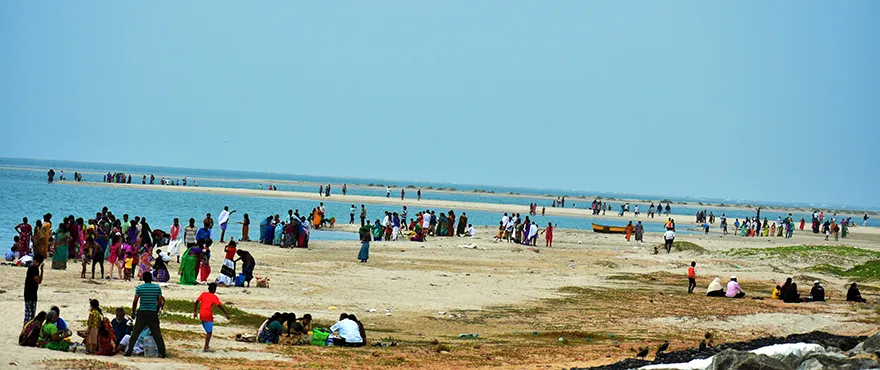
Nevertheless, a peaceful stroll or a bike ride along the beach delivers an unforgettable and exhilarating experience for visitors.
Rama Sethu or Arichal Munai View Point
Arichal Munai marks the exact point where the Indian Ocean meets the Bay of Bengal, and visitors can clearly view this natural confluence at Dhanushkodi.
According to legend, this is the sacred spot where Lord Rama pointed the end of his bow and commanded his army to build a bridge across the sea to Lanka (Sri Lanka) to rescue Goddess Sita. Therefore, this location holds immense mythological importance.
The southernmost end of Rameswaram and the meeting point of the two seas are collectively identified as Arichal Munai or Rama Sethu.
How to Reach Dhanushkodi
To facilitate tourism, the Government of India introduced public transportation services to Dhanushkodi. Visitors can reach the destination using government buses, auto-rickshaws, or private vehicles such as bikes, cars, and vans.
Dhanushkodi is situated approximately 26 kilometres from the Rameswaram bus stand and about 24 kilometres from the railway station. Moreover, Rameswaram connects well with major cities through road and rail networks. For air travel, the nearest airport is located at Madurai, nearly 198 kilometres away.
Epilogue
Ultimately, the haunting beauty of Dhanushkodi leaves a lasting impression on every visitor. The expansive beach, roaring tides, crystal-clear blue waters, and haunting ruins of the once-thriving town together evoke a deep sense of wonder and reflection.
Dhanushkodi – FAQ
Why is Dhanushkodi called a ghost town?
Dhanushkodi is called a ghost town because it was destroyed by a powerful cyclone in 1964. After the disaster, the town was declared unfit for habitation, leaving behind haunting ruins.
Where is Dhanushkodi located?
Dhanushkodi is located at the southeastern tip of Rameswaram Island in Ramanathapuram district, Tamil Nadu, where the Bay of Bengal meets the Indian Ocean.
What are the main attractions in Dhanushkodi?
Key attractions include the abandoned church ruins, old railway station remains, Arichal Munai (land’s end), and the serene beach views.
Is Dhanushkodi connected to the Ramayana?
Yes, according to legend, Lord Rama marked the spot here with his bow (Dhanush) before the construction of Rama Setu to Lanka, giving the town its name.
What is the best time to visit Dhanushkodi?
The best time to visit is from October to March when the weather is pleasant and ideal for sightseeing.
Tourist Attractions near Dhanushkodi:
- Ramanathaswamy Temple, Rameswaram
- Agni Theertham Beach
- APJ Abdul Kalam Memorial – Rameswaram
- Kunthukal Beach
- Pamban Bridge
Pamban Bridge: India’s First Sea Bridge – History, Facts & Travel Guide
The Pamban Bridge stands proudly as India’s first sea bridge and showcases an exceptional engineering achievement. The bridge directly connects the holy town of Rameswaram on Pamban Island with mainland India. Stretching nearly 2 kilometres across the sea and supported by 143 sturdy piers, the Pamban Bridge holds the distinction of being the second-longest sea bridge in India, next only to the Bandra–Worli Sea Link in Mumbai. Situated in Rameswaram, which lies at the southeastern tip of India, this century-old bridge serves as the lifeline that links the island town to the mainland, making it historically, culturally, and strategically significant.
Unique Design and Engineering Excellence of Pamban Bridge
Engineers designed the Pamban Bridge as India’s first cantilever bridge, making it truly unique. Most notably, they constructed a double-leaf bascule section over a century ago to ensure uninterrupted ferry movement. When the bridge opens, it splits into two sections, allowing ships and ferries to pass smoothly through the Palk Strait between Rameswaram and Pamban Island. This opening mechanism creates a breathtaking sight for visitors. Moreover, the bridge consists of over 140 spans, with the famous 114th span known as the Scherzer span. Altogether, the bridge measures 2.057 kilometres in length and includes 145 steel girder spans of 12.20 metres each, along with a 225-metre Scherzer rolling lift navigational span.
Construction History
Construction of the Pamban railway bridge began in 1911, and authorities commissioned it on February 24, 1914. German engineer Scherzer designed the central opening span, which allows ships and ferries to move freely beneath the bridge. On average, 10 to 15 boats and small vessels pass under the bridge every month. Although the devastating cyclone of 1964 destroyed the nearby port town of Dhanushkodi, the rolling lift center span of the bridge remained undamaged. Engineers and workers used nearly 4,000 tonnes of cement and the efforts of around 600 workers to complete this monumental structure.
Maintenance and Safety Measures
After the tragic train accident caused by the 1964 cyclone, Indian Railways strengthened safety measures on the Pamban Bridge. Authorities installed wind velocity monitoring devices to continuously assess wind conditions across the bridge. Whenever wind speeds exceed 58 kmph, officials immediately halt train services to ensure passenger safety. In addition, Indian Railways converted the bridge’s railway line from metre gauge to broad gauge in 2007, significantly improving rail connectivity to Rameswaram.
Pamban Road Bridge – A Scenic Parallel Wonder
Alongside the railway bridge, the Annai Indira Gandhi Road Bridge connects Rameswaram with the mainland. Authorities opened this road bridge in 1988, and it runs parallel to the railway bridge. Measuring about 2.3 kilometres in length, the bridge offers spectacular views of the sea, fishing boats, and the iconic railway bridge below. Driving across this bridge delivers a thrilling experience, especially during sunrise and sunset when golden light reflects on the water. As a result, photographers and tourists frequently stop here to admire the scenery. Additionally, this bridge provides the perfect vantage point to watch trains glide across the sea.
The New Pamban Bridge: India’s First Vertical Sea Bridge
To meet modern transportation demands, authorities began constructing the New Pamban Bridge in February 2020. This advanced structure spans 2,070 metres and introduces India’s first vertical lift sea-bridge technology, which allows sections of the bridge to rise vertically for maritime traffic. Engineers designed the bridge to support double railway tracks and future electrification. Standing 3 metres higher than the old bridge, the new structure significantly improves safety and capacity. By September 2024, authorities completed construction and successfully conducted trial runs in October 2024. The bridge is scheduled to open for traffic on April 6, 2025, marking a major milestone in India’s infrastructure journey.
How to Reach Pamban Bridge
Pamban Bridge lies approximately 14.8 kilometres from Rameswaram. Travelers can easily reach the bridge using public or private transport from Ramanathapuram and Rameswaram. Rameswaram also has its own railway station, which ensures convenient rail access. For air travel, visitors can use Madurai Airport, located about 120 kilometres away, or Thoothukudi Airport, which lies around 145 kilometres from Ramanathapuram.
Epilogue
Pamban Bridge ranks among the most iconic attractions in Tamil Nadu. A journey across this magnificent bridge offers an unforgettable experience, complete with sweeping views of the sea, Rameswaram Island, Kunthukal Vivekananda Memorial, and nearby islands. Visitors can also relax and spend quality family time at the Children’s Park located on the Mandapam shore at the far end of the bridge. Whether you love history, engineering, or scenic travel, Pamban Bridge delivers a truly memorable experience.
Pamban Bridge – FAQ
What is Pamban Bridge famous for?
Pamban Bridge is famous as India’s first sea bridge, connecting Rameswaram Island to mainland Tamil Nadu. It is known for its engineering design and scenic ocean views.
When was Pamban Bridge built?
The railway bridge was opened in 1914, making it over 110 years old and one of the oldest functioning sea bridges in India.
What is special about the structure of Pamban Bridge?
The bridge features a double-leaf bascule (Scherzer rolling lift) section that can be raised to allow ships to pass through the Palk Strait.
How long is Pamban Bridge?
Pamban Railway Bridge stretches approximately 2.06 kilometers across the sea, linking Mandapam to Rameswaram.
Is there a road bridge near Pamban Bridge?
Yes, alongside the railway bridge, the Annai Indira Gandhi Road Bridge provides road connectivity and offers panoramic views of the Bay of Bengal.