
The Brihadeeswarar Temple, located in Thanjavur, Tamil Nadu, stands as a magnificent tribute to Lord Shiva. Recognized as a UNESCO World Heritage Site, the temple forms part of the celebrated “Great Living Chola Temples.” Popularly known as the Big Temple, it showcases the extraordinary architectural brilliance of the Chola era. Situated nearly 350 kilometres southwest of Chennai, the temple lies just about one kilometre from the old bus stand in Thanjavur, making it easily accessible for visitors. As a result, it remains one of the most visited heritage monuments in Tamil Nadu.
History of Brihadeeswarar Temple
King Raja Raja Chola I commissioned the Brihadeeswarar Temple, also known as Rajarajesvaram or Peruvudaiyar Koyil, during the 11th century. At that time, Thanjavur served as a prominent Chola capital, which the rulers transformed from a cluster of villages into a grand temple city. Builders completed the temple in 1010 AD and named it Rajarajesvaram in honor of its patron. However, following the later invasions by the Nayakas and Marathas, the temple came to be known as Brihadeeswarar Temple. The name “Brihadeeswara” originates from the Sanskrit words Brihat, meaning “great” or “lofty,” and Ishvara, meaning “Lord Shiva.” Together, the name signifies “The Great Lord Shiva,” perfectly reflecting the temple’s scale and spiritual grandeur.
Architectural Excellence of Brihadeeswarar Temple
A true architectural masterpiece, the Brihadeeswarar Temple displays advanced engineering techniques far ahead of its time. Although many Chola palaces have vanished over the centuries, this temple has stood strong for more than a thousand years, proving the unmatched craftsmanship of the Chola dynasty. One of the most remarkable features of the temple is its towering Vimana (Shikhara), which does not cast a shadow at noon. Moreover, the temple holds the distinction of being the world’s first complete granite structure, adorned with intricately carved details.
Interestingly, builders transported the massive granite blocks from distant locations, as no granite quarries exist near the temple. This achievement further highlights the advanced planning and execution of Chola engineers.
Structures In and Around the Temple
The temple complex follows a rectangular layout and stands on a raised man-made platform. It is bordered by a water-filled moat on two sides and the Grand Anaicut canal on the remaining side.
Visitors can enter the temple through two gateways. The primary entrance features a majestic five-storey gopuram, while a smaller free-standing gopuram provides direct access to the inner complex. Both gateways face east, aligning with traditional temple design principles.
The outer gateway, known as the Keralantakan Tiruvasal, bears the title of Raja Raja Chola. Beyond it lies the Rajarajan Tiruvasal, which opens into a vast courtyard housing the main shrine and surrounding structures.
Within the courtyard, the towering Vimana dominates the skyline, while several axially aligned sub-shrines surround the main temple. Additionally, a large pillared Pradakshina veranda encircles the courtyard, allowing devotees to perform circumambulation.
Main Components of the Temple Complex
The temple complex, measuring approximately 240 metres by 122 metres, consists of five major architectural sections.
- Sri Vimana – Rising to a height of 66 metres, the Vimana ranks among the tallest temple towers in the world. An octagonal capstone weighing nearly 81 tonnes crowns the structure, earning it the title “Dakshina Meru,” or the Southern Mount Meru.
- Nandi Mandapam – At the entrance stands a massive monolithic statue of Nandi, the sacred bull and vehicle of Lord Shiva. Measuring about 13 feet high and 16 feet long, this Nayaka-period sculpture faces the sanctum and rests within a richly pillared hall.
- Mukhamandapam – Positioned between the Nandi Mandapam and the sanctum, this hall once hosted musicians and dancers who performed rituals in service of Lord Shiva. Two impressive Dwarapalakas guard its entrance.
- Mahamandapam – The great assembly hall features six sculpted pillars on each side and massive stone Dwarapalakas. Steps connect this hall to the Mukhamandapam.
- Ardhamandapam – This structure serves as the transitional space linking the Mahamandapam with the sanctum.
Garba Griha (Sanctum Sanctorum)
At the heart of the courtyard lies the Garba Griha, also known as the Periya Kovil. It enshrines Lord Shiva in the form of a colossal stone Linga measuring about 29 feet in height, making it one of the largest monolithic Lingas in India.
Other Deities and Sculptures
The outer walls of the sanctum feature Koshtha Moorthigal, including Dakshinamurthy, Surya, Chandra, Agni, Yama, Varuna, Vayu, Kubera, Isana, and the Ashta Dikpalakas.
The ground-floor walls display exquisite sculptures arranged by direction.
- East Wall – Lingodbhava, Pashupata Murti, and two Dwarapalakas.
- South Wall – Ganesha, Vishnu with Sridevi and Bhudevi, Lakshmi, Bhikshatana, Virabhadra, Dakshinamurti, Kalantaka, Nataraja, and Dwarapalakas.
- West Wall – Harihara, Lingodbhava, Chandrashekhara with and without Prabhavali, and Dwarapalakas.
- North Wall – Ardhanarishvara, Gangadhara, Pashupata Murti, Shiva-Alingana Murti, Saraswati, Mahishasuramardini, Bhairava, and Dwarapalakas.
On the second floor, artisans depicted Lord Shiva in his Tripurantaka form, while above it rises the monumental granite Vimana.
Brihadeeswarar Temple Attractions
- The temple walls display stunning paintings from the Chola and Nayaka periods.
- Builders used more than 130,000 tonnes of granite to construct the temple.
- Ancient inscriptions in Tamil and Grantha scripts describe rituals, donations, temple administration, and the artisans involved.
- The carvings and murals portray themes from art, mythology, science, and culture of the Chola era.
- The temple appears in contemporary literary works such as Muvar Ula and Kalingathuparani.
- The Archaeological Survey of India maintains the temple as a protected heritage monument.
- Every year, the temple hosts a grand dance festival lasting over ten days during Mahashivaratri in February.
Temple Timings of Brihadeeswarar Temple
It’s very common to see devotees throng the temple in queues as early as 5:00 AM. Sundays are extremely crowded. Timing are as follows
- 5:30 AM to 12:00 PM and
- 4:00 PM to 9:00 PM
Brihadeeswarar Temple Pooja Timings
| Morning Pooja/Kala Sandhi | 8:30 AM |
| Mid Noon Pooja/Utchi Kalam | 12:00 Noon |
| Evening Pooja/Sayaratchai | 5:30 PM |
| Night Pooja/Artha Jamam | 8:30 PM |
Brihadeeswarar Temple Festivals
The major festivals observed in the temple are:
- Chitirai Brahotsavam, 18 days festival during the Tamil month of Chitirai (April-May)
- Shivarathri, in the Tamil month of Maasi (February)
- Navarathri, 9 days festival during the Tamil month of Purattasi (September-October)
- Aaruthra Darshanam, in the Tamil month of Marghali (December-January)
- Pradosham, once in every fortnight
- Girivalam, every full moon day (Pournami)
- Special Pooja during the days of Thiruvadhirai, Aadi pooram and Karthigai
- Sathabisha star day every month, which is said to be the birth star of King Rajaraja
Accommodation
Thanjavur is known to be one of the most popular religious and cultural hub in Tamil Nadu. The place offers accommodation facilities that suits every budget and preferences.
How to reach Brihadeeswarar Temple
Thanjavur can be easily accessible by road from nearby cities. Frequent government and private buses take you to Thanjavur throughout the day. Thanjavur is the nearest rail head and Trichy Airport (65 kilometres) is the nearest airport.
Epilogue
Being a very popular tourist location, the temple is swarmed by tourists throughout the year. Uncover the grandeur of this temple along with the various legends associated with it. The place is a virtual treat for lovers of photography to soak in the divinity preferably in the morning and evening. A perfect blend of religious atmosphere and sheer architectural splendor, Brihadeeswara temple is indeed a sight to behold.
Brihadeeswarar Temple, Thanjavur – FAQ
Where is Brihadeeswarar Temple located?
Brihadeeswarar Temple is located in Thanjavur city, Tamil Nadu, and is one of the most iconic temples in South India.
Who built Brihadeeswarar Temple?
The temple was built in 1010 CE by the great Chola emperor Raja Raja Chola I as a symbol of Chola architectural excellence.
Why is Brihadeeswarar Temple famous?
The temple is famous for its massive 66-meter-high vimana (tower), monolithic Nandi statue, intricate frescoes, and its UNESCO World Heritage status under the Great Living Chola Temples.
Is Brihadeeswarar Temple a UNESCO World Heritage Site?
Yes, it is recognized as part of the UNESCO-listed Great Living Chola Temples, highlighting its historical and architectural significance.
What is the best time to visit Brihadeeswarar Temple?
The best time to visit is from October to March when the weather is pleasant for sightseeing in Thanjavur.
Tourist Attractions near Thanjavur
The Sangameswarar Temple, located in Bhavani town of the Erode District in Tamil Nadu, is a revered temple dedicated to Lord Shiva. Popularly known as Thirunana and Thirukooduthurai, the temple lies about 16 kilometres from Erode. Here, the Moolavar (main deity) is Lord Sangameswarar, while Goddess Vedha Nayagi is worshipped as the consort deity.
History & Legend of the Temple
The Bhavani Sangameswarar Temple traces its origins to ancient times and was built by the first Pallava king, Mahendra Verman. According to legend, during the British rule, William Karo, who served as the Collector of Coimbatore District, once visited Bhavani. One night, while he was asleep, a young girl woke him and led him out of the bungalow where he stayed. Immediately after he stepped outside, the bungalow collapsed.
Later, the temple priest informed him that Goddess Bhavani Vedanayagi Amman had saved his life. From that moment, William Karo became a devoted follower of the Goddess. Even today, the three holes he created in the temple wall to pray to the Goddess remain visible. Another legend states that Lord Shiva himself guided Kubera, the Lord of Wealth, to discover a Shivalingam beneath an Illandai tree at this sacred site.
Prominent Features of the Temple
About the Place
Bhavani holds great significance as a renowned Parihara Sthalam—a sacred place believed to absolve sins. The Sangameswarar Temple stands at the Sangamam (confluence) of three rivers: the Kaveri, Bhavani, and the mystical Amutha river that flows underground. Because of this unique confluence, devotees call the place the Dakshina Triveni Sangamam or the “Triveni Sangamam of the South.” The name Kooduthurai also reflects this sacred union of rivers.
Prominence of the Temple
The temple is one of the 276 Devara Paadal Petra Shiva Sthalams and holds the distinction of being the third such Sthalam in Kongu Nadu. Moreover, the Shiva Lingam worshipped here is a Swayambumurthi, meaning it manifested naturally without human installation.
A Place in Literature
The temple finds an important place in Tamil Shaiva literature. Saint Sambandar composed a Thevaram Pathigam here, praising Lord Shiva through ten hymns that form part of the Second Thirumurai.
Architecture of Sangameswarar Temple
The Sangameswarar Temple showcases unique architectural beauty with exquisite stone carvings. Built across a 4-acre area, the temple features a majestic five-tier gopuram positioned on the northern side, enhancing its visual grandeur.
Deities in the Temple
The presiding deity, Lord Sangameswarar, resides along with his consort Vedanayagi. At the entrance, devotees find the shrine of Kottai Vinayagar (Lord Ganesha) on the left and Kottai Anjaneyar (Lord Hanuman) on the right. The main tower houses the shrines of Raja Ganapathi and Lord Muthukumaraswamy (Lord Murugan).
Furthermore, the temple corridors feature shrines dedicated to Lord Vinayakar, Lord Murugan with his consorts, Goddess Gajalakshmi, the 63 Nayanmars, Jurahareshwarar in dancing posture, the Pancha Bhootha Lingams, Kasi Viswanathar, Goddess Visalakshi, Amirthalingam, and Jeshtadevi. Separate shrines also exist for Lord Adhikesava Perumal, Goddess Soundaranayaki, and Yoga Narasimhar.
Temple Timings – Sangameswarar Temple
The temple remains open daily from 5:00 AM to 1:00 PM and again from 4:00 PM to 9:00 PM.
Pooja Timings & Details
The temple follows a well-structured daily pooja schedule as listed below:
| Name of the Pooja | Timing |
|---|---|
| Thiruppallielichi | 5:00 AM |
| Kalasandhi | 8:00 AM |
| Uchikalam | 12:00 PM |
| Idaikalam | 4:00 PM |
| Saaya Rakshai | 5:15 PM |
| Pillairai (Artha Jama Pooja) | 8:30 PM |
Sangameswarar Temple Festivals
The temple celebrates several major festivals that attract large numbers of devotees throughout the year.
- The grand Car Festival (Ther), celebrated for 13 days during the Tamil month of Chithirai (April–May).
- Aadiperukku, observed on the 18th day of the Tamil month of Aadi (July–August).
- Important observances such as Pradosham Pooja, Amavasya (new moon days), Shiva Rathri, and Vaikunta Ekadasi.
How to reach Sangameswarar Temple
Bhavani, located at 15 kilometres from Erode, 30 kilometres from Gobichettipalayam, 56 kilometres from Salem, is well connected to all major cities. Erode is the nearest Railway hub and Coimbatore International Airport at a distance of around 96 kilometres is the nearest Airport.
Accommodation
Good number of lodges and cottages at affordable rates are available at Bhavani.
Bhavani Sangameswarar Temple, Erode – FAQ
Where is Bhavani Sangameswarar Temple located?
Bhavani Sangameswarar Temple is located in Bhavani town in Erode district, Tamil Nadu, at the confluence of the rivers Cauvery, Bhavani, and the mythical Amudha River.
Why is the temple called Sangameswarar Temple?
The temple is called Sangameswarar because it is situated at the sacred “Sangam” (confluence) of rivers, making it an important pilgrimage site for devotees.
Who are the presiding deities of the temple?
Lord Shiva is worshipped as Sangameswarar, and Goddess Parvati is worshipped as Vedanayaki Amman.
What is the spiritual significance of Bhavani Kooduthurai?
Bhavani Kooduthurai is considered highly sacred, and taking a holy dip at the confluence is believed to cleanse sins and bring spiritual blessings.
What is the best time to visit Bhavani Sangameswarar Temple?
The best time to visit is from October to March when the weather is pleasant, especially during Maha Shivaratri and temple festivals.
Tourist Attractions near Erode
Thindal Sri Velayudha Swamy Temple in Erode
Thindal Murugan Temple, popularly known as Arulmigu Velayutha Swamy Thirukovil, stands as one of the most revered places of worship in Erode, Tamil Nadu. Lord Murugan presides as the primary deity of this sacred shrine. The temple rises gracefully atop a small hillock known as Thindal Malai and lies about 8 kilometres from the Erode bus stand along the Perundurai road.
History of Thindalmalai Murugan Temple
Historically, Thindal formed one of the 24 regions of ancient Kongunadu. During that period, the Chera Kings ruled Kongunadu and divided it into smaller regions for administrative convenience. The Thindalmalai Murugan Temple reflects classic Dravidian architectural style and holds immense religious significance.
Among the 108 Murugan temples praised in the sacred Tirupugazh hymns of Sage Arunagiriar, Thindalmalai Murugan Temple occupies a prominent place. According to temple history, the region of Poondurai in Erode once suffered from severe drought. In response, farmers fervently prayed to Idumban, seeking the blessings of Lord Murugan. Following their prayers, rainfall revived the land and restored fertility. Even today, devotees continue the traditional ritual of seeking Idumban’s grace for prosperity and fertility.
Unique Features of Thindalmalai Murugan Temple
- The temple houses a magnificent golden temple chariot, which devotees use during ceremonial processions carrying the divine images.
- The temple complex consists of two distinct sections. The area above the hill rock is called Maelthindal or Thindalmedu, while the eastern side of the hill rock is known as Keel Thindal.
- The temple regularly conducts various pujas to fulfill devotees’ wishes, including prayers for marriage, progeny, and prosperity.
- Panguni Uthiram stands as the most important annual festival, attracting thousands of pilgrims from across southern India.
- The Deepa Sthamba (lamp post) enhances the temple’s beauty with its distinctive Kongu region design and intricate religious sculptures.
- A grand arch welcomes devotees at the entrance from the national highway, adorned with artistic paintings depicting various Hindu deities.
Other Deities and Sacred Locations in the Temple
- Arasamarathu Vinayagar – As per tradition, Lord Ganesha appears as the first deity within the temple premises. Built about 40 years ago, this shrine houses Arasamarathu Vinayagar beneath a sacred peepal tree (Arasamaram in Tamil) and is surrounded by Snake God idols (Naagar).
- Siddhi Vinayagar – The Siddhi Vinayagar shrine stands between two Naagar idols. From this mandap, devotees can view the idol of Velayudhaswamy. From here, a flight of 150 steps begins, leading uphill to the main shrine at a height of 60 metres.
- Idumban Sannadhi – Located a few steps from the entrance, the Idumban Sannadhi honors Idumban, also known as Idumbakkumaran or Idunbasan.
- Sri Velayuthaswamy Shrine – The main shrine sits atop the hill. To the left of the principal deity, devotees can see the Uchava Moorthy, where Lord Murugan appears with Valli and Deivanai.
- Thannasi Cave – Situated on the northwestern side of the temple, Thannasi Siddhar Cave hosts special poojas during the Karthigai festival.
- Upon reaching the Sanctum Sanctorum, devotees experience the divine presence of Lord Murugan holding his sacred ‘Vel’ and seek his blessings.
- Theertha Sunai – A sacred sweet-water spring flows on the northeastern side of the hill. Priests use this holy water for abhishekam, and devotees drink it as prasadam.
Festivals Celebrated at Thindalmalai Murugan Temple
The temple celebrates several festivals with great devotion and grandeur. Major festivals include Kandha Shasti, Thirukarthigai, Thai Poosam, and Panguni Uthiram, which draw large gatherings of pilgrims. Other notable celebrations include Chitra Pournami, Vaikasi Festival, Aadi Perukku, Aadi Karthigai, Markazhi Pooja, and additional Kandha Shasti observances.
Temple Timings – Thindalmalai Murugan Temple
The temple performs pujas three times a day at the following timings:
- Morning – 7:00 AM
- Noon – 12:00 PM
- Evening – 6:00 PM
On regular days, the temple remains open from 6:30 AM to 12:30 PM and from 4:00 PM to 8:30 PM. On festival days, devotees can visit the temple from 6:00 AM to 9:00 PM.
The temple serves Annadhanam daily at 12:30 PM for devotees. Additionally, the Golden Chariot procession, known as ‘Thangaratham Ulla’, takes place every evening at 7:00 PM. Devotees can sponsor this procession by paying a fee of Rs. 1500.
How to reach Thindalmalai Murugan Temple
The temple is located at a distance of 8 kilometres from Erode junction. It is easily accessible by road from Erode and Trichy. Nearest bus terminal is at Thindal and nearest railway station is Erode Junction. Coimbatore International Airport is the nearest airport.
Thindal Murugan Temple, Erode – FAQ
Where is Thindal Murugan Temple located?
Thindal Murugan Temple is located in Thindal near Erode city, Tamil Nadu, along the Erode–Perundurai road.
Why is Thindal Murugan Temple famous?
The temple is famous for Lord Murugan worshipped on a small hillock, offering a peaceful atmosphere and panoramic views of the surrounding area.
How can devotees reach the temple?
Devotees can reach the hilltop temple by climbing steps or via a motorable road that leads close to the shrine.
What are the major festivals celebrated at the temple?
Important festivals include Thaipusam, Panguni Uthiram, Skanda Sashti, and Karthigai Deepam, drawing large numbers of devotees.
What is the best time to visit Thindal Murugan Temple?
The best time to visit is from October to March when the weather is pleasant for hill temple visits and sightseeing.
Tourist Attractions near Erode
Sathuragiri Hills
Sathuragiri Hills lie about 15 kilometres from Watrap or Vathirayiruppu village near Srivilliputhur. Nestled amid majestic mountains, the Sathuragiri Shiva Temple is widely revered as the abode of Lord Shiva and innumerable saints who are believed to continue worshipping him even today.
The name “Sathuragiri” originates from the Sanskrit words “Chattur,” meaning four, and “Giri,” meaning hills. Therefore, the hills symbolically represent the place where all four Vedas unite as one. Alternatively, some believe the hills derive their name from their square (Chathuram) shape.
History of Sathuragiri Hills
According to legend, Lord Shiva once arrived at the temple disguised as a devotee and engaged the priest in conversation. When the priest explained that the temple was ancient and belonged to its landlord, Lord Shiva calmly claimed ownership of both the temple and the surrounding land.
To prove his claim, Lord Shiva asked the priest to take as much land as needed. After a moment’s thought, the priest replied, “Let a conch be blown, and the area reached by its sound shall belong to the temple.” Consequently, the land covered by the sound of the conch became temple property. Today, the hill houses three main temples – Sri Sundara Mahalinga Swamy Temple, Sri Santhana Mahalinga Swamy Temple, and Anandavalli Amma Temple.
Sathuragiri Trekking Journey
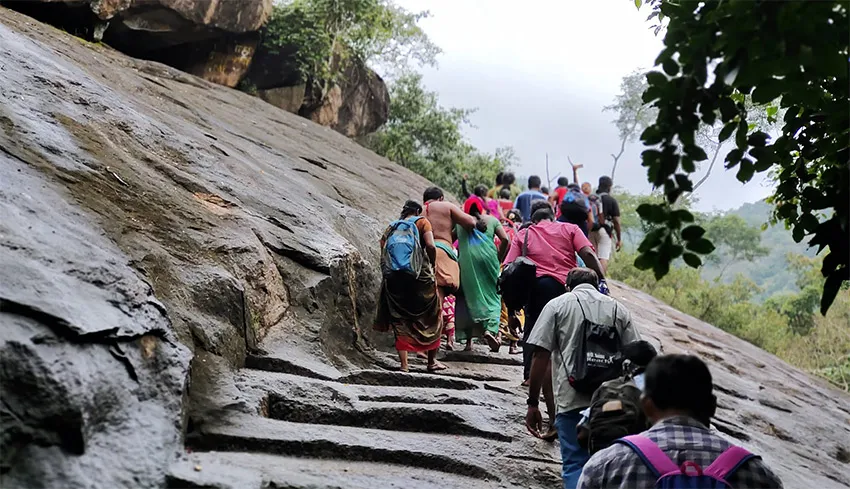
Sathuragiri trekking ranks among the most popular trekking in Tamilnadu. The uphill trek stretches for about 8 kilometres, beginning at Thanipaarai, the base of the hill. From this point onward, ashrams provide Annadhanam to devotees, while shops offer essentials such as torches, water bottles, and biscuits.
First Quarter of Sathuragiri Trekking Journey
After a walk of about half an hour, trekkers reach Kudhiraiootru. From there, the trail passes through Vazhakkuparai, which tends to be slippery, and then leads to Sangali Parai. Along the way, small streams flow gently, enhancing the natural charm.
Second Quarter of Sathuragiri Trekking Journey
Continuing beyond Sangali Parai, the path leads to Korakkar or Goraknath Cave. Thereafter, trekkers navigate through rocky terrain and water patches to reach the Irattai Lingam Cave.
Third Quarter of Sathuragiri Trekking Journey
The next stretch of the trek takes devotees to the Vanadurgai Temple, the forest’s protecting deity, and the Pilavadi Karuppasamy Temple, revered as the guardian of the hills.
Divine Darshan
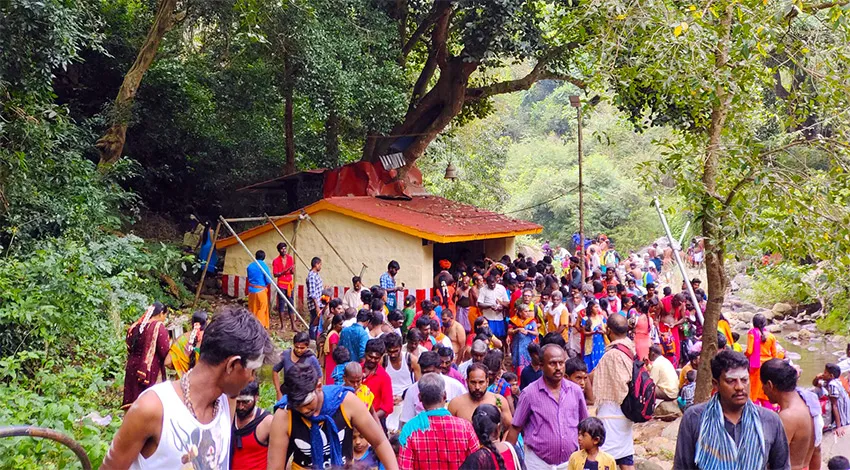
After an additional uphill walk of about 15 minutes, devotees reach the Sundara Mahalingam Temple and the nearby Sundara Moorthy Swamy Temple. Devotees regard Sundara Mahalingam as an Anidai Lingam, meaning a Lingam worshipped by Siddhas.
Behind the Sundara Mahalingam Temple stands the Anandavalli Amma Temple, where the goddess remains formless. She is believed to take form only during Navarathri. Climbing further uphill for another 15 minutes leads devotees to the Santhana Mahalingam Temple.
About 4 kilometres from the Santhana Mahalingam Temple lies the Periya Mahalingam, a massive Lingam that lives up to its name. Along the route, devotees can also worship Oonjal Karuppan Temple, Vellai Ganapathi, Nadu Kattu Ganapathi, Naga Kanni Kaavu, and Lord Ganesha at Thavasi Cave.
Essentials for Sathuragiri Trekking
Trekkers should carry water, torches, and blankets, especially if staying at the base camp. Elders often use walking sticks for support during the trek. Although ashrams provide Annadhanam along the route, it is advisable to avoid carrying food, as it attracts monkeys. Wearing flexible and comfortable clothing suitable for trekking ensures ease of movement. For elderly and physically challenged devotees, dolis (human carriers) are available. Ideally, trekkers should begin the ascent before 8:00 AM and return to the base after darshan by 6:00 PM.
Sathuragiri Temple Visiting Time
The Sathuragiri Temple opens only six days each month – three days during the New Moon (Amavasya) and three days during the Full Moon (Pournami). In addition, the temple remains open during Aadi and Thai Amavasya, when devotees gather in large numbers. Visiting hours generally range from 6:00 AM to 4:00 PM, depending on weather conditions.
Sathuragiri Routes and Distance
Thanipaarai lies about 80 kilometres from Madurai and 28 kilometres from Srivilliputhur. Srivilliputhur serves as the nearest railway station. Pilgrims traveling from Chennai usually follow the route Madurai – Srivilliputhur – Watrap – Thanipaarai. Meanwhile, pilgrims arriving from southern regions take the route Nagercoil – Tirunelveli – Rajapalayam – Srivilliputhur – Watrap – Thanipaarai.
Epilogue
A visit to the Sathuragiri Shiva Temple perfectly blends adventure with spiritual exploration. The hills offer devotees a serene environment to seek Lord Shiva’s blessings while enjoying fresh mountain air.
Ensure a safe and comfortable trek by following our complete trekking gear checklist.
Places to Visit in Srivilliputhur or Virudhunagar District
Srivilliputhur and Virudhunagar District in Tamil Nadu present a rich mix of cultural heritage and natural beauty. The Srivilliputhur Andal Temple, a UNESCO World Heritage Site, attracts visitors with its towering gopuram and historical importance. Nature enthusiasts can explore the Srivilliputhur Grizzled Squirrel Wildlife Sanctuary, which shelters rare flora and fauna.
Additionally, the Shenbagathoppu Hills offer lush greenery and scenic trekking trails, while Ayyanar Falls provides a peaceful retreat in the Western Ghats. Nearby Rajapalayam town is well known for its distinctive dog breed and weaving traditions. Visitors can also explore the bustling markets of Virudhunagar town, famous for spices and vibrant local culture. History lovers may visit the Virudhunagar Kamarajar Memorial House. Altogether, the district promises a deeply enriching travel experience.
Sathuragiri Hills Shiva Temple – FAQ
Where is Sathuragiri Hills Shiva Temple located?
Sathuragiri Hills Shiva Temple is located near Watrap in the Virudhunagar district of Tamil Nadu. It lies within the Western Ghats and is accessible through a trekking route.
Why is Sathuragiri called “Sundara Mahalingam” Temple?
The temple is dedicated to Lord Sundara Mahalingam (a form of Lord Shiva), and the hill is considered highly sacred by devotees and Siddhars who performed penance here.
Is trekking required to reach Sathuragiri Temple?
Yes, devotees must trek approximately 8–10 km from the foothills to reach the temple. The trek passes through forest paths and scenic mountain terrain.
What is the best time to visit Sathuragiri Hills?
The best time to visit is from September to February when the weather is cooler. Many devotees also visit during Amavasya and Pournami days for special prayers.
Are there any restrictions for visiting Sathuragiri Temple?
Yes, entry is regulated by the Forest Department. Visitors must follow trekking guidelines, and plastic usage is restricted to protect the forest environment.
Nearby Tourist Attractions
- Srivilliputhur Andal Renga Mannar Temple
- Grizzled Squirrel Wildlife Sanctuary
- Shenbaga Thoppu Meenvetti Parai Waterfalls
- Pilavakkal Dam, Virudhunagar
The Shirdi Sai Baba Temple in Chennai stands among the most respected and frequently visited places of worship in Tamil Nadu. Devotees from across India visit this sacred shrine to seek blessings from Sai Baba of Shirdi, the revered 18th-century saint known for his compassion and spiritual wisdom.
History & Foundation
In the 1940s, Narasimha Swamiji founded the All India Sai Samaj to spread the teachings of Sai Baba. Subsequently, he established the Shirdi Sai Baba Temple in 1952, which later became the headquarters of the Sai Samaj. Over the years, the temple has drawn hundreds of thousands of devotees, including well-known public figures.
Spiritual Philosophy & Inclusiveness
Sai Baba promoted unity beyond religious boundaries. Therefore, the temple welcomes people of all faiths without restriction. Uniquely, the temple conducts readings from the Quran and the Holy Bible, along with Hindu prayers, symbolizing harmony among religions.
Sacred Flame & Weekly Worship
One of the temple’s most unique features is the sacred flame (Dhuni), believed to originate from the fire lit by Sai Baba himself in Shirdi. Every Sunday, devotees perform Agni Puja to honor Sai Baba’s teachings and service to humanity.
A Place of Peace
Ultimately, the Shirdi Sai Baba Temple offers a calm and serene retreat. Whether devotees seek prayer, meditation, or spiritual music, the temple provides a peaceful space for reflection and inner harmony.
Tourist Attractions near Chennai
Mahalingapuram Sree Ayyappa Temple stands as one of the cleanest and most well-maintained temple complexes in Chennai. Devotees experience a calm and spiritually uplifting atmosphere the moment they enter the premises. The temple enshrines Lord Ayyappa in a form that closely resembles the panchaloha idol at Sabarimala, making it deeply significant for pilgrims.
Deities & Spiritual Ambience
Along with Lord Ayyappa, the temple also houses Sri Guruvayoorappan and Lord Ganapathy, among other deities. Therefore, devotees can offer prayers to multiple divine forms in one sacred space. The soothing pooja chants and chenda melam create a peaceful environment that helps visitors feel spiritually connected and relaxed.
Pilgrimage Importance
Moreover, the temple attracts a large number of devotees during the Sabarimala pilgrimage season. Many worshippers perform rituals here before beginning their journey to Sabarimala, as the temple follows traditional practices similar to those in Kerala.
Architecture & Accessibility
The temple’s architecture reflects traditional Kerala temple design, which further enhances its spiritual charm. Additionally, its location near Kodambakkam Bridge and Nungambakkam High Road ensures easy road access for visitors.
Why Visit?
Overall, Mahalingapuram Sree Ayyappa Temple offers peace, cleanliness, positive energy, and deep devotion, making it a must-visit spiritual destination in Chennai.
Tourist Attractions near Chennai
The Ashtalakshmi Temple stands gracefully near Besant Nagar Beach in Chennai and is dedicated to Goddess Lakshmi in her eight divine forms. Here, devotees worship Ashtalakshmi as the bestower of wealth, prosperity, success, knowledge, courage, nourishment, and overall well-being. Notably, Sri Chandrashekarendra Saraswati Swamigal envisioned this sacred shrine, and priests consecrated the temple in 1976. Since then, the temple has attracted thousands of devotees seeking divine blessings.
Architectural Concept of Ashtalakshmi Temple
The temple complex symbolically represents the sacred Hindu symbol “Om,” thereby reflecting deep spiritual meaning through its architecture. Moreover, the builders drew inspiration from the Sundararaja Perumal Temple at Uthiramerur and adopted the Ashtanga Vimana style, which consists of eight distinct architectural segments. As a result, devotees experience a unique spiritual journey as they ascend through the temple. As they move upward across four levels, they encounter the divine presence of the eight forms of Goddess Lakshmi in a structured and symbolic manner.
Sanctums and Divine Forms
On the second level, the temple houses the main shrine, where Goddess Lakshmi resides alongside Lord Vishnu. Therefore, this sanctum becomes the primary place of worship immediately after devotees enter the temple. Next, as devotees proceed to the third level, they receive blessings from Gajalakshmi, Santhanalakshmi, Vidyalakshmi, and Vijayalakshmi, who symbolize prosperity, progeny, knowledge, and victory respectively. Subsequently, the fourth level exclusively enshrines Dhanalakshmi, representing material wealth and abundance.
Meanwhile, the first level features the shrines of Dhaanya Lakshmi, Aadi Lakshmi, and Dhairya Lakshmi, each symbolizing nourishment, primordial energy, and courage. In addition, each floor displays the avatars of Lord Vishnu in standing, seated, and reclining postures, thereby enriching the spiritual ambiance. Furthermore, a majestic standing idol of Lord Vishnu accompanied by Goddess Lakshmi warmly welcomes devotees on the first floor.
Sacred Highlights of the Temple
A magnificent 5.5-foot gold-plated Kalasam crowns the sanctum sanctorum and signifies the divine presence of Mahavishnu and Mahalakshmi as the supreme deities. Along with this central Kalasam, 32 additional Kalasams adorn the temple structure. Consequently, these sacred elements enhance both the spiritual aura and the architectural grandeur of the temple.
Festivals and Devotional Experience
During major Hindu festivals such as Navratri, Gokulashtami, Deepavali, and Pongal, thousands of devotees gather at the temple to seek divine blessings. Moreover, the evening pooja creates a deeply spiritual atmosphere through its rituals, chants, and illuminated surroundings. As a result, not only local devotees but also tourists from across India and abroad visit the Ashtalakshmi Temple to experience its sacred energy, architectural brilliance, and serene coastal setting.
Ashtalakshmi Temple, Chennai – FAQ
Where is Ashtalakshmi Temple located in Chennai?
Ashtalakshmi Temple is located in Besant Nagar, Chennai, near Elliot’s Beach (Besant Nagar Beach), overlooking the Bay of Bengal.
What is special about Ashtalakshmi Temple?
The temple is dedicated to the eight forms of Goddess Lakshmi (Ashtalakshmi), representing wealth, prosperity, courage, knowledge, fertility, victory, and food.
What are the eight forms of Lakshmi worshipped here?
The eight forms include Adi Lakshmi, Dhanya Lakshmi, Dhairya Lakshmi, Gaja Lakshmi, Santana Lakshmi, Vijaya Lakshmi, Vidya Lakshmi, and Dhana Lakshmi.
What are the temple timings of Ashtalakshmi Temple?
The temple is generally open from early morning (around 6:30 AM) to 12:00 PM and again from 4:00 PM to 9:00 PM. Timings may vary on festival days.
What is the best time to visit Ashtalakshmi Temple?
The best time to visit is during Fridays, Navaratri, and other Lakshmi-related festivals, though early mornings and evenings offer a peaceful darshan experience.
Tourist Attractions near Chennai
Image Attribution : @Minion Clicks from Instagram
Kalikambal Temple stands in the heart of Chennai on Thambu Chetty Street and ranks among the city’s oldest and most revered temples. The temple also offers an additional entrance from Armenian Street, making access convenient for devotees. It is dedicated to the Shaivite deities Lord Shiva, worshipped here as Kamateshvarar, and Goddess Kamakshi, also known as Kalikambal, in her calm and benevolent form.
Historical Background of Kalikambal Temple
Originally, Kalikambal Temple stood within the premises of Fort St. George. Over time, authorities relocated the temple to its present location in George Town. According to tradition, devotees once worshipped a fierce form of Goddess Kali here. Later, they replaced it with a serene manifestation, reflecting the belief that devotion itself brings transformation and miracles. As a result, the temple today carries both spiritual depth and rich historical significance.
Royal and Literary Connections
The temple holds a special place in Indian history. The great Maratha warrior Chhatrapati Shivaji Maharaj visited this temple in the 17th century along with his trusted minister to seek the blessings of Goddess Kali. Furthermore, the renowned Tamil poet Subramania Bharathi frequently visited this shrine in the early 20th century. He composed several verses praising the goddess, and inscriptions on the temple walls still recall his devotion.
Unique Architectural Features
Kalikambal Temple has received patronage from people belonging to all sections of society, and this support has grown steadily over the years. One of the temple’s most distinctive features is its architecture, where the main deities are placed back to back. This arrangement is rare in traditional temple design and adds to the shrine’s uniqueness.
Other Deities and Devotional Beliefs
In addition to the main deities, devotees can also offer prayers to Lord Ganapathy, Lord Murugan with Valli and Deivanai, Veerabhadra Swamy, and Maha Kali. Many believers hold a strong faith that prayers offered here receive quick answers after darshan of Kalikambal. Consequently, the temple remains crowded throughout the year, especially on Tuesdays and Fridays.
How to Reach Kalikambal Temple
Devotees can reach Kalikambal Temple easily by MRTS. Visitors can get down at Beach Station and walk along First Line Beach to reach the temple. The shrine also lies close to Parry’s Corner bus stand, making it well connected by public transport. However, parking private vehicles near the temple can be challenging. Visitors usually park a few streets away and walk to the temple or use cycle rickshaws for short-distance travel.
Temple Timings
Kalikambal Temple remains open daily from 6:00 AM to 1:00 PM in the morning and from 3:00 PM to 8:00 PM in the evening.
Spiritual Experience
A visit to Kalikambal Temple offers an authentic glimpse into traditional Hindu culture. Despite being located in a busy part of Chennai, the temple radiates powerful spiritual vibrations and leaves devotees with a deep sense of peace and devotion. Therefore, any visit to Chennai feels incomplete without experiencing the divine atmosphere of this historic temple.
Kalikambal Temple Chennai – FAQ
Where is Kalikambal Temple located in Chennai?
Kalikambal Temple is located on Thambu Chetty Street in George Town, Chennai. It is one of the oldest temples in the city.
Which deity is worshipped at Kalikambal Temple?
The temple is dedicated to Goddess Kalikambal, a powerful form of Goddess Parvati. Lord Kamadeswarar (a form of Lord Shiva) is also worshipped here.
What is the historical significance of Kalikambal Temple?
The temple dates back several centuries and is believed to have been visited by Chhatrapati Shivaji Maharaj in the 17th century before his southern campaign.
What are the temple timings of Kalikambal Temple?
The temple is generally open from early morning around 6:00 AM to 12:00 PM and again from 4:30 PM to 8:30 PM. Timings may vary on festival days.
What festivals are celebrated at Kalikambal Temple?
Major festivals include Navaratri, Aadi month celebrations, and special poojas dedicated to Goddess Kalikambal, attracting many devotees.
Tourist Attractions near Chennai
Madhya Kailash Temple stands as a prominent spiritual landmark in Chennai, located in the Adyar area. The temple sits at the busy junction of Tidel Park Road and Sardar Patel Road, yet it offers a peaceful retreat amid the city’s hustle. Lord Ganesha serves as the presiding deity of this temple, which devotees also refer to as Nadukkayilai.
Unique Form of Adhyantha Prabhu
This temple gains special recognition for its unique deity known as Adhyantha Prabhu, a rare combined form of Lord Ganesha and Lord Anjaneya. The right side of the idol represents Ganesh, while the left side depicts Hanuman. Temple authorities crafted this idol after one of the officials experienced a divine vision of this form. In addition, the temple houses several other shrines dedicated to Lord Suryanarayana, Lord Shiva, Lord Anjaneya, Swarna Bhairavar, and other deities, enriching its spiritual significance.
Daily Rituals and Special Traditions
Every afternoon, the temple priest performs a distinctive ritual by offering cooked rice to Lord Vishnu. He then shapes the rice into a ball, carries it to the shrine of Lord Surya, and finally offers it to crows, symbolizing ancestral blessings. Another remarkable tradition takes place during Vinayaka Chaturthi. On this auspicious day, sunlight falls directly on the main deity, creating a divine spectacle. Simultaneously, the temple plays eight bells tuned to the classical notes Sa Ri Ga Ma Pa Da Ni Sa, enhancing the spiritual atmosphere.
Devotional Practices and Beliefs
Following Maharashtrian customs, devotees can light camphor directly in front of the deity, which offers a deep sense of devotion and fulfillment. Devotees also believe that Lord Vinayaka personally takes responsibility for appeasing ancestors. In earlier years, people frequently visited this temple to perform poojas for newly purchased vehicles, seeking divine protection and blessings.
Temple Timings and Structure
Madhya Kailash Temple opens daily from 6:00 AM to 12:00 PM and again from 4:30 PM to 9:00 PM. Although the temple is relatively small, it impresses visitors with its elegant design and spiritual aura. The temple is approximately 30 years old.
Peaceful Ambience Amid City Life
Despite standing at one of Chennai’s busiest traffic junctions, the temple maintains complete silence within its premises. This calm environment often inspires devotees to revisit the temple repeatedly. The temple provides sufficient parking space near the entrance, and several pooja item shops operate nearby for the convenience of visitors. Overall, Madhya Kailash Temple offers a serene space for self-reflection and devotion. Nestled in the heart of Chennai, this charming temple remains a must-visit spiritual destination.
Madhya Kailash Temple – Chennai – FAQ
Where is Madhya Kailash Temple located in Chennai?
Madhya Kailash Temple is located at Adyar Junction in Chennai, near IIT Madras and the Rajiv Gandhi IT Expressway (OMR).
Which deity is worshipped at Madhya Kailash Temple?
The temple is dedicated to Lord Shiva (Kailasanathar). It is also famous for the unique Adhyantha Prabhu idol, a combined form of Lord Ganesha and Lord Hanuman.
What is special about the Adhyantha Prabhu idol?
Adhyantha Prabhu is a rare deity that combines the features of Lord Ganesha and Lord Hanuman in a single idol, symbolizing wisdom and strength.
What are the temple timings of Madhya Kailash Temple?
The temple is generally open from around 5:30 AM to 12:00 PM and from 4:00 PM to 8:30 PM. Timings may vary on special occasions and festival days.
What festivals are celebrated at Madhya Kailash Temple?
Major festivals include Maha Shivaratri, Vinayaka Chaturthi, Hanuman Jayanti, and Navaratri, drawing large numbers of devotees.
Tourist Attractions near Chennai
Image Attribute : Sankar Pandian
Andal Renga Mannar Temple located in Srivilliputhur, Virudhunagar District is one of the 108 Divya Kshetrams or holy abodes of Lord Sri Vishnu.
History & Legend of Andal Temple
The temple’s history dates back to the rule of Pandia Dynasty and is dedicated to Lord Vishnu worshipped as Vatapatrasayi (Lord resting on a banyan tree leaf) and his consort Lakshmi as Andal. The temple also marks its divinity as the birthplace of Periyalwar and his adopted child Andal – an ardent devotee of Lord Vishnu.
Srivilliputhur Andal Temple Architecture
The temple houses a huge complex with ancient sculptures and drawings. It has two divisions – the first part constructed by King Villi is known as Vadabadra Sayana Temple. The second part constructed by different Kings of Pandia is known as Andal Sannadhi. The Rajagopuram (temple tower) rises to an awe-inspiring 192 feet high. The inscriptions of the great poet Kamban praising the temple is found in the tower.
The temple tower proudly adorns the symbol of the Government of Tamil Nadu
The temple of Srivilliputhur has given Tamil literature Tiruppavai – a collection of 30 poems composed by Andal and Tirupallandu composed by Periyalvar. These Vedic hymns are recited even today in the temple and hence visitors of the temple are assured of a soul-enriching experience. The temple is a must visit place for devotion and serenity and also for its architectural grandeur.
Famous Festivals in Srivilliputhur Andal Temple:
The Srivilliputhur Andal Temple celebrates vibrant festivals like Andal Thirukalyanam (divine wedding in Jan-Feb), Vaikunta Ekadasi (heavenly gate opening in Dec-Jan), Adi Pooram (Andal’s birth in July-Aug), Purattasi Saturdays (special Vishnu worship in Sep-Oct), Panguni Uthiram (divine marriage in Mar-Apr), and Margazhi Festival (Thiruppavai recitals in Dec-Jan). These events feature grand processions, temple decorations, devotional hymns, and the famous Srivilliputhur Palkova, offering a glimpse into Tamil Nadu’s rich spiritual and cultural heritage.
How to reach Srivilliputhur Andal Temple?
Srivilliputhur Andal Temple is accessible via multiple transportation options; the nearest major airport is Madurai Airport, from which you can hire a taxi or cab, and Srivilliputhur also has its own railway station for train travel, with local transport available from the station to the temple. Additionally, the town is well-connected by road, with frequent bus services from nearby cities in Tamil Nadu, and is easily reachable by car.
Must-Try Srivilliputhur Palkova
Srivilliputhur is famous for a sweet treat called Palkova. It’s made by slowly cooking milk and sugar together until it becomes thick and creamy. This process creates a rich, milky flavor that’s unique to this region. People love Palkova because it’s simple, natural, and delicious. You can find it in shops all around Srivilliputhur, and it’s a popular gift for visitors to take home.
Srivilliputhur Andal Temple Timings:
The Srivilliputhur Andal Temple timings are as follows:
Morning hours: 6.30 A.M to 1 P.M
Evening hours: 4 P.M to 9 P.M
Srivilliputhur Andal Temple Pooja Details:
The Pooja timings as below enlisted are different for each shrine.
Andal Temple Pooja Details:
| Pooja Time | Pooja Name |
|---|---|
| 6.30 A.M | Viswa Roopam |
| 8.30 A.M | Kala Sanathi |
| 12 NOON | Uchikkalam |
| 1.00 P.M | Nadai Sarthal |
| 4.00 P.M | Nadai Thirappu |
| 6.00 P.M | Saya Ratchai |
| 8.00 P.M | Atthalam |
| 9.00 P.M | Arvanai |
Vadapatrasayanar Temple Pooja Details:
| Pooja Time | Pooja Name |
|---|---|
| 7.00 A.M | Viswa Roopam |
| 8.00 A.M | Kala Sanathi |
Azhvar Sannathi Pooja Details:
| Pooja Time | Pooja Name |
|---|---|
| 8.00 A.M | Kala Santhi |
| 9.30 A.M | Thirumanjanam |
| 12.30 P.M | Nadai Sarthal |
| 4.30 P.M | Nadai Thirappu |
| 5.30 P.M | Saya Ratchai |
| 8.00 P.M | Atthalam |
| 8.30 P.M | Aravanai |
Srinivasa Perumal Temple Pooja Details:
| Pooja Time | Pooja Name |
|---|---|
| 7.00 A.M | Nadai Thirappu |
| 12 P.M | UchikKalam |
| 6.30 P.M | Saya Ratchai |
| 7.00 P.M | Nadai Sarthal |
Srivilliputhur Andal Temple – FAQ
Where is Srivilliputhur Andal Temple located?
Srivilliputhur Andal Temple is located in the town of Srivilliputhur in Virudhunagar district, Tamil Nadu. It is one of the most important Divya Desams dedicated to Lord Vishnu.
Why is Srivilliputhur Andal Temple famous?
The temple is famous as the birthplace of Goddess Andal, the only female Alvar saint. Its towering Rajagopuram is also the official emblem of the Government of Tamil Nadu.
Who are the main deities worshipped in the temple?
The temple is dedicated to Lord Vatapatrasayi (a form of Lord Vishnu) and Goddess Andal (Nachiyar). Devotees worship both deities with great reverence.
What is the significance of Andal in this temple?
Goddess Andal is revered for composing the sacred Tamil hymns Tiruppavai and Nachiyar Tirumozhi, which are recited widely during Margazhi month.
What are the temple timings of Srivilliputhur Andal Temple?
The temple is generally open from early morning around 6:00 AM to 12:00 PM and again from 4:00 PM to 8:30 PM. Timings may vary on festival days.