
Vivekananda Rock Memorial
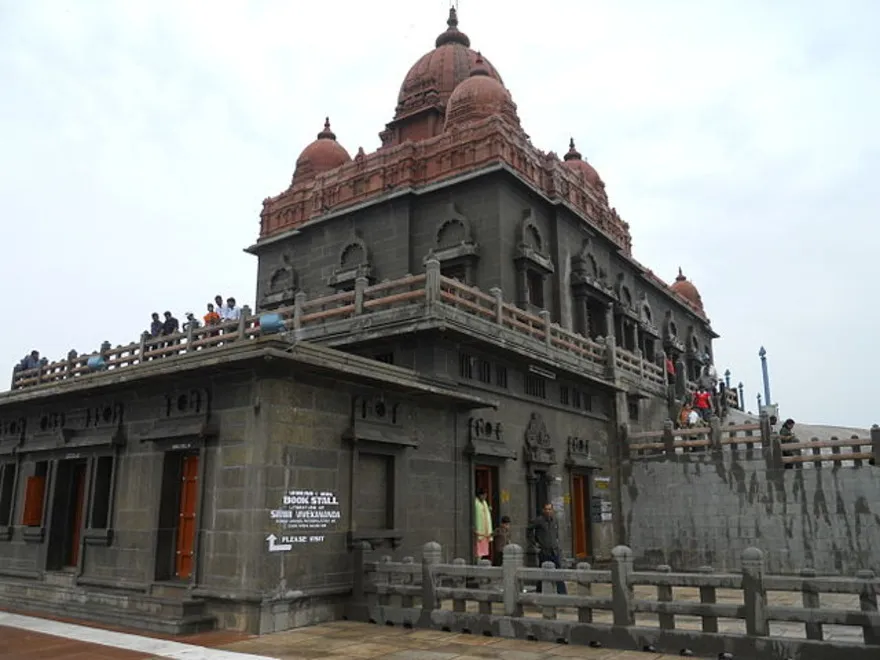
Vivekananda Rock Memorial, built in 1970 in honor of Swami Vivekananda, stands about 500 meters east of the mainland of Vavathurai in Kanyakumari. Located at the southernmost tip of the Indian peninsula, Kanyakumari—also known as Cape Comorin—is uniquely surrounded by the Indian Ocean, the Arabian Sea, and the Bay of Bengal. As a result, the memorial enjoys both geographical and spiritual prominence. The magnificent structure commemorates Swami Vivekananda, the great Indian Hindu monk and disciple of Sri Ramakrishna Paramahamsa. It is widely believed that Swamiji attained enlightenment while meditating on this very rock. Moreover, legend holds that Goddess Kanyakumari performed intense penance here, which led to the rock being revered as “Sripada Parai.” Today, visitors reach the memorial via ferry services operated by the Tamil Nadu Tourism Department, and the design reflects a harmonious blend of architectural styles from across India.
Image Attribution: tshrinivasan
Installation of the Memorial
During his visit to Kanyakumari on 24th December 1892, just before attending the World Parliament of Religions in Chicago, Swami Vivekananda meditated on this rock for two days. Subsequently, he emerged as one of India’s most influential philosophers and spiritual reformers, playing a key role in the revival of Hinduism. To commemorate his legacy, the Kanyakumari Committee was formed in January 1962 on the occasion of Swamiji’s birth centenary. Around the same time, the Ramakrishna Mission in Madras proposed the idea of a memorial. However, local opposition led to disputes, and authorities declared the rock a prohibited area. Eventually, on 17th January 1963, the government permitted the installation of a tablet acknowledging Swami Vivekananda’s association with the rock.
Shri Eknath Ramakrishna Ranade & His Role
Shri Eknath Ramakrishna Ranade, popularly known as Eknathji, played a decisive role in realizing the memorial. A devoted follower of Swami Vivekananda and a senior pracharak of the Rashtriya Swayamsevak Sangh, he founded the Vivekananda Rock Memorial Organising Committee and served as its Organising Secretary. Despite facing political challenges, including initial rejection by the Minister of Education and Culture, Ranade secured support from 323 Members of Parliament. Consequently, Prime Minister Indira Gandhi approved the project.
Ranade then mobilized volunteers nationwide to raise funds, with both State and Central Governments contributing to the total cost of Rs. 12.5 million. Thanks to his unwavering dedication, the memorial was completed within six years and inaugurated in 1970 by President V. V. Giri.
The Vivekananda Rock Memorial – Architectural Excellence
Architecturally, the Vivekananda Rock Memorial primarily blends West Bengal and Tamil Nadu styles. It comprises two major structures: Vivekananda Mandapam and Shripada Mandapam.
Vivekananda Mandapam includes:
- Dhyana Mandapam (Meditation Hall) with six adjoining rooms inspired by diverse Indian temple styles
- Sabha Mandapam (Assembly Hall), which houses the statue of Swami Vivekananda positioned to face the Shripadam
- Mukha Mandapam
- Namastubhyam dedicated to the son of Jagadamba
Shripada Mandapam consists of:
- Garbhagriha (Sanctum Sanctorum)
- Inner Prakaram
- Outer Prakaram
- Outer Platform
Vivekananda Kendra – The Living Memorial
Adjacent to the memorial, Vivekananda Kendra was founded on 7th January 1972 to mark the 108th birth anniversary of Swami Vivekananda. Eknath Ranade envisioned the Kendra as a platform where young men and women could serve society by serving humanity. Accordingly, the organization engages in rural development, yoga training, and educational seminars across the country.
Visiting Hours & Entry Fee
The Vivekananda Rock Memorial remains open throughout the year from 7:00 AM to 5:00 PM. The entry fee is Rs. 10, while charges are Rs. 10 for still cameras and Rs. 50 for video cameras. Additionally, ferry services cost Rs. 20 per person. Tourists can also find ample lodging and accommodation facilities in and around Kanyakumari.
How to Reach Vivekananda Rock Memorial
Kanyakumari lies about 19 kilometres from Nagercoil and 90 kilometres from Thiruvananthapuram and enjoys good road connectivity with major South Indian cities. The nearest railway station is Kanyakumari Junction, located roughly 1.5 kilometres away. Meanwhile, Trivandrum International Airport, about 95 kilometres away, serves as the nearest airport.
Epilogue
Ultimately, Vivekananda Rock Memorial stands as one of India’s most revered rock monuments. Its serene ambience, deep spiritual significance, and architectural brilliance draw visitors from across the world. By reflecting India’s cultural and philosophical values, the memorial remains a must-visit destination in Kanyakumari for seekers of peace, inspiration, and history.
Vivekananda Rock Memorial – FAQ
Where is Vivekananda Rock Memorial located?
Vivekananda Rock Memorial is located on a small rocky island off the coast of Kanyakumari, Tamil Nadu, at the confluence of the Arabian Sea, Bay of Bengal, and Indian Ocean.
Why is Vivekananda Rock Memorial famous?
The memorial is famous as the place where Swami Vivekananda meditated in 1892 before his historic speech at the Parliament of Religions in Chicago.
When was Vivekananda Rock Memorial built?
The memorial was inaugurated in 1970 and was constructed through nationwide contributions as a tribute to Swami Vivekananda.
How can visitors reach Vivekananda Rock Memorial?
Visitors can reach the memorial by ferry service operated from the Kanyakumari mainland, subject to sea and weather conditions.
What is the best time to visit Vivekananda Rock Memorial?
The best time to visit is from October to March when the weather is pleasant and suitable for ferry travel and sightseeing.