
Thiruvanaikaval Jambukeswarar Temple – History, Timings & Travel Guide
History of Thiruvanaikaval Jambukeswarar Temple
The history of the Thiruvanaikaval Jambukeswarar Temple dates back nearly 1,800 years. As per Tamil Nadu Tourism and historical references, the temple was originally built by Kochengat Cholan, one of the early Chola kings known for constructing elevated temples. The legendary tale narrates that Goddess Parvati performed penance here in the form of a yogini, making a lingam out of the water from the sacred Cauvery river.
The lingam continuously rests in a water-filled enclosure, symbolizing Shiva’s manifestation as the water element. This makes Thiruvanaikaval one of the holiest Shiva temples in India, with deep roots in Saivite tradition and Tamil Shaiva literature.
Architectural Significance of Thiruvanaikaval Jambukeswarar Temple
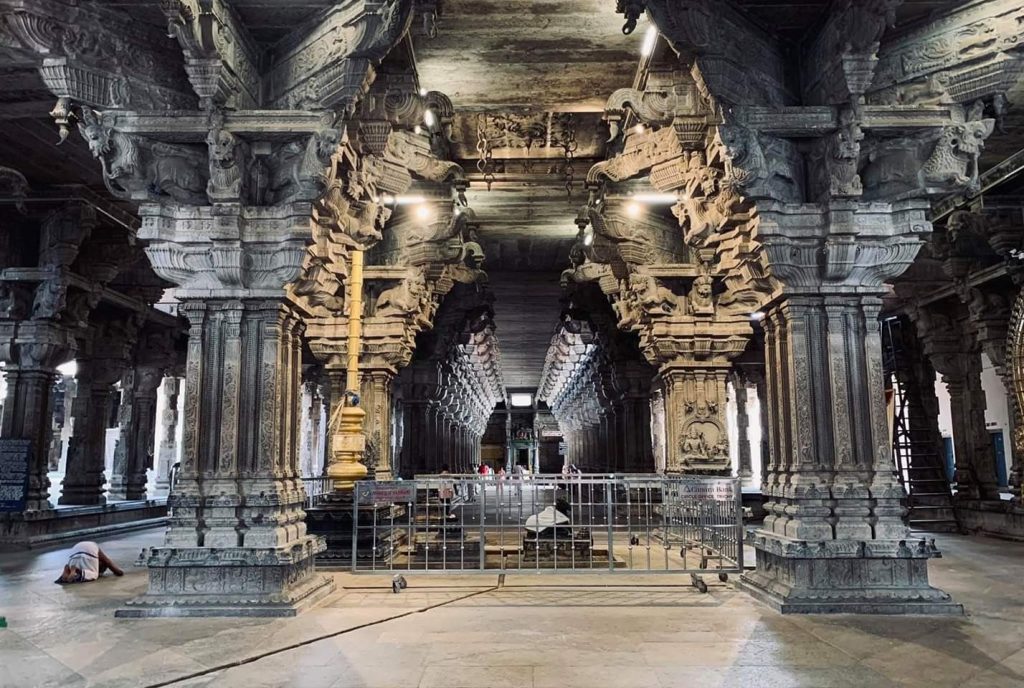
The Thiruvanaikaval Jambukeswarar Temple showcases exquisite Dravidian architecture, featuring five concentric prakaras, each representing ancient temple-building craftsmanship. The massive Raja Gopuram rises majestically, while the sanctum of Jambukeswarar is uniquely positioned in a water-filled chamber. The shrine of Goddess Akilandeswari displays remarkable sculptures and houses the famous ear ornaments gifted by Adi Shankaracharya.
The temple’s stone halls, thousand-pillared mandapam, and sacred water tank (Sivaganga Theertham) further highlight its architectural brilliance and spiritual significance.
Pooja Details & Daily Rituals at Thiruvanaikaval Jambukeswarar Temple
The temple follows traditional Saivite rituals performed according to Agama Sastras. One of the most unique aspects is the noon pooja, where the priest performs worship symbolically as Goddess Parvati, honoring the myth of her penance at this site.
- Ushakkala Pooja – Early Morning
- Kalasanthi Pooja – Morning
- Uchikala Pooja – Noon (Most Significant)
- Sayaratchai Pooja – Evening
- Arthajama Pooja – Night
Timings may vary on festival days, but the noon ritual remains the most powerful and culturally significant worship at the temple.
Temple Festivals at Thiruvanaikaval Jambukeswarar Temple
Festivals celebrated at the Thiruvanaikaval Jambukeswarar Temple bring thousands of devotees to witness the rich traditions of Tamil Nadu. Major festivals include:
- Panguni Brahmotsavam – The grandest celebration with chariot processions.
- Aadi Pooram – Dedicated to Akilandeswari.
- Navaratri – Nine-day celebration with daily rituals and cultural performances.
- Maha Shivaratri – Special abhishekams and night-long prayers.
- Karthigai Deepam – Celebrated with thousands of oil lamps.
Temple Timings of Thiruvanaikaval Jambukeswarar Temple
Morning Darshan: 5:30 AM – 12:00 PM
Evening Darshan: 4:00 PM – 9:00 PM
Special pooja timings may differ during festival days and auspicious occasions.
How to Reach Thiruvanaikaval Jambukeswarar Temple
The temple is located near Srirangam in Tiruchirappalli (Trichy), Tamil Nadu, and is well connected by all major transport modes.
By Air
Trichy International Airport (15 km) is the nearest airport with frequent domestic and international flights.
By Train
Trichy Junction and Srirangam Railway Station provide excellent rail connectivity.
By Road
Regular buses, autos, and cabs from Trichy city make the temple easily accessible.
Travel Tips for Visiting Thiruvanaikaval Jambukeswarar Temple
- Visit during early mornings to avoid crowds and heat.
- The noon pooja is a must-attend for spiritual seekers.
- Dress modestly as per temple customs.
- Photography may be restricted inside sanctum areas.
- Carry water and avoid peak summer afternoons.
Thiruvanaikaval Jambukeswarar Temple – FAQ
What is special about Thiruvanaikaval Jambukeswarar Temple?
It is the Appu Sthalam among the Pancha Bhoota Sthalams, representing the water element with a naturally water-filled sanctum.
Which goddess is worshipped at Thiruvanaikaval?
Goddess Akilandeswari, a powerful form of Parvati, is worshipped alongside Lord Jambukeswarar.
What is the significance of the noon pooja?
The priest performs rituals symbolically as Goddess Parvati, reenacting the divine penance story unique to this temple.
How old is the Thiruvanaikaval Temple?
The temple is estimated to be over 1,800 years old, originally built by the Chola king Kochengat Cholan.