
Jalakandeswarar Temple – Vellore
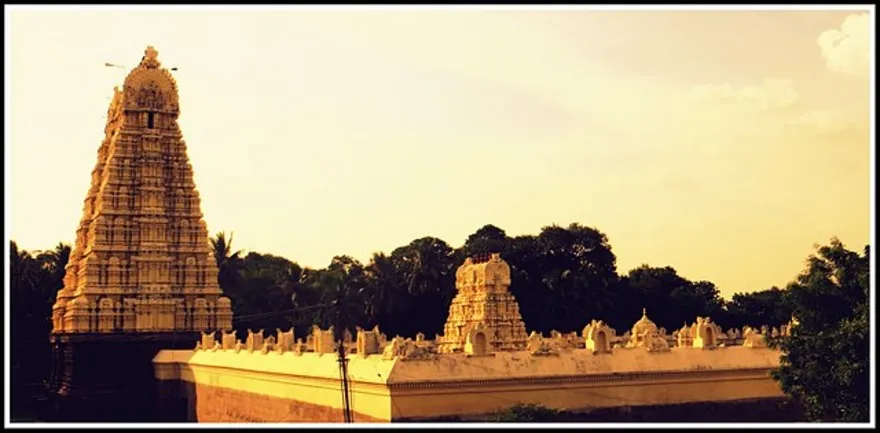
Jalakandeswarar Temple is a historic Shiva temple located within the premises of Vellore Fort. Built during the Vijayanagara period, the temple reflects deep religious and architectural significance. While the Archaeological Survey of India maintains the structure, the Government of Tamil Nadu oversees its administration. As a result, the temple continues to preserve its heritage while welcoming devotees and visitors.
Image Attribution: Soham Banarjee
History of Jalakandeswarar Temple
According to legend, a massive ant-hill once stood at the present temple site, surrounded by stagnant water.
Chinni Bommi Nayaka, a Vijayanagara chieftain and controller of the fort, received a divine vision in which Lord Shiva instructed him to build a temple at that location. Consequently, he cleared the ant-hill and constructed the temple in 1550 AD. He named the deity Jalakandeswarar, symbolizing Lord Shiva as the one who resides in water. The temple also enshrines Sri Akhilandeshwari Amman, the divine consort of Lord Jalakandeswarar. Later, during the capture of the fort and subsequent invasions, the temple suffered damage and worship ceased. For nearly 400 years, authorities used the temple as an arsenal, and devotees moved the main deity to the Jalakanda Vinayakar Temple for protection. Although the ASI assumed responsibility for the fort in 1921, worship did not resume immediately. However, in 1981, devotees carefully brought the deity back into the fort and reinstalled it, thereby restoring regular worship.
The Temple Architecture
Jalakandeswarar Temple stands as an outstanding example of Vijayanagara architecture. The temple showcases exquisitely carved gopurams, intricately sculpted stone pillars, impressive monoliths, and a mandapam adorned with detailed carvings. Notably, water surrounds the temple, enhancing its spiritual ambiance.
Lord Jalakandeswarar, worshipped in lingam form, serves as the presiding deity. A majestic Nandi statue faces the main sanctum. Additionally, the outer walls of the Amman sanctum house shrines dedicated to Lord Vinayaka, Goddesses Maheswari, Vaishnavi, Varahi, Lakshmi, and Saraswathi.
Jalakandeswarar Temple Timings and Festivals
The temple remains open every day from 6:30 AM to 1:00 PM and again from 5:00 PM to 8:30 PM, allowing devotees ample time for darshan and prayer.
The temple celebrates several important festivals throughout the year. Major celebrations include Chitra Pournami as a 10-day festival during April–May, Surasamharam in the month of Aipasi, Aadi Pooram as a 10-day festival in July–August, Vinayaka Chathurthi during Avani, and Navarathri in the month of Purattasi. During these festivals, the temple comes alive with devotion, rituals, and vibrant celebrations.
How to reach Jalakandeswarar Temple
Jalakandeswarar Temple is located inside the Vellore Fort. Vellore Fort is located at a distance of 138 kilometres from Chennai. Katpadi Junction in Vellore (around 7.5 kilometres north of the fort) is the nearest railway station. Vellore is well connected by road and rail with all the major cities in South India. The nearest international airport is at Chennai, 128 kilometres east of Vellore.
Jalakandeswarar Temple, Vellore – FAQ
Where is Jalakandeswarar Temple located?
Jalakandeswarar Temple is located inside the historic Vellore Fort in Vellore, Tamil Nadu.
What is Jalakandeswarar Temple famous for?
The temple is famous for its exquisite Vijayanagara-style architecture, intricate stone carvings, and detailed sculptures carved from granite.
Who are the presiding deities of the temple?
Lord Shiva is worshipped as Jalakandeswarar, and Goddess Parvati is worshipped as Akhilandeswari.
What is special about the temple’s architecture?
The temple features a beautifully carved gopuram, ornate pillars, and a remarkable stone chariot mandapam that showcases exceptional craftsmanship.
What is the best time to visit Jalakandeswarar Temple?
The best time to visit is between October and March when the weather is pleasant for exploring Vellore Fort and the temple complex.