
Ratnagiri Balamurugan Temple is one of the ancient and revered temples of Tamil Nadu, dedicated to Lord Murugan. The temple is located at Thirumanikundram near Vellore and is situated atop a scenic hill, offering both spiritual significance and panoramic views. Devotees believe that the presiding deity, Lord Murugan, manifested himself naturally in this sacred place. As a result, the temple attracts pilgrims seeking blessings, wisdom, and spiritual growth.
Deity and Historical Background
The chief deity, Lord Murugan, appears here in two distinct forms. In one form, he is worshipped along with his consorts Valli and Deva Sena, known as Thirukolam. In the other form, he appears as the divine Guru, referred to as Gurukolam. These manifestations highlight the temple’s unique spiritual importance. The temple dates back to the 14th century and gained prominence through the efforts of Balamurugan Adimaigal, who played a key role in developing this hilltop shrine into a major place of worship.
Temple Architecture and Shrines
The temple features a five-storeyed gopuram that was constructed in the year 1975. This towering structure adds to the visual grandeur of the temple and serves as a landmark for devotees approaching the hill. In addition to the main shrine, the temple complex includes separate shrines dedicated to Lord Ganesha, Lord Shani, and the Navagrahas. Consequently, devotees can offer prayers to multiple deities during a single visit.
Festivals Celebrated at Ratnagiri Temple
The temple observes several festivals throughout the year, with Aadi Krithika during July–August and Thai Krithika during January–February being the most significant. During these occasions, devotees gather in large numbers to participate in special poojas and celebrations.
Temple Timings
Ratnagiri Balamurugan Temple remains open on all days from 6:00 AM to 1:00 PM and again from 4:00 PM to 8:00 PM. However, temple timings may vary on festival days and special occasions.
How to Reach Ratnagiri Balamurugan Temple
Devotees can easily reach the temple by road, as direct bus services operate from Vellore to Ratnagiri Temple. The nearest railway station is located in Vellore, approximately 15 kilometres away. For air travellers, the nearest airport is in Chennai, situated about 115 kilometres from the temple. From Chennai or Vellore, visitors can continue their journey by bus or taxi.
Ratnagiri Balamurugan Temple, Vellore – FAQ
Where is Ratnagiri Balamurugan Temple located?
Ratnagiri Balamurugan Temple is located in Ratnagiri near Vellore in Tamil Nadu, situated atop a small hill along the Vellore–Arcot road.
What is Ratnagiri Balamurugan Temple famous for?
The temple is famous for Lord Murugan worshipped as Balamurugan and for its scenic hilltop setting that offers panoramic views of the surrounding landscape.
How can devotees reach the hilltop temple?
Devotees can reach the temple by climbing around 130 steps or by using the motorable road that leads directly to the hilltop.
What are the major festivals celebrated at the temple?
Important festivals include Thaipusam, Panguni Uthiram, Skanda Sashti, and Karthigai Deepam, drawing large numbers of Murugan devotees.
What is the best time to visit Ratnagiri Balamurugan Temple?
The best time to visit is from October to March when the weather is pleasant for climbing the hill and attending temple rituals.
Tourist Attractions near Vellore
Jalakandeswarar Temple is a historic Shiva temple located within the premises of Vellore Fort. Built during the Vijayanagara period, the temple reflects deep religious and architectural significance. While the Archaeological Survey of India maintains the structure, the Government of Tamil Nadu oversees its administration. As a result, the temple continues to preserve its heritage while welcoming devotees and visitors.
Image Attribution: Soham Banarjee
History of Jalakandeswarar Temple
According to legend, a massive ant-hill once stood at the present temple site, surrounded by stagnant water.
Chinni Bommi Nayaka, a Vijayanagara chieftain and controller of the fort, received a divine vision in which Lord Shiva instructed him to build a temple at that location. Consequently, he cleared the ant-hill and constructed the temple in 1550 AD. He named the deity Jalakandeswarar, symbolizing Lord Shiva as the one who resides in water. The temple also enshrines Sri Akhilandeshwari Amman, the divine consort of Lord Jalakandeswarar. Later, during the capture of the fort and subsequent invasions, the temple suffered damage and worship ceased. For nearly 400 years, authorities used the temple as an arsenal, and devotees moved the main deity to the Jalakanda Vinayakar Temple for protection. Although the ASI assumed responsibility for the fort in 1921, worship did not resume immediately. However, in 1981, devotees carefully brought the deity back into the fort and reinstalled it, thereby restoring regular worship.
The Temple Architecture
Jalakandeswarar Temple stands as an outstanding example of Vijayanagara architecture. The temple showcases exquisitely carved gopurams, intricately sculpted stone pillars, impressive monoliths, and a mandapam adorned with detailed carvings. Notably, water surrounds the temple, enhancing its spiritual ambiance.
Lord Jalakandeswarar, worshipped in lingam form, serves as the presiding deity. A majestic Nandi statue faces the main sanctum. Additionally, the outer walls of the Amman sanctum house shrines dedicated to Lord Vinayaka, Goddesses Maheswari, Vaishnavi, Varahi, Lakshmi, and Saraswathi.
Jalakandeswarar Temple Timings and Festivals
The temple remains open every day from 6:30 AM to 1:00 PM and again from 5:00 PM to 8:30 PM, allowing devotees ample time for darshan and prayer.
The temple celebrates several important festivals throughout the year. Major celebrations include Chitra Pournami as a 10-day festival during April–May, Surasamharam in the month of Aipasi, Aadi Pooram as a 10-day festival in July–August, Vinayaka Chathurthi during Avani, and Navarathri in the month of Purattasi. During these festivals, the temple comes alive with devotion, rituals, and vibrant celebrations.
How to reach Jalakandeswarar Temple
Jalakandeswarar Temple is located inside the Vellore Fort. Vellore Fort is located at a distance of 138 kilometres from Chennai. Katpadi Junction in Vellore (around 7.5 kilometres north of the fort) is the nearest railway station. Vellore is well connected by road and rail with all the major cities in South India. The nearest international airport is at Chennai, 128 kilometres east of Vellore.
Jalakandeswarar Temple, Vellore – FAQ
Where is Jalakandeswarar Temple located?
Jalakandeswarar Temple is located inside the historic Vellore Fort in Vellore, Tamil Nadu.
What is Jalakandeswarar Temple famous for?
The temple is famous for its exquisite Vijayanagara-style architecture, intricate stone carvings, and detailed sculptures carved from granite.
Who are the presiding deities of the temple?
Lord Shiva is worshipped as Jalakandeswarar, and Goddess Parvati is worshipped as Akhilandeswari.
What is special about the temple’s architecture?
The temple features a beautifully carved gopuram, ornate pillars, and a remarkable stone chariot mandapam that showcases exceptional craftsmanship.
What is the best time to visit Jalakandeswarar Temple?
The best time to visit is between October and March when the weather is pleasant for exploring Vellore Fort and the temple complex.
Tourist Attractions near Vellore
Vellore Fort stands prominently in the heart of Vellore city and is considered one of the most impregnable forts in Tamil Nadu. Historically, the rulers of the Vijayanagara Empire constructed this massive structure. Later, it functioned as the royal seat of the Aravidu Dynasty. Therefore, Vellore Fort holds immense historical, political, and cultural importance in South Indian history.
Architecture and Defensive Features
The fort is widely admired for its remarkable military architecture. Most notably, it features massive stone ramparts combined with a deep and wide moat that once provided strong protection. In fact, the fort complex extends across nearly 133 acres. Additionally, historical accounts suggest that the surrounding moat once housed thousands of crocodiles, which further enhanced the fort’s defensive strength.
Present Status of Vellore Fort
Today, the Archaeological Survey of India maintains and preserves Vellore Fort. As a result, the fort now remains open to tourists, researchers, and history enthusiasts. Visitors can walk along its massive walls, observe its architectural brilliance, and understand the strategic role it once played. Thus, Vellore Fort continues to stand as a powerful symbol of Tamil Nadu’s rich heritage and military excellence.
Image Attribution : Rajaraman Sundaram
Interesting Facts about Vellore Fort
-
During the British period, Tipu Sultan and his family, along with the last King of Sri Lanka, Sri Vikrama Rajasinha, were held captive inside the fort.
The tombs of Padshah Begum, Tipu Sultan’s sons, Bakshi Begum, and Sri Vikrama Rajasinha are located within the fort premises. - Builders constructed the fort using granite stones sourced from the nearby regions of Arcot and Chittoor.
-
Since rulers of different faiths governed the fort over time, it reflects a unique blend of cultures.
Consequently, the fort complex houses the
Jalakandeswarar Temple,
St. John’s Church, and a Muslim mosque. -
Over the centuries, various dynasties controlled the fort, as listed below:
- Vijayanagara Empire – built around the mid-16th century and ruled until the mid-17th century
- Bijapur Sultans – ruled between 1656 and 1678
- Marathas – ruled between 1678 and 1707
- Mughals – ruled from 1707 to 1760 before the British took control
-
The fort also houses the
Government Museum,
which displays historical artifacts and monuments of the former North Arcot District, covering present-day Vellore and Tiruvannamalai regions. - In addition, the Vellore Christian Hospital and several important public offices function within the fort premises.
How to reach Vellore Fort
Vellore Fort is located at a distance of 138 kilometres from Chennai. Katpadi Junction in Vellore (around 7.5 kilometres north of the fort) is the nearest railway station. Vellore is well connected by road and rail with all the major cities in South India. The nearest international airport is at Chennai, 128 kilometres east of Vellore.
Vellore Fort – FAQ
Where is Vellore Fort located?
Vellore Fort is located in the heart of Vellore city, Tamil Nadu, surrounded by a wide moat and historic structures.
Who built Vellore Fort?
Vellore Fort was built in the 16th century (around 1566) by the Vijayanagara rulers Chinna Bommi Nayak and Thimma Reddy Nayak.
What is Vellore Fort famous for?
The fort is famous for its massive granite walls, impressive moat, and for housing the Jalakandeswarar Temple, a church, and a mosque within its complex.
What is the historical importance of Vellore Fort?
Vellore Fort played a key role during the Vellore Mutiny of 1806, one of the earliest uprisings against British rule in India.
What are the visiting hours of Vellore Fort?
Vellore Fort is generally open to visitors from 8:00 AM to 6:00 PM daily, though timings may vary for specific monuments inside the fort.
Tourist Attractions near Vellore
Sripuram Golden Temple / Vellore Golden Temple
Sri Lakshmi Narayani Golden Temple
The Sripuram Golden Temple, popularly known as the Vellore Golden Temple, is located within the Sripuram Spiritual Park at the foothills of a small hill range in Malaikodi village, about 8 kilometres from Vellore. This magnificent spiritual destination attracts devotees from across the country for its divine ambience and unique architectural brilliance.
The Vellore-based charitable trust Sri Narayani Peedam constructed this temple under the guidance of its spiritual leader Sri Sakthi Amma, also known as Narayani Amma. The presiding deity of the temple is Sri Lakshmi Narayani, the consort of Lord Vishnu and the goddess of wealth, prosperity, and compassion.
Image Attribute : Dsudhakar555
The Temple Design and Architecture
The Temple Complex
It spans nearly 100 acres and shines with approximately 1,500 kilograms of pure gold. Skilled artisans designed the structure with intricate craftsmanship inspired by the Vedas. As devotees walk through the complex, they can admire finely carved sculptures, ornate pillars, and beautifully decorated roofs that reflect spiritual symbolism and artistic excellence.
The Star Path
At the heart of the complex, the temple stands surrounded by a star-shaped pathway that extends for about 1.8 kilometres. As devotees walk along this path, they read spiritual messages displayed at regular intervals. This meditative walk prepares the mind and soul before reaching the sanctum.
Serene Landscape
The temple authorities have carefully developed the surrounding landscape using organic manure. As a result, the lush greenery and well-maintained gardens create a calm and peaceful atmosphere, enhancing the spiritual experience for visitors.
Sahasra Deepam
On the eastern side of the star path near the temple entrance, the Sahasra Deepam Mandapam stands as a major attraction. This grand structure features towering wall statues of Goddess Durga, Goddess Saraswathi, and Goddess Lakshmi. At the center rises the Sahasra Deepam, a bronze structure holding 1,008 lamps. The lamp tower reaches a height of 18 feet and consists of nine beautifully crafted layers.
Sripuram Golden Temple Timings
The Sripuram Golden Temple welcomes devotees every day from 8:00 AM to 8:00 PM. In addition, specific rituals follow dedicated schedules:
- Abhishekam: 4:00 AM to 8:00 AM
- Aarthi Seva: 6:00 PM to 7:00 PM
With its radiant golden structure, serene surroundings, and profound spiritual messages, the Sripuram Golden Temple offers a deeply uplifting experience and remains one of the most revered spiritual landmarks near Vellore.
How to reach Sripuram Golden Temple
The temple is located at a distance of 145 kilometres from Chennai, 120 kilometres from Tirupati, 160 kilometres from Puducherry and 200 kilometres from Bengaluru.
The nearest railway station is at Vellore, about 12 kilometres from Sripuram. Frequent buses run from Vellore city to Golden Temple at Sripuram. Vellore is well connected by road with major cities including Bangalore, Chennai and Tirupati.
Chennai International Airport (148 kilometres away) and Bangalore International Airport (201 kilometres away) are the nearest airports.
Sripuram Golden Temple, Vellore – FAQ
Where is Sripuram Golden Temple located?
Sripuram Golden Temple is located in Thirumalaikodi near Vellore in Tamil Nadu, around 8 kilometers from Vellore city.
What is Sripuram Golden Temple famous for?
The temple is famous for its gold-plated structure dedicated to Goddess Mahalakshmi. It is one of the largest golden temples in India.
Who built Sripuram Golden Temple?
The temple was established by Sri Narayani Peedam under the guidance of spiritual leader Sri Sakthi Amma.
What are the visiting hours of Sripuram Golden Temple?
The temple is generally open from 8:00 AM to 8:00 PM daily, though timings may vary on special occasions and festival days.
Is there an entry fee to visit Sripuram Golden Temple?
Entry is free for general darshan, but special darshan tickets may be available for quicker access during peak hours.
Tourist Attractions near Vellore
Among the most visited spiritual landmarks in the ‘City of Temples’, Kanchipuram, the Ekambareswarar Temple stands as a magnificent symbol of Shaivite heritage. The temple is one of the revered Pancha Bhootha Sthalangal, where Lord Shiva is worshipped as the Prithvi Lingam, representing the earth element among the five primordial elements. His divine consort Parvati is worshipped here as Gowridevi Amman.
Presently, the Hindu Religious and Charitable Endowments Department of the Government of Tamil Nadu administers and maintains this historic temple.
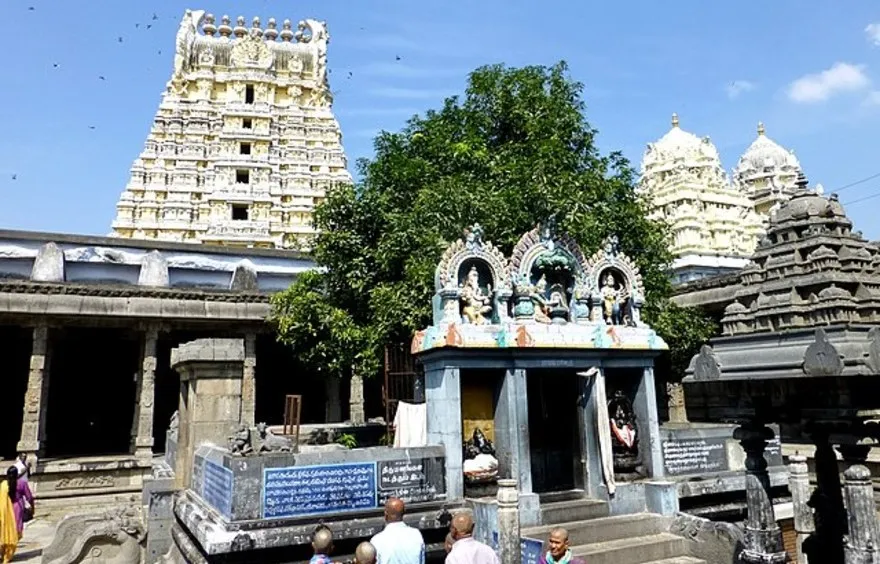
The Temple – Legend
According to sacred legend, Goddess Parvati worshipped Lord Shiva here in the form of a sand Lingam beneath a mango tree. During her penance, the nearby Vegavati River overflowed and threatened to wash away the Lingam. In response, Parvati embraced the Lingam to protect it. Moved by her devotion, Lord Shiva appeared before her and accepted her as his consort through divine marriage.
Kancheepuram Ekambareswarar Temple Architecture
The Ekambareswarar Temple spans an impressive area of about 23 acres, making it one of the largest temple complexes in Tamil Nadu. Within its vast premises lies the Nilathingal Thundam Perumal Temple, one of the 108 Divyadesams dedicated to Lord Vishnu.
Furthermore, the temple features an exquisitely carved 1,000-pillared hall, a towering 192-foot-high Rajagopuram, five expansive corridors, and a massive outer stone wall. Remarkably, around 1,008 Shivalingams decorate the inner walls of the temple, enhancing its spiritual grandeur.
The temple’s sacred tree is a mango tree believed to be over 3,500 years old. Devotees regard it as a living embodiment of the four Vedas, as it yields four different varieties of mangoes.
Reference in Literature
The presiding deity, Lord Shiva of Ekambareswarar Temple, receives exalted mention in the 7th-century Tamil Saiva canonical work Thevaram, composed by the revered Nayanar saints. Owing to this recognition, the temple holds the esteemed status of a Paadal Petra Sthalam.
Temple Timings of Ekambareswarar Temple
The temple welcomes devotees every day during the following hours:
Morning: 6:30 AM to 12:30 PM
Evening: 4:00 PM to 8:30 PM
Pooja Timings in Ekambareswarar Temple
| Pooja Name | Timing |
|---|---|
| Usha Kalam | 5:30 AM |
| Kalasanthi | 8:00 AM |
| Uchikalam | 10:00 AM |
| Sayaratchai | 6:00 PM |
| Irandam Kalam | 8:00 PM |
| Arthajamam | 10:00 PM |
Temple Festivals of Ekambareswarar Temple
The Ekambareswarar Temple celebrates several vibrant festivals throughout the year, drawing devotees from across the country. The major festivals include:
- Panguni Brahmotsavam – A grand 10-day festival during Panguni (March–April)
- Adi Krithikai (July–August)
- Avani Moolam (August–September)
- Navarathri (September–October)
- Karthikai Deepam (November–December)
- Thai Poosam (January–February)
- Chitra Pournami (April–May)
- Vaikasi Vishakam (May–June)
- Fortnightly Pradosham rituals
- Amavasya (New Moon) and Pournami (Full Moon) observances
How to reach Ekambareswarar Temple
The temple is located at a distance of 2 kilometres from Kancheepuram bus stand. One can either take an auto or walk to the temple from the bus stand. Kancheepuram Railway Station is located at less than a kilometer from the temple. The temple is about 80 kilometres from Chennai and frequent buses are available from Chennai to Kancheepuram. The nearest international airport is also at Chennai.
Ekambareswarar Temple, Kanchipuram – FAQ
Where is Ekambareswarar Temple located?
Ekambareswarar Temple is located in Kanchipuram, Tamil Nadu, one of the most sacred temple cities in South India.
Why is Ekambareswarar Temple famous?
The temple is famous as one of the Pancha Bhoota Sthalams, representing the Earth element (Prithvi). It is dedicated to Lord Shiva worshipped as Ekambareswarar.
What is special about the mango tree inside the temple?
The temple houses a sacred mango tree believed to be over 3,500 years old. According to legend, Goddess Parvati worshipped Lord Shiva under this tree.
What is the architectural highlight of Ekambareswarar Temple?
The temple features a massive Rajagopuram standing about 59 meters (192 feet) tall, making it one of the tallest temple towers in Tamil Nadu.
What is the best time to visit Ekambareswarar Temple?
The best time to visit is from October to March when the weather is pleasant, especially during Panguni Uthiram festival.
Tourist Attractions near Kanchipuram
Varadharaja Perumal Temple, located in the sacred city of Kanchipuram, ranks among the 108 Divya Desams dedicated to Lord Vishnu. The temple forms an integral part of Vishnu Kanchi, a prominent suburb of Kanchipuram. According to tradition, the revered Alwars, the twelve poet-saints of Vaishnavism, visited and glorified this holy shrine. The temple stands to the west of Gandhi Road, beside the Vedapureswarar Temple, and both shrines come under the administration of the same trust.
Image Attribution : Nithi Anand
Varadharaja Perumal Temple – Religious Importance
Built during the reign of the Chola kings around 1053 CE, Varadharaja Perumal Temple holds immense religious importance for Vaishnavites. Along with the Ekambareswarar Temple and Kamakshi Amman Temple, this shrine forms the sacred trio known as Mumurtisivam, symbolizing the combined presence of Shiva, Vishnu, and Shakti in Kanchipuram. Furthermore, tradition holds that the great Hindu philosopher Ramanuja once resided in this temple, adding to its spiritual prominence.
Historically, the temple was known by the names Hastigiri and Attiyuran. The name Hastigiri connects to the legend of Gajendra Moksham, where Indra’s elephant Airavata bears the image of Lord Vishnu. Meanwhile, the name Attiyur originates from the belief that the original idol of Varadharaja Perumal was crafted from the attimaram, or fig tree.
The Temple – Legend
According to legend, after creating the universe, Lord Brahma wished to invite Lord Vishnu to descend to Earth. To fulfill this desire, Brahma performed the Ashwamedha Yagna along with his consorts Gayatri and Savitri, without the presence of Goddess Saraswathi. As a result, the enraged Goddess Saraswathi transformed herself into the River Vegavati and surged toward the site of the yagna. However, at the conclusion of the ritual, Lord Vishnu appeared from the sacred flames along with his consort as Lord Varadharaja, thereby granting Lord Brahma’s wish and restoring harmony.
Varadharaja Perumal Temple Architecture
Varadharaja Perumal Temple stands as a vast architectural marvel spread across a 23-acre complex. The temple features an impressive hall with 100 intricately carved pillars and unfolds within three massive concentric enclosures. Various dynasties contributed to its construction over different periods, enhancing its grandeur.
The presiding deity of the temple is worshipped in a swayambhu, or self-manifested form. The idol of Lord Varadharaja Perumal measures nearly 40 feet in length and rests in a reclining posture. Devotees worship Goddess Perundevi Taayaar as the divine consort. In addition, the temple complex houses shrines dedicated to the Alwars, Acharyas, Lord Rama, Andal, and Varaha Perumal.
Varadharaja Perumal Temple – Timings & Pooja Details
The temple is open on all days from 6:00 AM to 12:30 Noon and 3:30 PM to 8:30 PM. Poojas are performed as below:
| Pooja Details | Pooja Details |
|---|---|
| Vishwaroopa Darsanam | 6:00 AM |
| First Thiruvadhanam | 6:30 to 7:30 AM and 7:30 to 9:00 AM |
| Second Nivedanam | 10:00 AM to 11:00 AM |
| Thirukkapu Sathudal (Closing of Sannidhi) | 12:30 PM to 3:30 PM |
| Sarva Darshan | 3:30 PM to 6:00 PM |
| Third Thirumalai Sathupadi & Nivedanam | 6:00 PM to 6:30 PM |
| Fourth Thiruvadanam | 7:00 PM to 8:00 PM |
| Manna Senai Theermanam | 8:00 PM to 8:30 PM |
The Varadharaja Perumal Temple – Festivals
- Brahmotsavam Festival (10 days) in the month of Vaikasi (May-June)
- Navarathri in the Tamil month of Purattasi (September-October)
- Vaikunda Ekadasi in the Tamil month of Margazhi (December-January)
How to reach Varadharaja Perumal Temple
The temple is easily accessible by bus or taxi from Kancheepuram. Kancheepuram is connected to major cities by road and is at a distance of about 75 kilometres from Chennai. Varadharaja Temple is located at a distance of 5 kilometres from Kancheepuram Railway Station. Chennai International Airport is the nearest airport to the temple at a distance of about 60 kilometres.
Epilogue
The Varadharaja Temple is an important religious center in the holy city of Kancheepuram and one of the well-visited temples in Tamil Nadu. Tourists are sure to get mesmerized by the intricate carvings and the majestic architecture of the temple in a serene atmosphere.
Varadharaja Perumal Temple, Kanchipuram – FAQ
Where is Varadharaja Perumal Temple located?
Varadharaja Perumal Temple is located in Kanchipuram, Tamil Nadu, one of the seven sacred Moksha-puris in Hindu tradition.
Why is Varadharaja Perumal Temple famous?
The temple is famous as one of the 108 Divya Desams dedicated to Lord Vishnu and for its grand annual Brahmotsavam festival.
What is special about the Athi Varadar idol?
The wooden idol of Athi Varadar, carved from fig wood, is kept submerged in the temple tank and brought out for public darshan once every 40 years.
Who are the presiding deities of the temple?
Lord Vishnu is worshipped as Varadharaja Perumal, and Goddess Lakshmi is worshipped as Perundevi Thayar.
What is the best time to visit Varadharaja Perumal Temple?
The best time to visit is from October to March for pleasant weather, especially during Vaikunta Ekadasi and Brahmotsavam celebrations.
Tourist Attractions near Kanchipuram
Kancheepuram Kailasanathar Temple
The Kailasanathar Temple stands as one of the most prominent monuments reflecting the historical grandeur of Kanchipuram. As one of the oldest temples in the region, this sacred structure showcases the excellence of Dravidian architecture developed during the Pallava dynasty. Specifically, Pallava ruler Narasimhavarman II (Rajasimhar) commissioned the construction of this temple between 680 AD and 705 AD. As a result, the temple remains a remarkable testimony to early South Indian temple architecture. The temple rises gracefully on the banks of the Vegathy River at Pilayar Palayam and is dedicated to Lord Shiva, worshipped here as Lord Kailasanathar. Moreover, people often refer to this shrine as the Sand Temple because artisans used sandstone extensively in its construction. Currently, the Archaeological Survey of India maintains the temple, ensuring the preservation of its historical and architectural significance.
Image Attribution : Sridharan Sivakumar Ji
The Temple and Its Structure
The Kailasanathar Temple complex features nearly 60 shrines, each reflecting intricate craftsmanship. However, the temple’s prime attraction lies in the narrow inner circumambulatory passage that encircles the sanctum of Lord Kailasanathar. The main Shiva Lingam stands approximately 10 feet high and uniquely displays 16 faces, symbolizing divine power and cosmic energy. Additionally, eight meditation caves appear in front of the main shrine, each housing a Shiva Lingam and offering a serene space for contemplation. At the entrance, a striking blue wooden door welcomes devotees. On either side, massive sculptures of Lord Shiva stand majestically. Furthermore, stone lions placed at the feet of these sculptures represent the distinctive emblem of the Pallava dynasty. Equally captivating, the temple’s shikara enhances the visual appeal of the structure with its elegant form and detailed carvings. The parikrama path around the sanctum remains intentionally narrow. Devotees must crawl through parts of this passage and climb steps to exit. Symbolically, this path represents the journey of life and death, signifying one’s entry into and exit from paradise. Facing the sanctum, the Nandi Mandap stands about 100 metres away, reinforcing the traditional axial alignment seen in ancient Shiva temples.
Temple Timings in Kailasanathar Temple
The Kailasanathar Temple remains open for worship every day from 6:00 AM to 12:00 PM and again from 4:00 PM to 7:00 PM, allowing devotees ample time for prayer and exploration.
Temple Festivals of Kailasanathar Temple
The temple celebrates Maha Shivaratri with immense devotion during the Tamil month of Maasi (February). Consequently, devotees consider visiting the temple during this festival highly auspicious, as the entire complex radiates spiritual vibrancy.
How to Reach Kailasanathar Temple
The temple is located about 5 kilometres from the Kanchipuram bus stand. From here, visitors can access frequent bus services to major cities such as Bangalore, Chennai, Tirupati, and Vellore. Notably, Kanchipuram lies approximately 75 kilometres from Chennai.
For rail travelers, Kanchipuram Railway Station (3 km away), Arakkonam Railway Station (29 km away), and Chennai Railway Station (around 75 km away) serve as the nearest railheads. Meanwhile, Chennai International Airport, located about 70 kilometres away, provides the closest air connectivity.
Epilogue
The Kailasanathar Temple enchants visitors with its serene spiritual ambience and extraordinary architectural brilliance. Therefore, it stands as a must-visit destination for devotees, history enthusiasts, and travelers alike. Moreover, the temple’s unique design attracts art lovers and architecture students from across the country. Photography enthusiasts can also spend quality time capturing the temple’s stunning backdrop. Ultimately, the temple’s divine aura and artistic excellence continue to draw countless devotees year after year.
Kailasanathar Temple, Kancheepuram – FAQ
Where is Kailasanathar Temple located?
Kailasanathar Temple is located in Kanchipuram (Kancheepuram), Tamil Nadu, one of the oldest temple cities in South India.
What is Kailasanathar Temple famous for?
The temple is famous as the oldest structural stone temple in Kanchipuram, built in the 7th–8th century by the Pallava king Narasimhavarman II (Rajasimha).
What is special about the architecture of Kailasanathar Temple?
The temple showcases early Dravidian architecture with sandstone carvings, intricate sculptures, and a pyramidal vimana dedicated to Lord Shiva.
Who is the presiding deity of the temple?
Lord Shiva is worshipped as Kailasanathar, representing the Lord of Mount Kailasa.
What is the best time to visit Kailasanathar Temple?
The best time to visit is from October to March when the weather is pleasant for exploring the temple’s architectural beauty.
Tourist Attractions near Kanchipuram
The Kamakshi Amman Temple stands proudly in the historic city of Kanchipuram. Dedicated to Goddess Kamakshi, a revered form of Goddess Parvati, this sacred shrine serves as one of the most important centers of worship in Tamil Nadu. Moreover, the temple holds exceptional spiritual value as one of the 51 Shakti Peethams in India, drawing devotees from across the country.
Temple Legend
Kamakshi Amman is worshipped here as Parabrahma Swaroopini. Initially, the Goddess manifested in her fierce form as Ugra Swaroopini. However, according to tradition, the great philosopher Jagadguru Adi Shankaracharya pacified her by installing the sacred Sri Chakra in front of the deity. Consequently, the Goddess assumed her calm and benevolent form known as Shantha Roopini. Furthermore, temple legends state that Goddess Kamakshi performed intense penance on a sand-made Shiva Lingam to attain Lord Shiva as her consort. Pleased with her devotion, Lord Shiva accepted her prayers and married Goddess Kamakshi, thus sanctifying this holy site.
Temple Architecture
Architecturally, the temple showcases remarkable Dravidian design. The presiding deity, Goddess Kamakshi Amman, sits gracefully in the sanctum sanctorum, flanked by the divine trinity—Lord Brahma, Lord Vishnu, and Lord Shiva. Spread across five acres, the temple features four grand entrances and several subsidiary shrines dedicated to Bangaru Kamakshi, Adi Shankaracharya, and Maha Saraswathi.
At the main entrance, devotees encounter the shrines of Mahishasura Mardhini on the right and Kala Bhairavar on the left. Moving inward, the towering Dwajasthamba leads worshippers to the shrine of Lord Vinayagar. Additionally, the outer prakaram houses shrines of Ayyappan, Saraswathi, Annapoorani, and Adi Shankaracharya.
Encircling the Gayathri Mandapam, devotees can also see shrines of Varahi, Arupalakshmi Kalvarperumal, Roopalakshmi, and Arthanariswarar. The temple tank within the premises further enhances the spiritual ambiance. Notably, a dedicated gallery illustrates the life history of Adi Shankaracharya.
Goddess Kamakshi Amman
Inside the sanctum, Goddess Kamakshi Amman appears in a serene seated posture known as Padmasana. She holds a lotus and parrot in her upper right hand, while her upper left hand carries a sugarcane bow. Additionally, the Goddess bears the divine weapons Pesa and Angusa, and a crescent-shaped moon adorns her forehead, symbolizing grace and wisdom.
Temple Timings at Kamakshi Amman Temple
The Kamakshi Amman Temple welcomes devotees daily from 5:30 AM to 12:15 PM in the morning and from 4:00 PM to 8:15 PM in the evening. Furthermore, the temple remains open until 9:30 PM on Fridays and extends darshan hours until 10:30 PM on Pournami (full moon) days, allowing devotees ample time for worship.
Pooja Details of Kamakshi Amman temple
The temple follows the below mentioned pooja timings, the timings however is subject to changes on festive days.
| Pooja Details | Pooja Details |
|---|---|
| Abhishekam (3 times in a day) | 5:30 AM, 10:30 AM and 4:00 PM |
| Sahasranama Archana (everyday) | 9:00 AM to 10:00 AM and 7:00 PM to 8:00 PM |
| Ashtotthara Archana (everyday) | 7:00 AM to 12 Noon and 6:00 PM to 8:00 PM |
| Chandana Alankara (on Wednesdays and Saturdays) | 4:30 PM |
| Navavarana Pooja (on Pournami/Full Moon days every month) | After 9:30 PM |
| Swarna Ratha (on Fridays, Full Moon Days, New Moon Days, and 1st Day of Tamil months) | 7:30 PM |
Temple Festivals in Kamakshi Amman temple
The annual festival is held during the Tamil month of Masi (February-Mid), suring which the Ther (chariot) festival and Theppam (float) festival is celebrated. Other festivals observed in the temple include Aadi and Aippasi Pooram, Navarathri, Sankara Jayanthi and Vasantha Utsavam.
How to reach Kamakshi Amman temple
Kancheepuram city is well connected of the state through national highways and roads. The main bus stand is located at a distance of less than one kilometer from the temple. Kancheepuram Railway Station (3 kilometres away), Arakonnam Railway Station (29 kilometres away) and Chennai Railway Station (around 75 kilometres away) are the nearest rail heads. Chennai International Airport (68 kilometres away) is the nearest airport to the temple.
Epilogue
The spirituality of this historical temple is an experience in itself and its scenic beauty should be witnessed especially during early mornings and at night. The temple with its sculptures and bright lights at night make it an excellent site for photography.
Tourist Attractions near Kanchipuram
Hare Island is a scenic coastal destination located near the Thoothukudi Port in Thoothukudi. The island lies about 9 kilometres from the old bus stand of Thoothukudi city, making it easily accessible for local visitors and tourists.
Gulf of Mannar Marine National Park
Importantly, Hare Island forms a part of the Gulf of Mannar Marine National Park, one of India’s richest marine biosphere reserves. This protected region includes 21 small islands and stretches nearly 160 kilometres between Thoothukudi and Dhanushkodi. Because of this ecological significance, the area supports diverse marine life and coastal ecosystems.
Size & Accessibility
Covering an area of 1.29 square kilometres, Hare Island stands as the largest island in the Gulf of Mannar. Although it was once completely surrounded by water, the island is now connected to the mainland by road, allowing visitors to reach it conveniently without boats.
Picnic Spot & Visitor Experience
Today, Hare Island serves as a popular picnic and leisure spot, especially during weekends and public holidays. Due to its proximity to the city, families and groups frequently visit to enjoy fresh sea air and peaceful surroundings. Moreover, the calm coastal environment makes the island an ideal escape for relaxation and nature appreciation.
Why Visit Hare Island?
Overall, Hare Island offers a refreshing blend of nature, accessibility, and tranquility, making it a perfect short getaway near Thoothukudi.
Tourist Attractions near Thoothukudi
The Arulmigu Subramanya Swamy Temple is located in the town of Tiruchendur along the scenic shores of the Bay of Bengal. As one of the most revered ancient Hindu temples, it is dedicated to Lord Murugan. Most importantly, the temple is recognised as one of the six sacred abodes, known as the Arupadaiveedu, of Lord Murugan.
Legend
According to legend, Tiruchendur is the sacred place where Lord Murugan, the second warrior son of Lord Shiva, defeated the powerful demon Surapadman. Furthermore, it is believed that the divine demigods wished to worship Lord Murugan at a location blessed with mountains, the sea, and a river. Therefore, Tiruchendur was chosen as the ideal divine setting.
Structure of the Tiruchendur Subramanya Swamy Temple
The Raja Gopuram, which serves as the main temple tower, stands on the western side of the temple. Unlike most temples where the Raja Gopuram rises on the eastern side, this unique orientation exists because the sea lies very close to the eastern boundary of the temple.
Moreover, the nine-tiered gopuram rises to an impressive height of 138 feet, making it a prominent landmark. Inside the sanctum sanctorum, Lord Subramanyam appears in a majestic standing posture. Additionally, devotees can find the shrine of Sivalinga Jagannatha located to the left of the main deity.
Temple Festivals of Tiruchendur Subramanya Swamy Temple
- Brahmotsavam is celebrated twice every year during the Tamil months of Masi (February–March) and Aavani (August–September). Consequently, thousands of devotees gather for the 12-day-long celebrations.
- The Vasantha Festival is a ten-day celebration held during the Tamil month of Chittirai (April–May).
- In addition, Vaikasi Visagam is observed during the Tamil month of Vaikasi (May–June).
- Finally, the Skanda Sasti Festival is a seven-day celebration conducted in the Tamil month of Aippasi (October–November).
Timings of Tiruchendur Subramanya Swamy Temple
Temple is open on all days from 5:00 AM to 9:00 PM.
Pooja Details of Tiruchendur Subramanya Swamy Temple
| Pooja Name | Pooja Timing |
|---|---|
| Suprabatam | 5:10 AM |
| Viswaroopa Darshanam | 5:30 AM |
| Dwajasthamba Namaskaram | 5:45 AM |
| Udaya Marthanda Abhishekam | 6:15 AM |
| Udaya Marthanda Deeparadhanai | 7:00 AM |
| Kalasandhi Pooja | 8:00 to 8:30 AM |
| Kalasha Pooja | 10:00 AM |
| Uchikala Abhishekam | 10:30 AM |
| Uchikala Deeparadhanai | 12:00 Noon |
| Sayaratchai Pooja | 5:00 PM |
| Arthasama Abhishekam | 7:15 PM |
| Arthasama Pooja | 8:15 PM |
| Ekanda Seva | 8:30 PM |
| Ragasia Deeparadhanai | 8:45 PM |
| Nadai Thirukappiduthal | 9:00 PM |
How to reach Tiruchendur Subramanya Swamy Temple
The temple is located at a distance of 60 kilometres south-east of Tirunelveli, 40 kilometres from Tuticorin and 75 kilometres north-east of Kanyakumari.
Tiruchendur is well connected with many major cities across South India. Thoothukudi Railway Station is the nearest station to the temple at a distance of around 42 kilometres. The nearest airport is at Madurai (around 99 kilometres away).
Tiruchendur Subramanya Swamy Temple – FAQ
Where is Tiruchendur Subramanya Swamy Temple located?
The temple is located in Tiruchendur in Thoothukudi district, Tamil Nadu, uniquely situated along the shores of the Bay of Bengal.
Why is Tiruchendur Temple famous?
Tiruchendur Temple is famous as one of the six sacred Arupadai Veedu temples of Lord Murugan and for its coastal location beside the sea.
What is the significance of Tiruchendur in Hindu mythology?
According to legend, Lord Murugan defeated the demon Surapadman at Tiruchendur, making it a powerful spiritual site associated with Skanda Sashti.
What are the major festivals celebrated at Tiruchendur Temple?
The temple’s major festivals include Skanda Sashti, Vaikasi Visakam, and Aavani Festival, attracting lakhs of devotees every year.
What is the best time to visit Tiruchendur Temple?
The best time to visit is between October and March when the weather is pleasant, especially during Skanda Sashti for a vibrant devotional experience.