
Chennai, the capital city of Tamil Nadu, beautifully balances rapid urban development with rich cultural traditions. Amidst its busy roads and vibrant neighborhoods, the city offers several well-maintained parks that provide a refreshing escape into nature. These green spaces allow residents and visitors to slow down, breathe fresh air, and reconnect with the outdoors.
Nature, Relaxation & Urban Life
Chennai’s parks actively serve as peaceful retreats where greenery, open spaces, and wildlife coexist in harmony. Tall trees, landscaped lawns, and walking paths create an inviting atmosphere for relaxation. As a result, people of all age groups visit these parks daily for morning walks, yoga, jogging, and quiet reflection.
Ideal Spaces for Families & Fitness
Many parks in Chennai cater specifically to families and fitness enthusiasts. Children enjoy dedicated play areas, while elders find shaded benches and calm surroundings for rest. At the same time, fitness lovers use jogging tracks and open grounds for exercise. Therefore, these parks play an important role in promoting a healthy lifestyle within the city.
Wildlife & Scenic Experiences
Some parks also support local biodiversity by hosting birds, butterflies, and small animals. Visitors often spot colorful birds early in the morning, making these parks ideal for nature lovers and photographers. Moreover, seasonal flowers and landscaped gardens add visual charm throughout the year.
Why Visit Parks in Chennai?
Whether you seek a peaceful stroll, quality family time, or a refreshing break from city life, Chennai’s parks offer something for everyone. They strengthen the bond between people and nature while enhancing the city’s livability. Thus, exploring parks in Chennai remains one of the simplest and most rewarding experiences for both locals and tourists.
The Chitrangudi Bird Sanctuary forms an integral part of Chitrangudi village in the Ramanathapuram District. Covering an area of about 4763 sq km, the region received official protection and was declared a bird sanctuary in the year 1989.
The sanctuary lies adjacent to the Kanjirankulam Bird Sanctuary and is popularly known as Chitrangudi Kanmoli. It is located within the community tank embankment and the surrounding water-holding channel, which extends approximately 15 metres from the base of the embankment.
Image Attribution : rajesh.udhayan
Fauna of Chitrangudi Sanctuary
This scenic, crescent-shaped sanctuary attracts a wide variety of migratory birds during the winter season. As the area provides excellent nesting and feeding conditions, it has become a preferred nesting ground for colonial birds and heronry species.
In particular, the months between October and February offer the best opportunity to observe colourful migratory birds arriving from distant regions. The sanctuary supports diverse fauna, including Spot-billed Pelican, Open-billed Stork, Little Egret, Large Egret, and Purple Heron.
Flora of Chitrangudi Sanctuary
In addition to its rich birdlife, the sanctuary is equally known for its distinctive vegetation. The most prominent feature of the landscape is the widespread presence of Babul trees.
Furthermore, the Chitrangudi region largely consists of dry deciduous forest interspersed with grassy vegetation. Several other tree species such as Tamarind, Silk Cotton, Fig, Neem, Palmyra, Drumstick trees, and various medicinal plants thrive naturally in this area.
Epilogue
Chitrangudi Bird Sanctuary remains open throughout the year and serves as an ideal weekend getaway for nature enthusiasts. Bird watching and leisurely nature walks, therefore, remain the most rewarding ways to experience the tranquil environment of the sanctuary.
Accommodation facilities are available at the PWD Guest House in Mudukalathur, located approximately 10 kilometres away. In addition, visitors can also stay at the Forest Rest House in Sayalgudi and Paramakudi.
How to reach Chitrangudi Bird Sanctuary
Chitrangudi Bird Sanctuary can be reached by road from Mudukalathur (4 kilometres), Sayalgudi (12 kilometres), Ramanathapuram (45 kilometres) and Madurai (120 kilometres). The nearest railway station to the sanctuary is at Paramakudi (around 34 kilometres away) and nearest airport is at Madurai(around 96 kilometres away).
Chitrangudi Bird Sanctuary – FAQ
Where is Chitrangudi Bird Sanctuary located?
Chitrangudi Bird Sanctuary is located in Ramanathapuram district of Tamil Nadu, near Mudukulathur, and is part of a protected wetland ecosystem.
Why is Chitrangudi Bird Sanctuary famous?
The sanctuary is famous for attracting migratory birds such as painted storks, open-bill storks, herons, and egrets during the winter season.
What is the best time to visit Chitrangudi Bird Sanctuary?
The best time to visit is between November and February when migratory birds arrive and the wetlands are filled with water.
Is Chitrangudi Bird Sanctuary suitable for bird photography?
Yes, the sanctuary offers excellent opportunities for bird watching and wildlife photography, especially during early morning hours.
Are there entry fees or facilities available?
Visitors may need permission from the Forest Department. Basic facilities are limited, so it is advisable to plan your visit accordingly.
Tourist Attractions near Ramanathapuram
Kunthukal Beach & Vivekananda Memorial Hall, Rameswaram
Kunthukal Beach lies in the quiet fishing village of Kunthukal, located about 12 kilometres from Rameswaram. With its crystal-clear blue waters and gentle tides, this scenic shoreline offers a calm and refreshing coastal experience. Moreover, the peaceful ambience makes Kunthukal Beach an ideal spot for relaxation away from crowded tourist areas.
Adjacent to the beach, near Pamban, stands the Vivekananda Memorial Hall. This memorial commemorates the historic return of Swami Vivekananda to India on January 26, 1897, after his iconic participation in the Parliament of World Religions held in Chicago. Swami Vivekananda, a revered Indian Hindu monk, was a devoted disciple of Sri Ramakrishna Paramahansa and played a vital role in introducing Indian philosophy to the Western world.
More About Vivekananda Memorial Hall
- The Vivekananda Memorial Hall was inaugurated on January 26, 2010. Prior to its construction, a simple pillar marked the site in memory of Swami Vivekananda.
- The memorial proudly houses a six-foot statue of Swami Vivekananda alongside Ramanathapuram King Baskara Sethupathi, who generously sponsored his journey to Chicago.
- In addition, the complex features a spiritual library and a serene meditation hall, encouraging visitors to reflect and unwind.
- The memorial is situated close to Kunthukal Beach and is approximately 15 kilometres from the Rameswaram bus stand.
How to Reach Kunthukal Beach
Kunthukal is located nearly 12 kilometres from Rameswaram. Rameswaram enjoys excellent road and rail connectivity with major cities such as Chennai, Madurai, Coimbatore, and Trichy. Furthermore, Madurai Airport, situated about 163 kilometres away, serves as the nearest airport for travellers heading to Kunthukal Beach.
Tourist Attractions near Kunthukal Beach:
- Pamban Bridge
- APJ Abdul Kalam Memorial – Rameswaram
- Ramanathaswamy Temple, Rameswaram
- Agni Theertham Beach
- Dhanushkodi
Uthirakosamangai Mangalanatha Swamy Temple, located in Ramanathapuram, is an ancient and sacred Hindu temple dedicated to Lord Shiva. Believed to be over 3,000 years old, this revered shrine stands as one of the oldest Shaivite temples in Tamil Nadu. At present, the Hindu Religious and Charitable Endowments Department of the Government of Tamil Nadu administers and maintains the temple.
More About Uthirakosamangai Mangalanatha Swamy Temple
Uthirakosamangai holds immense spiritual, historical, and literary significance. Over the centuries, saints, poets, and devotees have celebrated this sacred site for its divine legends and unique traditions.
- Notably, the temple finds mention in the devotional hymns of the 9th-century saint Manickavasagar and later in the verses of the 15th-century Tamil poet Arunagirinathar.
- The main shrine of Lord Shiva exists in the form of a Swayambumurthi, meaning the Shiva Lingam is self-manifested.
- Over different periods, Pandya rulers such as Achutappa Nayak, Muthuveerappar, and the kings of Ramanathapuram contributed to the temple’s construction and expansion.
- Interestingly, the name Uthirakosamangai originates from Tamil words—Uthiram meaning “secrets,” Kosam meaning “to convey,” and Mangai referring to Goddess Parvati. According to belief, Lord Shiva revealed the sacred secrets of the Vedas to Parvati at this very place.
- The temple houses prominent shrines of Mangalanathar (Lord Shiva), Mangalambigai (Goddess Parvati), and Natarajar. Remarkably, the Nataraja idol stands six feet tall and is carved from Maragatha, a rare emerald stone.
- Unlike most Shiva temples, devotees worship the presiding deity using Thazhambu (screw pine flower), which is considered highly auspicious here.
Temple Timings
The temple welcomes devotees every day from 6:00 AM to 11:00 AM and again from 4:00 PM to 8:00 PM.
How to Reach the Temple
Uthirakosamangalam Temple lies about 17 kilometres from Ramanathapuram town. Ramanathapuram Railway Station serves as the nearest railhead. Meanwhile, Madurai Airport, located nearly 110 kilometres away, offers the closest air connectivity to the temple.
Nearby Tourist Attractions
- Ramanathaswamy Temple, Rameswaram
- Agni Theertham, Rameswaram
- Pamban Bridge, Rameswaram
- Dhanushkode, Rameswaram
- Dr. APJ Abdul Kalam Memorial, Rameswaram
- Devipattinam, Navashabashanam
- Aadhi Jaganatha Perumal Temple – Thiruppullani (about 10 kilometres from Ramanathapuram)
- Erwadi Dargah, Kilakkarai
Sri Adi Jagannatha Perumal Temple, situated in Thiruppullani, stands as one of the revered 108 Divya Desams dedicated to Lord Vishnu. Notably, the Ramanathapuram Samasthan Devasthanam manages and maintains this ancient shrine, while the Hindu Religious and Charitable Endowments Department of the Government of Tamil Nadu audits its accounts. At this sacred site, devotees worship Lord Vishnu as Adi Jagannatha Perumal in a reclining posture. Meanwhile, Goddess Lakshmi appears as Padmasini, symbolizing divine grace, prosperity, and harmony alongside the presiding deity.
Legend and History of Sri Adi Jagannatha Perumal Temple
According to the Indian epic Ramayana, Lord Rama, an incarnation of Lord Vishnu, rested on sacred Dharba grass at this location. During this period, he prayed to Samudraraja, the God of the Ocean, seeking guidance to cross the sea and reach Lanka. As a result, the place earned the name Dharbasayanam, meaning “the place of resting on Dharba grass. In addition, another legend from the Ramayana recounts that King Dasaratha arrived here with his queens to worship the deity. Following their prayers, he received sacred Payasam at this site. Consequently, he shared it with his wives, which eventually led to the birth of Lord Rama and his brothers.
From a historical perspective, the temple’s earliest structure dates back to the Chola period. Subsequently, the Pandya kings expanded and enhanced the complex. Moreover, rulers of Ramanathapuram, along with the Jaffna kings and the Vijayanagara Empire, contributed significantly to the temple’s architectural and spiritual growth.
Architecture of Sri Adi Jagannatha Perumal Temple
Architecturally speaking, Sri Adi Jagannatha Perumal Temple impresses visitors with its timeless elegance and sacred atmosphere. Built in the traditional Dravidian style, the temple rises gracefully in the village of Thiruppullani. Furthermore, the east-facing five-tiered Rajagopuram forms a striking and majestic entrance. Inside the complex, worshippers can see shrines dedicated to Adi Jagannatha Perumal along with Bhudevi and Sridevi in seated postures. Separately, Goddess Padmasini has her own shrine, emphasizing her distinct importance. Additionally, the temple houses the shrine of Dharbasayana Ramar in a reclining posture and a rare metal idol of Lord Krishna from the 13th-century Pandya era.
Literary References and Spiritual Importance
Sri Adi Jagannatha Perumal Temple occupies a prominent place in Tamil Vaishnavite literature. The sacred site finds mention in the renowned Kamba Ramayanam. Furthermore, Thirumangai Azhwar praised the temple in twenty verses of his Periya Thirumozhi, which forms part of the revered Nalayira Divya Prabandham.
Temple Timings – Sri Adi Jagannatha Perumal Temple
The temple remains open from 7:00 AM to 12:30 PM and from 3:30 PM to 8:30 PM.
The temple rituals performed during the day are:
| Pooja Name | Timings |
|---|---|
| Usha kalam | 7:00 AM |
| Kalasanthi | 8:00 AM |
| Uchikalam | 12:00 Noon |
| Sayaratchai | 6:00 PM |
| Irandan Kalam | 7:00 PM |
| Arthajamam | 10:00 PM |
Thiruppullani Sri Adi Jagannatha Perumal Temple Festivals
The major festivals celebrated in the temple are the Panguni Brahmotsavam in the Tamil month of Panguni (March-April) and Rama Navami Utsavam during the Tamil month of Chittirai (April-May). Other major festivals include Vaikunta Ekadasi, Krishna Jayanti, Pongal and Diwali
.
How to reach Sri Adi Jagannatha Perumal Temple
The temple is located at a distance of 66 kilometres from Rameshwaram and 15 kilometres from Ramanathapuram. Nearest railway station to the temple is located at Ramanathapuram. Madurai airport is the nearest terminal, around 125 kilometres from the temple.
Sri Adi Jagannatha Perumal Temple, Thiruppullani – FAQ
What is Sri Adi Jagannatha Perumal Temple famous for?
The temple is famous for its association with the Ramayana. It is believed that Lord Rama worshipped Lord Vishnu here before building the Rama Setu to Lanka.
Where is Sri Adi Jagannatha Perumal Temple located?
The temple is located in Thiruppullani near Ramanathapuram in Tamil Nadu, close to the sacred coastal region of Rameswaram.
Who are the presiding deities of the temple?
Lord Vishnu is worshipped as Adi Jagannatha Perumal, and the temple also houses Dharba Sayana Ramar, depicting Lord Rama in a reclining posture on sacred grass (dharba).
Is Thiruppullani Temple a Divya Desam?
Yes, the temple is one of the 108 Divya Desams, the sacred Vishnu temples praised in the hymns of the Alvars.
What is the best time to visit the temple?
The ideal time to visit is between October and March when the weather is pleasant for temple visits and pilgrimage travel.
Tourist Attractions in Ramanathapuram
- Pamban Bridge – Rameswaram
- Dhanushkode – Rameswaram
- Dr. APJ Abdul Kalam Memorial – Rameswaram
- Devipattinam Navashabashanam – Ramanathapuram
- Uthirakosamangai Mangalanatha Swamy Temple – Ramanathapuram
- Kunthukal Beach – Rameswaram
- Chitrangudi Bird Sanctuary – Ramanathapuram
Navabashanam Temple derives its name from the Tamil words Nava, meaning nine, and Bashanam, meaning stones. This sacred Hindu temple is located in Devipattinam, an ancient coastal town and historic port in Ramanathapuram district of Tamil Nadu. The temple is dedicated to the nine planetary deities, collectively worshipped as the Navagrahas in Hindu tradition.
Earlier, the Sivaganga Devasthanam administered and maintained the temple. However, in 2012, the Hindu Religious and Charitable Endowments Department of the Government of Tamil Nadu assumed control. As a result, the temple now benefits from systematic management and regular upkeep.
Location of the Navagraha Temple
The Navagraha Temple stands uniquely within the waters of the Bay of Bengal. Therefore, it is considered one of the most distinctive pilgrimage centres in Tamil Nadu. The Navagraha deities appear in a matrix-like formation. They are represented by nine sacred stones placed in shallow sea waters.
An entrance arch on the shoreline welcomes devotees. From there, a pathway measuring about 100 yards (91 metres) leads toward the sanctum. In addition, four stepped pathways descend into the sea from the four cardinal directions. These steps provide easier access to the sacred stones.
Depending on tide levels, visitors can clearly view the nine stones symbolising the planetary deities. During low tide, access becomes even more convenient.
Legend and History of Navabashanam Temple
According to popular legend, Lord Rama, an incarnation of Lord Vishnu, worshipped the Navagrahas here. He performed this worship before beginning his expedition to Lanka to rescue Goddess Sita from Ravana.
It is believed that Lord Rama fashioned the Navagraha idols using sacred clay. He then installed them at this very site. Consequently, Navabashanam gained immense spiritual importance. Devotees regard it as a sacred place where divine planetary worship began under Lord Rama’s guidance.
Timings and Festivals of Navagraha Temple
The Navagraha Temple remains open daily from 4:30 AM to 6:30 PM. Throughout the year, several important festivals draw large crowds.
The major festivals include Aadi Amavasai and Aadi Pournami during July–August. In addition, Thai Amavasai in January–February attracts thousands of pilgrims. During these auspicious days, devotees gather in large numbers. They offer prayers, perform rituals, and seek relief from planetary doshas.
How to reach Devipattinam Navabashanam
Navabashanam is located in Devipattinam. It lies about 66 kilometres along the East Coast Road. Moreover, it is just 14 kilometres from the district headquarters of Ramanathapuram.
Ramanathapuram connects well by road and rail to major cities across Tamil Nadu. Therefore, reaching the temple is convenient for pilgrims.
The nearest airport is Madurai Airport, located around 120 kilometres away. Alternatively, Tuticorin Airport is about 125 kilometres from Ramanathapuram.
Navagraha Temple at Devipattinam – FAQ
What is special about the Navagraha Temple at Devipattinam?
The Navagraha Temple at Devipattinam is unique because the nine planetary deities (Navagrahas) are represented by stone pillars installed in the sea, known as Navapashanam.
What is the historical significance of this temple?
According to legend, Lord Rama installed the Navagrahas here and performed prayers before proceeding to Lanka, linking the site to the Ramayana.
Where is the Navagraha Temple located?
The temple is located in Devipattinam in Ramanathapuram district, Tamil Nadu, along the Bay of Bengal coast.
What rituals are performed at Devipattinam Navagraha Temple?
Devotees perform Navagraha dosha parihara poojas, offering prayers while standing in the shallow sea waters around the stone pillars.
What is the best time to visit Devipattinam?
The ideal time to visit is from October to March when the weather is pleasant and suitable for pilgrimage and coastal travel.
Nearby Attractions to Navabashanam Temple
Devipattinam, a serene coastal town, is a popular pilgrimage destination with the Navabashanam Temple as its centerpiece. Beyond the temple, visitors can explore nearby attractions like the sacred Ramanathaswamy Temple in Rameswaram, the historic Dhanushkodi, and the scenic Pamban Bridge. Other notable sites include the Dr. APJ Abdul Kalam Memorial and the holy Agniteertham. These attractions offer a unique blend of spirituality, history, and natural beauty, making Devipattinam a worthwhile destination for travelers seeking a meaningful experience.
One of the most popular tourist attractions in the temple town of Rameswaram is the memorial dedicated to India’s renowned scientist, visionary leader, and former President, Dr. APJ Abdul Kalam. The memorial honours his life, ideals, and invaluable contributions to the nation.
The Dr. APJ Abdul Kalam National Memorial was inaugurated by the Prime Minister of India, Mr. Narendra Modi, on 27th July 2017. Since then, the memorial has consistently attracted visitors from across the country. The APJ Abdul Kalam Memorial spreads across 2.11 acres and stands on the very site where Dr. Kalam’s mortal remains were laid to rest on 27th July 2015. With an investment of Rs. 20 crore, authorities completed the construction within a remarkably short span of just nine months.
More about the Dr. APJ Abdul Kalam Memorial
- An Initiative of DRDO: The Defence Research and Development Organisation (DRDO), with which Dr. Kalam remained closely associated for several years, took the initiative to construct this memorial as a tribute to his service to the nation.
- Symbol of National Integration: The memorial strongly reflects India’s unity in diversity, a value Dr. Kalam deeply admired. Notably, the entrance resembles India Gate, while its doorway mirrors the entrance of the Brihadeeswara Temple in Thanjavur. Additionally, the main dome draws inspiration from the Rashtrapati Bhavan. Together, these elements create a harmonious blend of Mughal and Indian architectural styles. Materials, plants, and flowers were sourced from various parts of the country, further symbolising national unity.
- The Memorial’s Inside: The interior of the memorial actively reflects the teachings, vision, and beliefs of Dr. Kalam. It features four exhibition halls, each highlighting a distinct phase of his life. Moreover, exhibits on the Pokhran nuclear tests, along with replicas of rockets and missiles, celebrate his outstanding contributions to space science and national defence.
- Statue of the Missile Man of India: Another major attraction is the life-size statue of Dr. Kalam, inaugurated in 2016. This statue, placed at the centre of the memorial, portrays him playing the veena. In addition, two silicon statues depict Dr. Kalam in his presidential attire, shown in both sitting and standing postures.
- The Garden: The garden surrounding the memorial resembles traditional Mughal-style landscaping. Designers carefully selected plants and flowers from different states, keeping Dr. Kalam’s preferences in mind. Furthermore, a model of the Agni missile stands at the rear of the memorial, reinforcing his legacy as a pioneering scientist.
Opening Time:
The Memorial is open in the morning from 9:00 AM to 1:00 PM and from 2:00 PM to 5:00 PM.
How to reach Dr. APJ Abdul Kalam Memorial
The memorial is less than 3.5-kilometers distance from Rameswaram Bus stand. Rameswaram is well connected by road and rail with Chennai, Madurai, Coimbatore, Trichy and other important cities. The nearest airport is at Madurai, 163 kilometres from Rameswaram.
Dr. APJ Abdul Kalam Memorial – FAQ
Where is Dr. APJ Abdul Kalam Memorial located?
Dr. APJ Abdul Kalam Memorial is located in Pei Karumbu near Rameswaram in Ramanathapuram district, Tamil Nadu.
Why is the Dr. APJ Abdul Kalam Memorial important?
The memorial honors India’s former President Dr. A.P.J. Abdul Kalam, known as the “Missile Man of India,” celebrating his contributions to space research, defense technology, and education.
What can visitors see at the memorial?
Visitors can explore galleries showcasing Dr. Kalam’s photographs, personal belongings, awards, books, and models of missiles and rockets related to his scientific achievements.
What are the visiting hours of Dr. APJ Abdul Kalam Memorial?
The memorial is generally open daily from 8:00 AM to 7:00 PM, though timings may vary on public holidays.
Is there an entry fee to visit the memorial?
No, entry to Dr. APJ Abdul Kalam Memorial is free for visitors.
Nearby Tourist Attractions:
- Pamban Bridge
- Kunthukal Beach – Rameswaram
- Ramanathaswamy Temple, Rameswaram
- Agni Theertham Beach
- Dhanushkodi
Overview
Dhanushkodi lies at the southern tip of Rameswaram, bordered by the Bay of Bengal on one side and the Indian Ocean on the other. As a result of this unique location, the town offers dramatic coastal views. The name Dhanushkodi literally translates to “the tip of the bow,” symbolizing its mythological and geographical significance.
The Devastating Cyclone of 1964
Until December 22, 1964, Dhanushkodi functioned as a bustling and densely populated town. However, a catastrophic cyclonic storm completely washed away the settlement, leaving it in ruins.
Today, visitors can still witness the shattered remnants of the Church, Railway Station, and Passport Office, which stand as silent reminders of the tragedy. At present, only around 500 people live in Dhanushkodi, primarily fishermen and their families who have resettled in the area.
Popular Attractions in Dhanushkodi
Dhanushkodi Beach
The Dhanushkodi Beach stretches for nearly 15 kilometres, offering vast and uninterrupted coastal scenery. However, the shoreline frequently experiences high tides and strong currents, making swimming unsafe for non-swimmers.
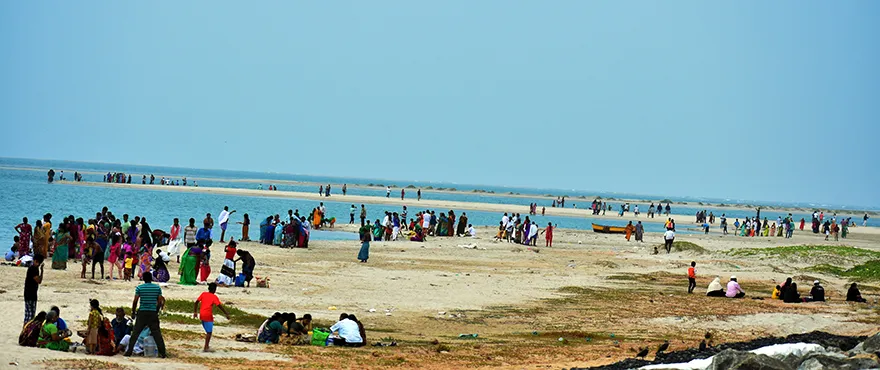
Nevertheless, a peaceful stroll or a bike ride along the beach delivers an unforgettable and exhilarating experience for visitors.
Rama Sethu or Arichal Munai View Point
Arichal Munai marks the exact point where the Indian Ocean meets the Bay of Bengal, and visitors can clearly view this natural confluence at Dhanushkodi.
According to legend, this is the sacred spot where Lord Rama pointed the end of his bow and commanded his army to build a bridge across the sea to Lanka (Sri Lanka) to rescue Goddess Sita. Therefore, this location holds immense mythological importance.
The southernmost end of Rameswaram and the meeting point of the two seas are collectively identified as Arichal Munai or Rama Sethu.
How to Reach Dhanushkodi
To facilitate tourism, the Government of India introduced public transportation services to Dhanushkodi. Visitors can reach the destination using government buses, auto-rickshaws, or private vehicles such as bikes, cars, and vans.
Dhanushkodi is situated approximately 26 kilometres from the Rameswaram bus stand and about 24 kilometres from the railway station. Moreover, Rameswaram connects well with major cities through road and rail networks. For air travel, the nearest airport is located at Madurai, nearly 198 kilometres away.
Epilogue
Ultimately, the haunting beauty of Dhanushkodi leaves a lasting impression on every visitor. The expansive beach, roaring tides, crystal-clear blue waters, and haunting ruins of the once-thriving town together evoke a deep sense of wonder and reflection.
Dhanushkodi – FAQ
Why is Dhanushkodi called a ghost town?
Dhanushkodi is called a ghost town because it was destroyed by a powerful cyclone in 1964. After the disaster, the town was declared unfit for habitation, leaving behind haunting ruins.
Where is Dhanushkodi located?
Dhanushkodi is located at the southeastern tip of Rameswaram Island in Ramanathapuram district, Tamil Nadu, where the Bay of Bengal meets the Indian Ocean.
What are the main attractions in Dhanushkodi?
Key attractions include the abandoned church ruins, old railway station remains, Arichal Munai (land’s end), and the serene beach views.
Is Dhanushkodi connected to the Ramayana?
Yes, according to legend, Lord Rama marked the spot here with his bow (Dhanush) before the construction of Rama Setu to Lanka, giving the town its name.
What is the best time to visit Dhanushkodi?
The best time to visit is from October to March when the weather is pleasant and ideal for sightseeing.
Tourist Attractions near Dhanushkodi:
- Ramanathaswamy Temple, Rameswaram
- Agni Theertham Beach
- APJ Abdul Kalam Memorial – Rameswaram
- Kunthukal Beach
- Pamban Bridge
Pamban Bridge: India’s First Sea Bridge – History, Facts & Travel Guide
The Pamban Bridge stands proudly as India’s first sea bridge and showcases an exceptional engineering achievement. The bridge directly connects the holy town of Rameswaram on Pamban Island with mainland India. Stretching nearly 2 kilometres across the sea and supported by 143 sturdy piers, the Pamban Bridge holds the distinction of being the second-longest sea bridge in India, next only to the Bandra–Worli Sea Link in Mumbai. Situated in Rameswaram, which lies at the southeastern tip of India, this century-old bridge serves as the lifeline that links the island town to the mainland, making it historically, culturally, and strategically significant.
Unique Design and Engineering Excellence of Pamban Bridge
Engineers designed the Pamban Bridge as India’s first cantilever bridge, making it truly unique. Most notably, they constructed a double-leaf bascule section over a century ago to ensure uninterrupted ferry movement. When the bridge opens, it splits into two sections, allowing ships and ferries to pass smoothly through the Palk Strait between Rameswaram and Pamban Island. This opening mechanism creates a breathtaking sight for visitors. Moreover, the bridge consists of over 140 spans, with the famous 114th span known as the Scherzer span. Altogether, the bridge measures 2.057 kilometres in length and includes 145 steel girder spans of 12.20 metres each, along with a 225-metre Scherzer rolling lift navigational span.
Construction History
Construction of the Pamban railway bridge began in 1911, and authorities commissioned it on February 24, 1914. German engineer Scherzer designed the central opening span, which allows ships and ferries to move freely beneath the bridge. On average, 10 to 15 boats and small vessels pass under the bridge every month. Although the devastating cyclone of 1964 destroyed the nearby port town of Dhanushkodi, the rolling lift center span of the bridge remained undamaged. Engineers and workers used nearly 4,000 tonnes of cement and the efforts of around 600 workers to complete this monumental structure.
Maintenance and Safety Measures
After the tragic train accident caused by the 1964 cyclone, Indian Railways strengthened safety measures on the Pamban Bridge. Authorities installed wind velocity monitoring devices to continuously assess wind conditions across the bridge. Whenever wind speeds exceed 58 kmph, officials immediately halt train services to ensure passenger safety. In addition, Indian Railways converted the bridge’s railway line from metre gauge to broad gauge in 2007, significantly improving rail connectivity to Rameswaram.
Pamban Road Bridge – A Scenic Parallel Wonder
Alongside the railway bridge, the Annai Indira Gandhi Road Bridge connects Rameswaram with the mainland. Authorities opened this road bridge in 1988, and it runs parallel to the railway bridge. Measuring about 2.3 kilometres in length, the bridge offers spectacular views of the sea, fishing boats, and the iconic railway bridge below. Driving across this bridge delivers a thrilling experience, especially during sunrise and sunset when golden light reflects on the water. As a result, photographers and tourists frequently stop here to admire the scenery. Additionally, this bridge provides the perfect vantage point to watch trains glide across the sea.
The New Pamban Bridge: India’s First Vertical Sea Bridge
To meet modern transportation demands, authorities began constructing the New Pamban Bridge in February 2020. This advanced structure spans 2,070 metres and introduces India’s first vertical lift sea-bridge technology, which allows sections of the bridge to rise vertically for maritime traffic. Engineers designed the bridge to support double railway tracks and future electrification. Standing 3 metres higher than the old bridge, the new structure significantly improves safety and capacity. By September 2024, authorities completed construction and successfully conducted trial runs in October 2024. The bridge is scheduled to open for traffic on April 6, 2025, marking a major milestone in India’s infrastructure journey.
How to Reach Pamban Bridge
Pamban Bridge lies approximately 14.8 kilometres from Rameswaram. Travelers can easily reach the bridge using public or private transport from Ramanathapuram and Rameswaram. Rameswaram also has its own railway station, which ensures convenient rail access. For air travel, visitors can use Madurai Airport, located about 120 kilometres away, or Thoothukudi Airport, which lies around 145 kilometres from Ramanathapuram.
Epilogue
Pamban Bridge ranks among the most iconic attractions in Tamil Nadu. A journey across this magnificent bridge offers an unforgettable experience, complete with sweeping views of the sea, Rameswaram Island, Kunthukal Vivekananda Memorial, and nearby islands. Visitors can also relax and spend quality family time at the Children’s Park located on the Mandapam shore at the far end of the bridge. Whether you love history, engineering, or scenic travel, Pamban Bridge delivers a truly memorable experience.
Pamban Bridge – FAQ
What is Pamban Bridge famous for?
Pamban Bridge is famous as India’s first sea bridge, connecting Rameswaram Island to mainland Tamil Nadu. It is known for its engineering design and scenic ocean views.
When was Pamban Bridge built?
The railway bridge was opened in 1914, making it over 110 years old and one of the oldest functioning sea bridges in India.
What is special about the structure of Pamban Bridge?
The bridge features a double-leaf bascule (Scherzer rolling lift) section that can be raised to allow ships to pass through the Palk Strait.
How long is Pamban Bridge?
Pamban Railway Bridge stretches approximately 2.06 kilometers across the sea, linking Mandapam to Rameswaram.
Is there a road bridge near Pamban Bridge?
Yes, alongside the railway bridge, the Annai Indira Gandhi Road Bridge provides road connectivity and offers panoramic views of the Bay of Bengal.
Nearby Tourist Attractions
- Dr. APJ Abdul Kalam Memorial – Rameswaram
- Ramanathaswamy Temple, Rameswaram
- Agni Theertham Beach
- Dhanushkodi
There are sixty-four Theerthams (sacred water bodies) in and around Rameswaram, each holding deep spiritual significance. Among them, twenty-two Theerthams are located within the Ramanathaswamy Temple. Devotees believe that bathing in these holy waters equals intense penance, and therefore, it forms an essential part of the Rameswaram pilgrimage. Notably, every Theertham carries its own unique religious importance.
Among these sacred sites, the eastern seashore located opposite the Ramanathaswamy Temple is known as Agni Theertham. Significantly, Agni Theertham is regarded as the primary and most important sea shore associated with the temple.
Discover the Spiritual Significance of Agni Theertham
According to legend, Goddess Sita underwent the Agni Pariksha (ordeal by fire) at this sacred spot to prove her chastity to Lord Rama. However, since she was pure, sinless, and virtuous, the fire caused her no harm. Consequently, Lord Agni, believing that he had committed a sin by touching Goddess Sita, prayed to Lord Shiva and immersed himself in the sea. Over time, this sacred location came to be known as Agni Theertham.
The Rituals and Beliefs Associated with Agni Theertham
- The term Agni means fire in Sanskrit, while Theertham refers to holy water. Therefore, Agni Theertham is revered as a sacred pilgrimage centre among Hindus.
- Devotees visiting the Theertham offer prayers and take a ritual dip in the holy waters, believing it helps atone for their sins.
- In addition, devotees perform sacred ancestral rituals, including Tharpanam, at Agni Theertham.
- Bathing in the holy waters on full moon and new moon days is considered especially auspicious.
- Notably, Agni Theertham is the only Theertham of the Ramanathaswamy Temple that lies outside the temple complex.
How to Reach Agni Theertham
Agni Theertham is located just 3 kilometres from the Rameswaram bus stand. As a result, visitors can easily reach the site by local bus or by hiring an auto rickshaw. Similarly, the nearest railway station is Rameswaram, which is also approximately 3 kilometres away.
Moreover, Rameswaram enjoys excellent road and rail connectivity with major cities such as Chennai, Madurai, Coimbatore, Trichy, and several other important destinations.
The 2.3-kilometre-long Indira Gandhi Road Bridge, popularly known as the Pamban Bridge, connects Mandapam on the Indian mainland with Pamban, the fisherman town of Rameswaram. Furthermore, the nearest airport is located in Madurai, approximately 163 kilometres from Rameswaram.
Agni Theertham Beach, Rameswaram – FAQ
What is Agni Theertham famous for?
Agni Theertham is a sacred sea bathing spot located near Ramanathaswamy Temple in Rameswaram. Devotees take a holy dip here before entering the temple for darshan.
Why is Agni Theertham spiritually significant?
According to legend, Lord Rama worshipped Lord Shiva here to absolve sins after the battle in Lanka. Bathing in Agni Theertham is believed to cleanse sins and remove doshas.
Where is Agni Theertham Beach located?
Agni Theertham is situated on the eastern shore of Rameswaram Island in Ramanathapuram district, just a short walk from Ramanathaswamy Temple.
Is Agni Theertham safe for bathing?
The waters are generally calm and shallow, making it suitable for ritual bathing. However, visitors should follow safety instructions and local guidelines.
What is the best time to visit Agni Theertham?
The best time to visit is between October and March when the weather is pleasant for pilgrimage and coastal visits.