
Exploring the Art and Heritage of Silambam: Indian Stick Fighting
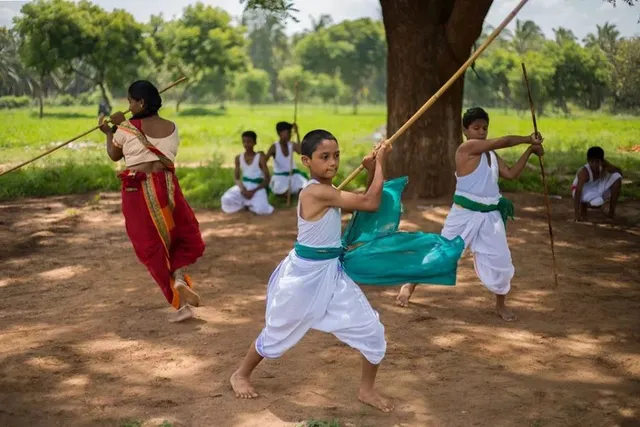
Exploring the art and heritage of Silambam reveals an ancient Indian martial art with a history spanning several centuries. Originating in the southern state of Tamil Nadu, Silambam stands as a traditional martial art that focuses on stick-based combat and rhythmic movements. Practitioners across the world continue to practice and celebrate this art form, preserving its historical importance while carrying it forward into modern times.
Origins and History of Silambam
Silambam traces its origins to the southern regions of India, especially Tamil Nadu and Kerala. Historical records and traditions suggest that people practiced Silambam for over 2,000 years. The art closely connects to the Sangam period of Tamil history, which flourished between 300 BC and 300 AD.
The name “Silambam” comes from the Tamil words “Silam,” meaning hill or mountain, and “Ambu,” meaning arrow. This name reflects how early practitioners used sticks both as combat weapons and as hunting tools in hilly terrains.
Silambam Techniques and Traditional Art Forms
Silambam showcases intricate techniques and structured forms that rely on skilled stick handling. Practitioners primarily use the Silambam staff, a long stick crafted from materials chosen for flexibility, strength, and balance. Each practitioner selects a staff length that generally measures from the ground to the armpit.
Key Weapons in Silambam
Silambam training includes a range of weapons and equipment, each designed to serve a specific purpose. The following tools play a vital role in developing technique, control, and combat skills.
Silambam Staff (Silambattam): The staff remains the primary weapon in Silambam. Craftsmen traditionally make it from bamboo, rattan, or hardwood. Practitioners choose the length based on height and comfort, usually reaching up to the armpit.
Yerikkaiparam: This short wooden baton functions as a secondary weapon. Practitioners often hold it in the non-dominant hand to assist with defense or close-range strikes.
Kodi Kambu (Flagpole): Trainers use the Kodi Kambu to build wrist strength, arm control, and striking precision. The pole often includes a decorative flag or finial.
Maan Kombu (Deer Horn Knives): Advanced practitioners occasionally train with these curved, horn-shaped knives. The weapons support dual-wielding techniques and advanced combat forms.
Maru Kombu (Metal Rods):Some modern Silambam variations incorporate short metal rods for striking and self-defense, although traditional practice does not include them.
Karambit:Originating from Filipino martial arts, the Karambit sometimes appears in modern Silambam adaptations due to its curved blade and grip control.
Sword and Shield: Some practitioners blend Silambam footwork and movements with sword and shield techniques, demonstrating the art’s adaptability.
Bullwhip:In contemporary interpretations, practitioners use the bullwhip to develop timing, reach, and control.
Philosophy and Training in the Art of Silambam
Silambam emphasizes discipline, focus, and self-control beyond physical combat. Practitioners follow ethical principles that promote respect for opponents and the art itself. Training demands physical conditioning, technical mastery, and disciplined weapon handling. Practitioners also integrate breath control and meditation into regular practice.
Benefits of Silambam
Strength and Endurance:Silambam training builds muscular strength and endurance, particularly in the upper body, through repetitive and controlled movements.
Flexibility: Regular practice improves flexibility and agility by encouraging wide ranges of motion.
Cardiovascular Health:The fast-paced and rhythmic training routines enhance cardiovascular endurance and stamina.
Balance and Coordination:Complex footwork and weapon movements sharpen balance, coordination, and body control.
Weight Management:Consistent Silambam practice supports weight control and overall physical fitness.
Silambam Today
In recent years, Silambam has gained global recognition beyond its traditional roots. Martial artists from different countries actively learn and practice this ancient art. Various organizations now promote Silambam through competitions, workshops, and training programs to preserve its legacy.
Epilogue
Overall, Silambam offers a powerful glimpse into the martial heritage of Tamil Nadu. Its refined techniques, disciplined philosophy, and cultural depth make it a valuable martial tradition. As interest continues to grow worldwide, Silambam stands as a living testament to the enduring strength of traditional martial arts.
Silambam – FAQ
What is Silambam?
Silambam is an ancient martial art form originating from Tamil Nadu. It primarily involves the use of a long bamboo staff along with swift footwork and defensive techniques.
How old is Silambam?
Silambam dates back over 2,000 years and is mentioned in Sangam literature, making it one of the oldest traditional martial arts in India.
What weapons are used in Silambam?
While the bamboo staff (silambam) is the main weapon, practitioners also train with swords, shields, knives, and flexible weapons as part of advanced techniques.
Is Silambam still practiced today?
Yes, Silambam is actively practiced in Tamil Nadu and across India. It is promoted through cultural events, competitions, and martial arts training academies.
What are the benefits of learning Silambam?
Silambam improves physical fitness, agility, coordination, discipline, and self-defense skills while preserving Tamil cultural heritage.