
Arunachaleswarar Temple, Tiruvannamalai
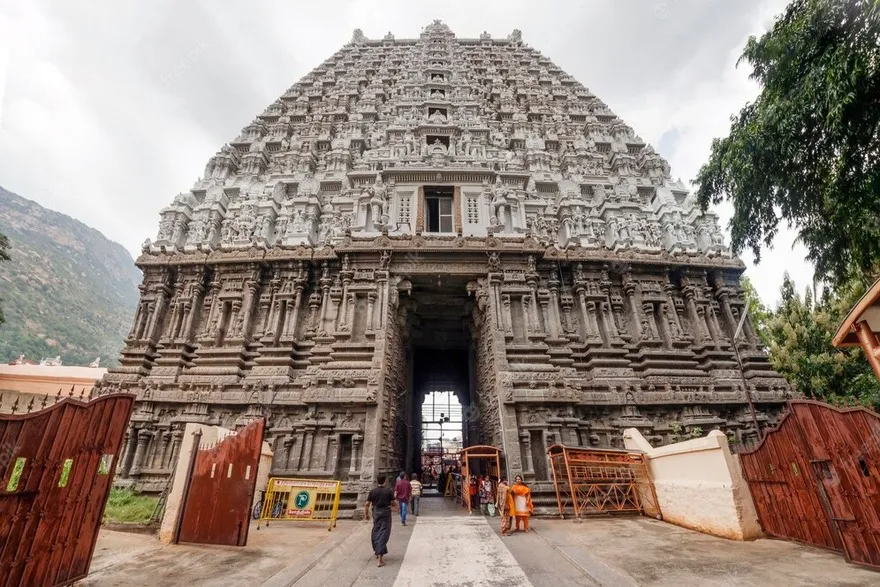
Located at the foothills of the sacred Arunachala Hills (2,668 feet high) in Thiruvannamalai, the Arunachaleswarar Temple—also known as Annamalaiyar Temple—stands as one of the most revered Shaivite temples in India. Dedicated to Lord Shiva, the temple holds immense spiritual importance in Saivism. Moreover, it is one of the five Pancha Bhootha Sthalangal, where Lord Shiva manifests as the Agni Lingam, symbolizing the element of fire. Goddess Parvati is worshipped here as Unnamalai Amman. At present, the Hindu Religious and Charitable Endowments Department of the Government of Tamil Nadu maintains and administers the temple.
History of Arunachaleswarar Temple
The history of Arunachaleswarar Temple unfolds across several ruling dynasties, each contributing to its growth and grandeur.
- Initially, the Chola kings constructed the temple during the 9th century CE.
- Later, the Vijayanagara rulers expanded the temple, as evidenced by numerous inscriptions.
- Over time, the temple passed through both Hindu and Muslim stewardship.
- In 1757, the French briefly controlled Tiruvannamalai before the British occupied it in 1760.
- Subsequently, Tipu Sultan captured the town in 1790 CE.
- During the early 19th century, the British assumed complete control of the region.
- Finally, from 1951 onwards, the temple has remained under HR&CE administration.
Legend of Arunachaleswarar Temple
According to Hindu mythology, Lord Vishnu and Lord Brahma once debated supremacy, neglecting their cosmic duties. To dissolve their ego, Lord Shiva appeared as an infinite pillar of fire. He declared that whoever found its beginning or end would be supreme.
While Lord Vishnu assumed the form of Varaha and searched downward, Lord Brahma took the form of a swan (Annam) and flew upward. However, both failed. Eventually, realizing their limitations, they surrendered their pride. Consequently, Lord Shiva revealed his true form. This divine event is celebrated annually as Karthigai Deepam.
References in Sacred Literature
Significantly, the temple finds mention in the 7th-century Tamil Shaivite canonical work Tevaram, composed by the Nayanmars. Hence, the shrine holds the honored status of a Paadal Petra Sthalam. Furthermore, Saint Manikkavasagar composed his celebrated work Tiruvemparai at this sacred site.
Temple Structure and Shrines
Spanning nearly 10 hectares, Arunachaleswarar Temple ranks among the largest temple complexes in India. Notably, the temple features four majestic gopurams. Among them, the eastern gopuram stands tallest, rising to 217 feet with 11 tiers. In addition, the temple houses several mandapams, including the famed thousand-pillared hall. Numerous shrines dedicated to various deities further enhance the spiritual ambiance of the complex.
Arunachaleswarar Temple Timings
The temple remains open daily from 5:30 AM to 12:30 PM and again from 3:30 PM to 9:30 PM.
Arunachaleswarar Temple Pooja Timings
| Name of the Pooja | Timing |
|---|---|
| Ushakala | 5:30 AM |
| Kalasandhi | 8:00 AM |
| Uchikalam | 11:30 AM |
| Saayaratchai | 5:30 PM |
| Irandam Kalam | 7:30 PM |
| Artha Jama Pooja | 9:00 PM |
Festivals Celebrated at Arunachaleswarar Temple
Throughout the year, the temple hosts several grand festivals that attract devotees from across the country.
- Chitirai Utsavam – April to May (10 days)
- Ani Brahmotsavam – June to July (10 days)
- Adi Pooram Brahmotsavam – July to August (10 days)
- Kanda Shashti – October to November (6 days)
- Karthigai Deepam Brahmotsavam – November to December (17 days)
- Uthrayana Punyakala – January to February (10 days)
- Panguni Uthiram Thirukalyanam – March to April (6 days)
Tiruvannamalai Karthigai Deepam
Karthigai Deepam, celebrated during November–December, marks the divine manifestation of Lord Shiva as fire. On this auspicious day, devotees light the massive Mahadeepam atop Arunachala Hill. Remarkably, the flame remains visible from several kilometers away, drawing thousands of pilgrims to Tiruvannamalai.
Girivalam (Arunachala Pradakshina)
Girivalam, the sacred circumambulation of Arunachala Hill, spans 14 kilometers. The name Arunachalam signifies the fiery red hill, symbolizing Shiva as Agni.
Devotees perform Girivalam barefoot throughout the year, especially on full moon days. By doing so, believers seek spiritual merit and fulfillment of wishes. Along the path, devotees worship eight sacred lingams known as Ashta Lingams, each associated with lunar constellations.
How to Reach Arunachaleswarar Temple
Tiruvannamalai enjoys excellent connectivity by road. Regular buses operate from major towns across Tamil Nadu. Additionally, both the Tiruvannamalai Bus Stand and Railway Station lie just 2 kilometers from the temple. For air travelers, Chennai Airport serves as the nearest airport, located approximately 185 kilometers away.
Epilogue
As one of India’s most magnificent temple complexes, Arunachaleswarar Temple captivates devotees with its spiritual aura and architectural splendor. Ultimately, the sacred hill, grand gopurams, and ornate halls offer not just religious fulfillment but also an enduring sense of peace and inner tranquility.
Arunachaleswarar Temple – Tiruvannamalai – FAQ
Where is Arunachaleswarar Temple located?
Arunachaleswarar Temple is located in Tiruvannamalai, Tamil Nadu, at the base of the sacred Arunachala Hill. It is one of the largest Shiva temples in India.
Why is Arunachaleswarar Temple famous?
The temple is famous as one of the Pancha Bhoota Sthalams, representing the fire element (Agni). It is also renowned for the grand Karthigai Deepam festival.
What is Girivalam in Tiruvannamalai?
Girivalam is the sacred 14-kilometre circumambulation of Arunachala Hill performed by devotees, especially on full moon (Pournami) days.
Who built Arunachaleswarar Temple?
The temple was expanded by the Chola, Pandya, and Vijayanagara kings over centuries, showcasing magnificent Dravidian architecture and towering gopurams.
What are the temple timings?
The temple is generally open from early morning to night, with multiple poojas conducted throughout the day. Timings may vary during festivals.