
Nagore Dargah
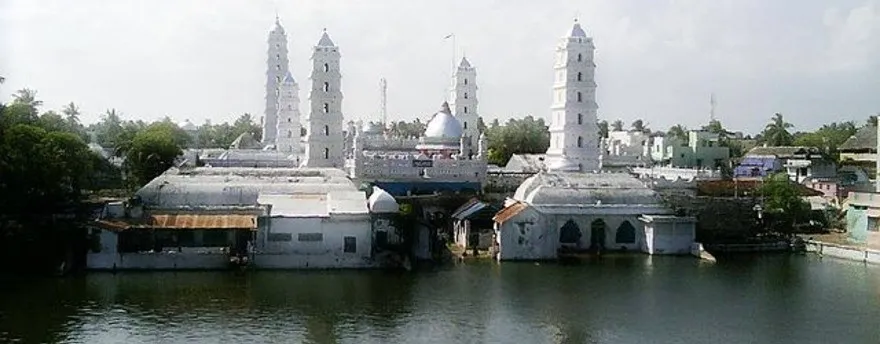
Located in the coastal town of Nagore in the Nagapattinam district, the revered Nagore Dargah stands over the tomb of the great Sufi saint Shahul Hameed. Devotees widely know this sacred shrine by various names, including Nagoor Dargah, Syed Shahul Hameed Dargah, and Nagore Andavar Dargah. Notably, three major Nagore shrines exist at Nagore, Vanjur, and Silladi. Among them, the Nagore shrine serves as the principal and most prominent place of worship.
Image Attribution : Sundaramrajaraman
About Saint Syed Shahul Hameed
Saint Syed Shahul Hameed, popularly known as Nagore Miran, was a 16th-century Muslim Sufi saint born in Manikhpur in North India. From an early age, he embraced a spiritual path and devoted his life to mysticism and faith. Subsequently, he travelled extensively through West Asia, visiting Mecca, Burma, and China, before finally reaching Ceylon and the South Indian coastline. Over time, people across the region revered him as Nagore Andavar, meaning the “God of Nagore.” According to local belief, Shahul Hameed performed several miracles in Nagore. Most notably, he cured the 16th-century Hindu ruler of Thanjavur, King Achutappa Nayak, who suffered from a severe ailment believed to be caused by sorcery. Legend says the saint identified a pigeon pierced with needles inside the palace as the cause of the king’s suffering. After removing the needles, the king’s health reportedly improved. As a result, devotees continue the symbolic tradition of setting pigeons free at the dargah in remembrance of this miracle. Thus, the saint’s mysticism deeply touched people of all faiths, from royalty to common folk.
History of Nagore Dargah
After recovering from his illness, King Achutappa Nayak donated nearly 200 acres of land to the followers of Saint Shahul Hameed. Consequently, devotees constructed the Nagore Dargah on a portion of this gifted land. Furthermore, Shahul Hameed reportedly foretold the time of his death and instructed his adopted son Yusuf about his burial place. Following his demise, devotees built a mausoleum over his tomb. Significantly, both Hindus and Muslims contributed generously to the construction of the dargah, highlighting its interfaith harmony.
Architecture
Nagore Dargah spreads across an area of approximately 5 acres and is enclosed by a protective compound wall. The main complex features four grand entrances, facing all four cardinal directions. Additionally, the dargah showcases five towering minarets of varying heights. The tallest minaret rises to an impressive 131 feet, while the others include Sahib Minara (77 ft), Thalaimattu Minara (93.5 ft), Muthubaq Minara (93.25 ft), and Ottu Minara (80 ft). At the heart of the complex lies the tomb of Saint Shahul Hameed. Devotees reach the sanctum through seven thresholds, of which three are crafted in gold and four in silver. Moreover, the dargah also houses the tombs of Shahul Hameed, his son Yusuf, and his daughter-in-law Saeeda Sultana Biwi.
Nagore Dargah Timings & Festivals
The outer doors of Nagore Dargah remain open at all times. However, the inner sanctum opens daily from 4:30 AM to 7:00 AM and again from 6:25 PM to 9:30 PM. On Fridays, the inner doors also open additionally from 12:00 Noon to 2:30 PM. Every year, devotees observe the Kanduri Urs festival to commemorate the death anniversary of Saint Shahul Hameed. This grand 14-day celebration includes a saffron flag procession, street parades, recitation of Quranic verses, and the observance of Fatiha.
How to Reach Nagore Dargah
Reaching Nagore Dargah is convenient, as the town enjoys good road connectivity. Regular bus services operate from Nagapattinam (4 km), Karaikkal (12 km), Thanjavur (78 km), and Chennai (90 km). Additionally, Nagapattinam Railway Station serves as the nearest railhead. For air travelers, the closest airport is located at Trichy, approximately 150 kilometres away.
Epilogue
Nagore Dargah stands as a powerful symbol of unity and devotion, attracting followers from different religions throughout the year. Local Hindu fishermen firmly believe that Nagore Andavar protects them during storms and rescues them from dangers at sea.
Remarkably, fishermen living nearly 300 kilometres north of Nagore continue to name their boats after the saint, honoring him as their guardian of the seas. Often referred to as the “Ajmer of South India”, Nagore Dargah remains one of the most significant interfaith pilgrimage centers in the region.
Nagore Dargah – FAQ
What is Nagore Dargah famous for?
Nagore Dargah is famous as the shrine of Hazrat Syed Shahul Hameed Qadir Wali, a revered Sufi saint. It is an important Islamic pilgrimage center in Tamil Nadu known for its spiritual significance and harmony.
Where is Nagore Dargah located?
Nagore Dargah is located in Nagore town near Nagapattinam in Tamil Nadu, along the Coromandel Coast.
What is the Kanduri Festival at Nagore Dargah?
The Kanduri Festival is the annual 14-day celebration commemorating the saint’s death anniversary. Devotees participate in special prayers, flag hoisting, and religious processions.
Is Nagore Dargah open to people of all religions?
Yes, Nagore Dargah welcomes devotees from all religious backgrounds, symbolizing communal harmony and unity.
What is the architectural highlight of Nagore Dargah?
The dargah complex features five prominent minarets, with the tallest standing at about 131 feet, showcasing Indo-Islamic architectural style.