
Vellore Fort
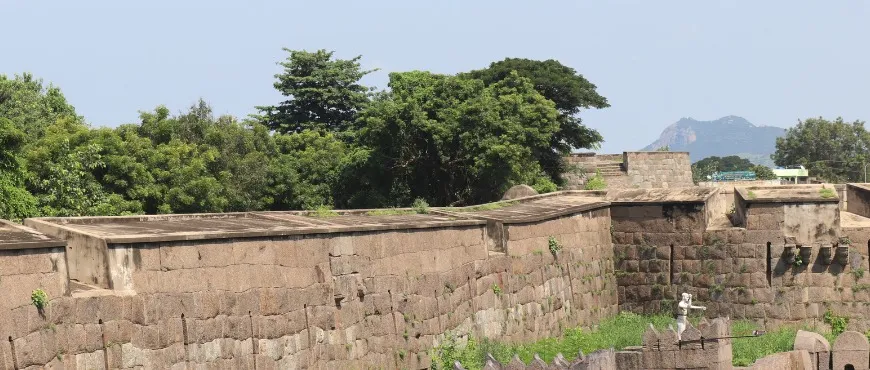
Vellore Fort stands prominently in the heart of Vellore city and is considered one of the most impregnable forts in Tamil Nadu. Historically, the rulers of the Vijayanagara Empire constructed this massive structure. Later, it functioned as the royal seat of the Aravidu Dynasty. Therefore, Vellore Fort holds immense historical, political, and cultural importance in South Indian history.
Architecture and Defensive Features
The fort is widely admired for its remarkable military architecture. Most notably, it features massive stone ramparts combined with a deep and wide moat that once provided strong protection. In fact, the fort complex extends across nearly 133 acres. Additionally, historical accounts suggest that the surrounding moat once housed thousands of crocodiles, which further enhanced the fort’s defensive strength.
Present Status of Vellore Fort
Today, the Archaeological Survey of India maintains and preserves Vellore Fort. As a result, the fort now remains open to tourists, researchers, and history enthusiasts. Visitors can walk along its massive walls, observe its architectural brilliance, and understand the strategic role it once played. Thus, Vellore Fort continues to stand as a powerful symbol of Tamil Nadu’s rich heritage and military excellence.
Image Attribution : Rajaraman Sundaram
Interesting Facts about Vellore Fort
-
During the British period, Tipu Sultan and his family, along with the last King of Sri Lanka, Sri Vikrama Rajasinha, were held captive inside the fort.
The tombs of Padshah Begum, Tipu Sultan’s sons, Bakshi Begum, and Sri Vikrama Rajasinha are located within the fort premises. - Builders constructed the fort using granite stones sourced from the nearby regions of Arcot and Chittoor.
-
Since rulers of different faiths governed the fort over time, it reflects a unique blend of cultures.
Consequently, the fort complex houses the
Jalakandeswarar Temple,
St. John’s Church, and a Muslim mosque. -
Over the centuries, various dynasties controlled the fort, as listed below:
- Vijayanagara Empire – built around the mid-16th century and ruled until the mid-17th century
- Bijapur Sultans – ruled between 1656 and 1678
- Marathas – ruled between 1678 and 1707
- Mughals – ruled from 1707 to 1760 before the British took control
-
The fort also houses the
Government Museum,
which displays historical artifacts and monuments of the former North Arcot District, covering present-day Vellore and Tiruvannamalai regions. - In addition, the Vellore Christian Hospital and several important public offices function within the fort premises.
How to reach Vellore Fort
Vellore Fort is located at a distance of 138 kilometres from Chennai. Katpadi Junction in Vellore (around 7.5 kilometres north of the fort) is the nearest railway station. Vellore is well connected by road and rail with all the major cities in South India. The nearest international airport is at Chennai, 128 kilometres east of Vellore.
Vellore Fort – FAQ
Where is Vellore Fort located?
Vellore Fort is located in the heart of Vellore city, Tamil Nadu, surrounded by a wide moat and historic structures.
Who built Vellore Fort?
Vellore Fort was built in the 16th century (around 1566) by the Vijayanagara rulers Chinna Bommi Nayak and Thimma Reddy Nayak.
What is Vellore Fort famous for?
The fort is famous for its massive granite walls, impressive moat, and for housing the Jalakandeswarar Temple, a church, and a mosque within its complex.
What is the historical importance of Vellore Fort?
Vellore Fort played a key role during the Vellore Mutiny of 1806, one of the earliest uprisings against British rule in India.
What are the visiting hours of Vellore Fort?
Vellore Fort is generally open to visitors from 8:00 AM to 6:00 PM daily, though timings may vary for specific monuments inside the fort.