
Kamakshi Amman Temple – Kancheepuram
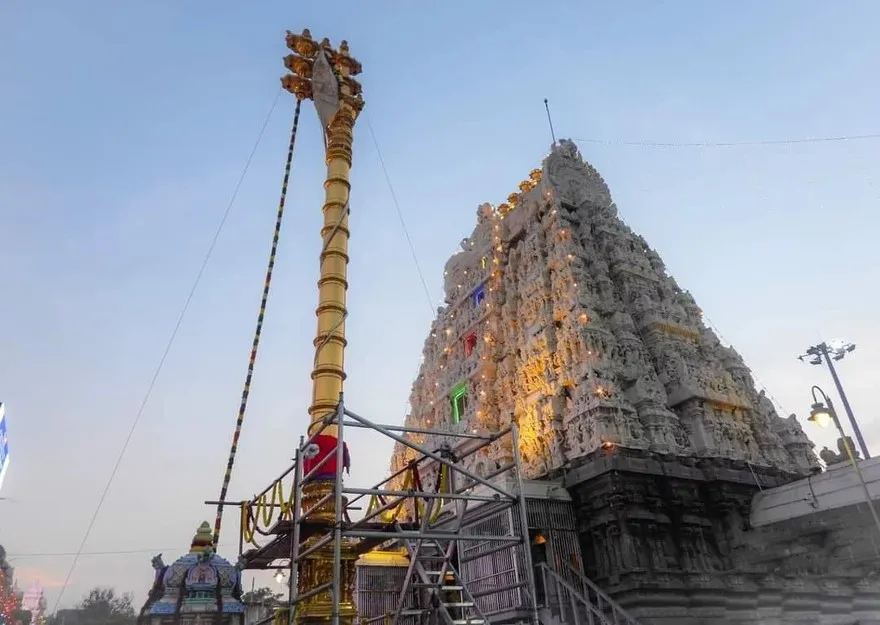
The Kamakshi Amman Temple stands proudly in the historic city of Kanchipuram. Dedicated to Goddess Kamakshi, a revered form of Goddess Parvati, this sacred shrine serves as one of the most important centers of worship in Tamil Nadu. Moreover, the temple holds exceptional spiritual value as one of the 51 Shakti Peethams in India, drawing devotees from across the country.
Temple Legend
Kamakshi Amman is worshipped here as Parabrahma Swaroopini. Initially, the Goddess manifested in her fierce form as Ugra Swaroopini. However, according to tradition, the great philosopher Jagadguru Adi Shankaracharya pacified her by installing the sacred Sri Chakra in front of the deity. Consequently, the Goddess assumed her calm and benevolent form known as Shantha Roopini. Furthermore, temple legends state that Goddess Kamakshi performed intense penance on a sand-made Shiva Lingam to attain Lord Shiva as her consort. Pleased with her devotion, Lord Shiva accepted her prayers and married Goddess Kamakshi, thus sanctifying this holy site.
Temple Architecture
Architecturally, the temple showcases remarkable Dravidian design. The presiding deity, Goddess Kamakshi Amman, sits gracefully in the sanctum sanctorum, flanked by the divine trinity—Lord Brahma, Lord Vishnu, and Lord Shiva. Spread across five acres, the temple features four grand entrances and several subsidiary shrines dedicated to Bangaru Kamakshi, Adi Shankaracharya, and Maha Saraswathi.
At the main entrance, devotees encounter the shrines of Mahishasura Mardhini on the right and Kala Bhairavar on the left. Moving inward, the towering Dwajasthamba leads worshippers to the shrine of Lord Vinayagar. Additionally, the outer prakaram houses shrines of Ayyappan, Saraswathi, Annapoorani, and Adi Shankaracharya.
Encircling the Gayathri Mandapam, devotees can also see shrines of Varahi, Arupalakshmi Kalvarperumal, Roopalakshmi, and Arthanariswarar. The temple tank within the premises further enhances the spiritual ambiance. Notably, a dedicated gallery illustrates the life history of Adi Shankaracharya.
Goddess Kamakshi Amman
Inside the sanctum, Goddess Kamakshi Amman appears in a serene seated posture known as Padmasana. She holds a lotus and parrot in her upper right hand, while her upper left hand carries a sugarcane bow. Additionally, the Goddess bears the divine weapons Pesa and Angusa, and a crescent-shaped moon adorns her forehead, symbolizing grace and wisdom.
Temple Timings at Kamakshi Amman Temple
The Kamakshi Amman Temple welcomes devotees daily from 5:30 AM to 12:15 PM in the morning and from 4:00 PM to 8:15 PM in the evening. Furthermore, the temple remains open until 9:30 PM on Fridays and extends darshan hours until 10:30 PM on Pournami (full moon) days, allowing devotees ample time for worship.
Pooja Details of Kamakshi Amman temple
The temple follows the below mentioned pooja timings, the timings however is subject to changes on festive days.
| Pooja Details | Pooja Details |
|---|---|
| Abhishekam (3 times in a day) | 5:30 AM, 10:30 AM and 4:00 PM |
| Sahasranama Archana (everyday) | 9:00 AM to 10:00 AM and 7:00 PM to 8:00 PM |
| Ashtotthara Archana (everyday) | 7:00 AM to 12 Noon and 6:00 PM to 8:00 PM |
| Chandana Alankara (on Wednesdays and Saturdays) | 4:30 PM |
| Navavarana Pooja (on Pournami/Full Moon days every month) | After 9:30 PM |
| Swarna Ratha (on Fridays, Full Moon Days, New Moon Days, and 1st Day of Tamil months) | 7:30 PM |
Temple Festivals in Kamakshi Amman temple
The annual festival is held during the Tamil month of Masi (February-Mid), suring which the Ther (chariot) festival and Theppam (float) festival is celebrated. Other festivals observed in the temple include Aadi and Aippasi Pooram, Navarathri, Sankara Jayanthi and Vasantha Utsavam.
How to reach Kamakshi Amman temple
Kancheepuram city is well connected of the state through national highways and roads. The main bus stand is located at a distance of less than one kilometer from the temple. Kancheepuram Railway Station (3 kilometres away), Arakonnam Railway Station (29 kilometres away) and Chennai Railway Station (around 75 kilometres away) are the nearest rail heads. Chennai International Airport (68 kilometres away) is the nearest airport to the temple.
Epilogue
The spirituality of this historical temple is an experience in itself and its scenic beauty should be witnessed especially during early mornings and at night. The temple with its sculptures and bright lights at night make it an excellent site for photography.