
Mahabalipuram Shore Temple
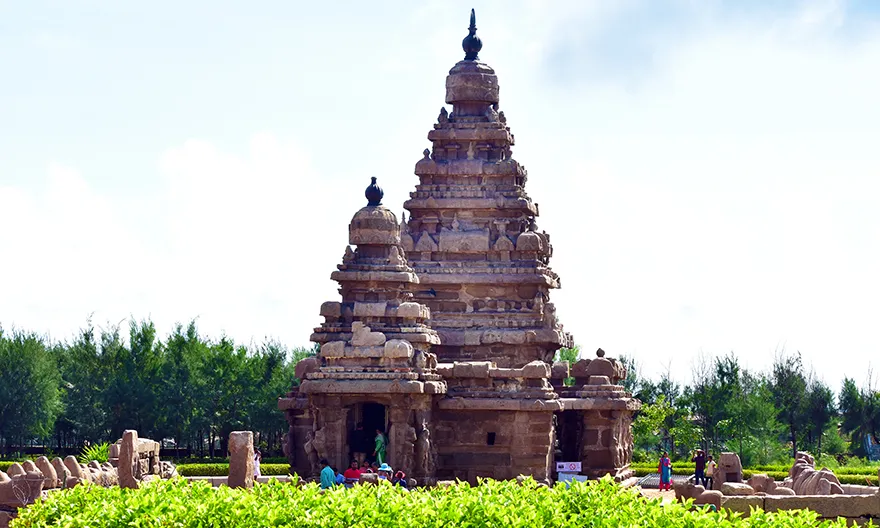
The Mahabalipuram Shore Temple, built between 700 and 728 AD during the reign of Narasimhavarman II, stands as one of the oldest structural stone temples in South India. Located in Mamallapuram (Mahabalipuram), the temple majestically overlooks the shores of the Bay of Bengal and, therefore, earns the name “Shore Temple.” This sacred complex consists of temples and shrines constructed using granite blocks that date back to the 8th century AD.
Moreover, the monuments and temples of Mahabalipuram, including the iconic Shore Temple complex, were collectively recognized as a UNESCO World Heritage Site in 1984, highlighting their outstanding universal value.
History of Mahabalipuram Shore Temple
Mamallapuram, also known as Mahabalipuram, earned the nickname “Seven Pagodas” when early European explorers arrived at its shores. According to legend, six additional temples once stood alongside the Shore Temple, forming a magnificent coastal ensemble.
King Narasimhavarman II of the Pallava dynasty receives credit for the architectural brilliance of the Shore Temple as a structural temple complex. Later, after the Cholas took control of Mahabalipuram from the Pallavas, they added certain architectural elements to the existing structure.
Furthermore, in December 2004, the devastating tsunami that struck the Coromandel Coast revealed the remains of a collapsed ancient temple and several rock sculptures from the Pallava period. As a result, historians inferred that this complex formed part of a larger group of temples that once existed along the now-submerged coastline. Although the tsunami caused some damage, only a portion of the Shore Temple suffered structural impact.
Legend Behind the Shore Temple
Mythology links the Shore Temple to the legendary tale of Prahalada and his father, King Hiranyakashipu. Prahalada remained a devoted follower of Lord Vishnu, despite his father’s arrogance and defiance. Eventually, the Lord destroyed the tyrant king for his transgressions. According to legend, Prahalada’s son, King Bali, founded Mahabalipuram at this very location.
Additionally, another legend suggests that the gods themselves caused floods to submerge part of the city and its temples, as they grew envious of the site’s extraordinary architectural beauty.
Architecture of the Mahabalipuram Shore Temple
The Shore Temple complex comprises three temples built on a single elevated platform. The main shrine, dedicated to Lord Shiva in Lingam form, faces east and rises as a five-storeyed structure crafted from sculpted granite stones.
Furthermore, the complex includes three shrines: two dedicated to Lord Shiva and a third shrine devoted to Lord Vishnu in a reclining posture. Devotees enter the temple through a western gateway that leads through a simple barrel-vaulted gopuram.
Other Prominent Features of the Shore Temple
- The sanctum sanctorum houses Lord Shiva within a small mandapam and is enclosed by a thick outer wall, leaving a narrow passage for circumambulation.
- Additional shrines within the complex honor Ksatriyasimmesvara, Lord Vishnu, and Goddess Durga.
- Similar to the Vishnu shrine, the inner and outer walls of the Shiva shrines display rich cultural and mythological carvings.
- The shikaras of the two Shiva temples feature an octagonal design and reflect classic Dravidian architectural style.
- The inner walls of the east-facing Ksatriyasimhesvara shrine showcase the Dharalinga and Somaskanda panel.
- The outer walls display artistic carvings sculpted from boulders, which have gradually weathered due to constant exposure to wind and sea air.
- A row of sculpted bulls representing Nandi, the sacred vehicle of Lord Shiva, lines the entrance wall.
- The Shore Temple forms the scenic backdrop for the annual Mahabalipuram Dance Festival held during January and February.
- The temple captures the first rays of the rising sun and once served as a navigational landmark for ships along the coast.
- Although regular worship no longer takes place, visitors occasionally offer flowers and prayers at the shrines.
- The Archaeological Survey of India currently preserves and conserves the entire temple complex.
Significance of the Mahabalipuram Shore Temple
The Shore Temple marks a crucial transition from rock-cut architecture to free-standing structural temples. Consequently, it stands as a fine example of Dravidian architectural evolution. Additionally, the temple’s significance lies in its religious harmony, as it enshrines both Lord Shiva and Lord Vishnu within the same sacred complex.
How to Reach Mahabalipuram
Mahabalipuram, located in Chengalpattu district, enjoys excellent road connectivity with major cities across Tamil Nadu. The nearest airport is situated in Chennai, approximately 55 kilometers away.
Epilogue
The Shore Temple offers an ideal destination for travelers who admire art, architecture, and history. Therefore, while visiting Mahabalipuram, take time to absorb the timeless beauty of the Shore Temple set against the vast expanse of the sea.
Mahabalipuram Related Articles
How to reach Mahabalipuram?
Mahabalipuram Shore Temple – FAQ
Where is the Mahabalipuram Shore Temple located?
The Shore Temple is located in Mahabalipuram (Mamallapuram), Tamil Nadu, along the Bay of Bengal coast. It is one of the most iconic monuments in the region.
Who built the Shore Temple?
The Shore Temple was built during the 8th century by the Pallava king Narasimhavarman II (Rajasimha). It is one of the earliest structural stone temples in South India.
What is the architectural significance of the Shore Temple?
The temple showcases early Dravidian architecture and is part of the UNESCO World Heritage Site group of monuments at Mahabalipuram.
Which deities are worshipped in the Shore Temple?
The temple complex is primarily dedicated to Lord Shiva, with shrines for Lord Vishnu and other deities within the premises.
What are the visiting hours and entry fee for the Shore Temple?
The Shore Temple is generally open from sunrise to sunset. An entry fee is applicable for visitors, and tickets can be purchased at the site.